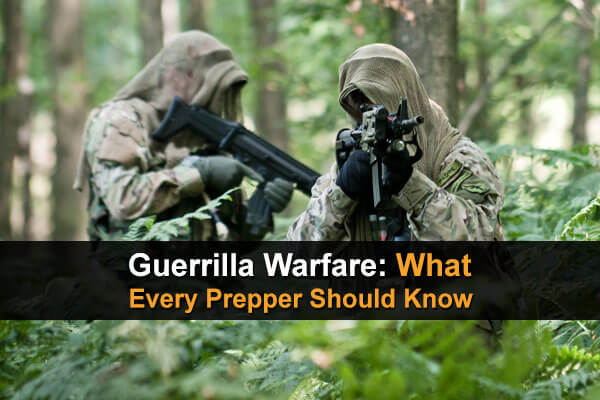
Guerrilla Warfare: What Every Prepper Should Know (Part 1): guerrillas can take advantage of this defense/public-relations balancing game and force the hands of the security forces to further their long-term goals.

Disclaimer: Although this article is being published during a time of great upheaval, this is by no means an endorsement by the author or publication of any of the actions described in this article. This article is purely for academic purposes and to allow law-abiding citizens to make more informed choices regarding the defense and security of their communities.

Guerrilla warfare has been the bane of empires since the beginning of recorded history. When conventional forces fail or cannot be reasonably employed, and when a will to fight remains amongst the people, it can be expected that irregular warfare, or guerrilla warfare, will occur.

For Americans, the concept isn’t new. Americans have spent the better portion of the last fifty years fighting against guerrillas in Vietnam and the Middle East. The overwhelming firepower of the United States military has forced modern insurgents, terrorists, and revolutionaries to almost exclusively employ guerrilla tactics.

At the same time, The United States was forced to utilize guerrilla warfare in order to combat the British and likely wouldn’t exist if such tactics didn’t prove so effective.

While the terminology we use for guerrilla warfare originated in the early 19th century with Napoleon’s occupation of Spain (in Spanish it means, “little war”) and subsequent uprising of irregular forces to oppose him, records of such warfare can be found as far back as Alexander the Great’s campaigns in Afghanistan.

Learning about guerrilla warfare is the next logical step for those who understand the importance of utilizing their second amendment rights when it is constitutionally called for. If you can understand why the second amendment and training with your firearm are necessary, you should also understand the necessity of learning to employ your protective weaponry in more complex scenarios.

For any SHTF scenario, you will need an understanding of employable tactics. Since you will likely be operating with a small group of like-minded community members, guerrilla tactics will be the ones that you can employ to best defend your neighborhoods.

To this end, we are going to explore guerrilla warfare and the tactics involved. This will be a two-part piece, with the first piece (this one) covering the goals, methods, and stages of guerrilla warfare. The second part will spend more time looking at specific tactics and techniques utilized in guerrilla warfare.

TABLE OF CONTENTS:

  • Why Should All Citizens Have a Basic Understanding of Guerrilla Warfare?
  • What is Guerrilla Warfare? What are Guerrilla Tactics?
    • Realities Vary By Conflict, But Similarities Remain
    • Are Guerrillas Terrorists?
    • Guerrilla Warfare has Political Goals
    • Food for Thought: Is It Worth It?
  • The Stages of Guerrilla Warfare
    • Propaganda Stage
    • Growth Stage
    • Assault Stage
  • A Guerrilla Warfare Case Study: 1969 Belfast
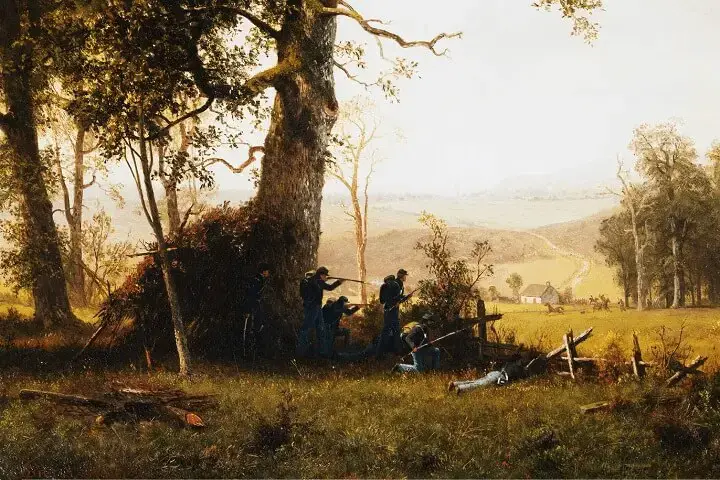
Union Soldiers Picket Duty

WHY SHOULD ALL CITIZENS HAVE A BASIC UNDERSTANDING OF GUERRILLA WARFARE?

An understanding of guerrilla warfare allows well-drilled groups of the local populace to defend against organized militaries, as well as react against groups of militarized criminals.

While most of us understand the first scenario, like Red Dawn, where a scrappy militia fights back against soldiers, the latter is just as likely for us in North America if things collapse. Gangs taking over chunks of territory is nothing new, and the cartels are often well-armed and well manned.

For example, in 2014, drug cartels had more or less dominated a large portion of Mexico. Luckily, after the government proved inept, the local populace rose up and began to push the drug lords out of their towns.

Sadly, the Mexican government took control of the militias, and they once again became ineffective, but the example is still a good one. From this case study, we can see that in the Americas, these cartels are capable of dominating swathes of territory, but also that organized populaces are capable of resisting them with the right strategies.

As we stated earlier, if you can understand why the second amendment is necessary, you should also understand the necessity of learning to effectively employ your weaponry for any SHTF conflict that goes beyond your personal property.

By understanding guerrilla tactics, you can better understand how to defend your community and how bad actors may be planning to work against you.

The military and police need to understand these tactics for much the same reasons. In the Marine Corps Manual: The Guerrilla and How to Fight Him the Marines emphasize the importance of learning how to deal with constant hit and run tactics and how devastating they can be to both life and morale when left unchecked.

WHAT IS GUERRILLA WARFARE? WHAT ARE GUERRILLA TACTICS?

“Two weapons today threaten freedom in our world. One is the 100-megaton hydrogen bomb; it requires vast resources, technology, effort, and money… The other is a nail in a piece of wood buried in a rice paddy.” – The Guerrilla and How to Fight Him, USMC Manual
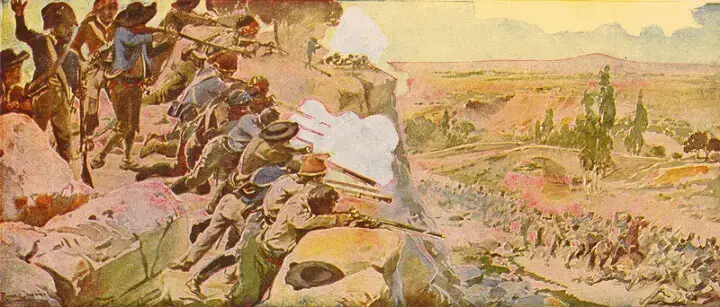
Portugese Guerrillas

Guerrilla warfare is a form of war that is indirect. Guerrilla warfare is ‘irregular,’ it involves small groups of armed personnel (often not official soldiers, though soldiers can fight as guerrillas) who utilize tactics such as ambushes, booby-traps, hit-and-runs, assassinations, and more to maximize damage with minimized risk and the minimal resources on-hand.

These tactics allow a small and less organized force to deal with more substantial and more traditional militaries. As far back as the biblical age and the Roman conquests of Judea, you can see the use of guerrilla tactics to strike back at an overpowering military.

The organization of a guerrilla unit has some similar characteristics, whether you are talking 19th century China or 1st century Judea. The guerrilla unit may originate in any the following ways:

  1. From the people upset at the law or an occupation.
  2. Regular army soldiers put behind enemy lines for that purpose.
  3. Combination of A and B, with groups of A typically being trained by elite units of B.
  4. From the local militia.
  5. Deserters from the ranks of the enemy.

REALITIES VARY BY CONFLICT, BUT SIMILARITIES REMAIN

Every conflict is informed by the culture and weapons of the age. The guerrillas who fought against Napoleon in Spain looked and thought quite differently from the ISIS fighters who took over sections of the Philippine Capital. However, many of the methods, strategic goals, and tactics will remain quite similar from conflict to conflict.

“The guerrilla band is an armed nucleus, the fighting vanguard of the people. It draws its great force from the mass of the people themselves. The guerrilla band is not inferior to the army which it fights simply because it is inferior in firepower. Guerrilla warfare is used by the side which is supported by a majority but which possesses a much smaller number of arms for use in defense against oppression.” – Che Guevara 

ARE GUERRILLAS TERRORISTS?

The simple answer is: sometimes. In my opinion, you should think of guerrillas as a force designation, like a militia or cavalry, and terrorism more as a set of tactics. Terrorism is the act of spreading terror, typically through violence, in order to further political goals.

Guerrilla forces specialize in hit-and-run tactics that go after supply lines and symbolic targets; this often overlaps with terror tactics. While some guerrilla forces may utilize terrorism, others may not.

When Che Guevera talked about terrorism, he noted that killings of enemies of ‘small importance’ would typically gain noting and only lead to reprisals. Rather, he emphasized strategic sabotage when possible—though history shows his forces were the cause of much terror.

Regardless, in almost all cases, guerrilla forces will be labeled as terrorists by the government they oppose. This is typically done as a public relations move rather than due to any precise definitions.

GUERRILLA WARFARE HAS POLITICAL GOALS

The circumstances that lead to guerrilla warfare, an armed sector of the populace against a much larger force, will 99% of the time be a political fight on some level. Traditionally, guerrilla leaders have spent as much time on instruction, agitation, and propaganda as they have on fighting, “for their most important job is to win over the people.”

Guerrilla warfare is typically not conducted in an effort to defeat the opposing force, but to either make the occupation too expensive or too politically untenable—and these goals often overlap. More supplies, information, and ultimately victory can occur when you can make your efforts are politically popular.

Even the FARC (Revolutionary Armed Forces of Colombia), who have a multi-step plan for controlling large areas of drug production (and have spent decades operating mainly as a drug cartel and hostage-taker), plan to eventually rely on a popular general uprising to overthrow the government. All guerrilla wars eventually need to engage in politics to succeed.

To this end, Mao made some interesting points regarding how his guerrilla forces should act and how this benefits them. Basically, Mao said that guerrillas must train to be polite and courteous to the people. Shut doors after yourself, pick up things you knock over, replace items and pay for food, etc.

By doing this, guerrillas can operate behind enemy lines for extended periods since their presence isn’t disruptive or upsetting to the local people. If you are the local people, these acts keep you in the good graces of your community.

FOOD FOR THOUGHT: IS IT WORTH IT?

If you are employing guerrilla warfare in defense of your community, that means a superior military force is currently dominating your community. Deciding to engage in this form of combat means you must think of your goals in the long-term (i.e., eventual freedom) because immediate actions will likely increase the violence and danger in your community.

Engaging in guerrilla warfare to protect your neighborhood will often be counterproductive as it will likely ensure a more extensive response. However, large-scale guerrilla warfare on multiple fronts and protracted long-term resistance have all proven to be effective at combating even the most potent forces in the modern age.

THE STAGES OF GUERRILLA WARFARE

This is a simplified summary of works published during the Vietnam war, a paper by Che Guevera, and a thesis by an American general.

PROPAGANDA STAGE

Goal: Raise Awareness, Gain Sympathy, and Gain Resources.

In this stage, symbolic attacks and attempts to obtain weapons or money are the most common. Attacking foreign embassies and emblematic buildings, as well as symbolic assassinations, are standard methods. The terrorists we see launch attacks from time to time are usually attempting some sort of propaganda message via their attacks, although reckless violence will often turn a populace against you.

These may not need to be violent attacks at all. The internet can be very useful, and you can see during the Syrian civil war how multiple groups used various forms of propaganda to grow their cause and gain recruits.

The surrounding culture and nature of the supposed conflict will typically dictate what the propaganda stage looks like as it is less about being tactically efficient and more about winning over ‘hearts and minds.’

GROWTH STAGE

In this stage, the guerrilla forces are able to put enough pressure in one area (let’s say we are working with a rural and urban sector) to draw troops from another. If the guerrillas can put enough pressure on the urban area, they can draw enemy soldiers away from the rural sector.

Once they can move in and dominate one of the sectors, the guerrilla forces are able to increase their supplies and recruits exponentially. Or, if they do not intend to stay and occupy, the guerrilla forces can at least ensure that the one sector is no longer aiding their opposition.

You can see during the occupation of Afghanistan how roadside bombs and ambushes were done in an attempt to isolate American outposts and occupied cities so that insurgent forces could draw attention away from other areas and soften them up for a more significant assault.

By doing so, the Taliban was able to occupy U.S. built power plants and other infrastructure and even began to tax the surrounding area.

ASSAULT STAGE

Attacks move from symbolic to strategic. Attacks on police stations or barracks force government troops out of more areas. In many cases, guerrillas will begin to take over sections of government in the areas they have started to control. Radio stations and media points are often targeted in an attempt to take control o the airwaves.

From here war is fought over territory, equipment, and messaging for control of the state.

Sometimes, the goal may not be to overthrow an existing state, but to establish a separate one or to simply survive (as we saw with the Jews in the Warsaw Ghetto and in the Russian forests). In either case, the end goal is to hold off government forces long enough to make conflict no longer tenable for them, not to necessarily dominate on the battlefield.

A GUERRILLA WARFARE CASE STUDY: 1969 BELFAST

This is a summary of a piece in the U.S. Army’s Urban Operations Handbook.

During the Irish uprisings against the British, Belfast became a hotspot full of explosions, shootings, barricades, petrol bombs, and other tactics that challenged the British forces. The British were able to defend infrastructure targets, which opened more military targets up to attack. These relatively isolated soldiers made for easy targets and were more legitimate targets for violent attacks in the public eye.

In response, the British were forced to increase the armor and armaments their soldiers were equipped with, which in turn made them look even more like a brutal occupier. As force-protection increased, the region’s stabilization decreased, and guerrillas were then offered better targets for attack.

The lesson here is that guerrillas can take advantage of this defense/public-relations balancing game and force the hands of the security forces to further their long-term goals.

Next week we’ll talk about guerrilla tactics and strategies.
The Art of War in the 21st Century (The supreme art of war is to subdue the enemy without fighting.)

Sun Tzu’s The Art of War is one of the most influential books written on military strategy and philosophy. This is not confined to just Asians but Europeans and Americans alike have attempted to study The Art of War hoping its wisdom would be revealed to them.

However, it is clear with how the western intergovernmental military alliance, known as NATO, has chosen to conduct itself since its inception in 1949, that western understanding of long-term military strategy has left much to be desired.

The largest folly they continue to commit is that they think that it is through stubborn force and intimidation that one gets their way. True one may be successful to a certain extent using mainly force, one may achieve that assassination of a key figure, one may convince the people that their ally is their foe, and one may get that regime-change they were hoping for, but these have all proven themselves temporary orientations in the long-term scheme of things. One reason for this is that the truth almost always eventually comes out

It is a very tiring strategy one has to admit, to be always using stubborn force, and despite all this force that one is constantly applying to the subject they wish to bend it never quite behaves as one commands it to, at least not for very long.

Despite this strategy being the most inefficient and energy intensive, that has not deterred imperialists from mulishly using it over and over again. The world has been an unbending subject to such a strategy since Churchill’s announcement of the Iron Curtain in 1946. That is, the world has been subject to an ongoing cold war for 74 years.

However, this seemingly never ending war has been a complete failure.

Russia, China and India are much stronger in every way than they were in 1946, despite all efforts to prevent this, and have become veritable leaders in the world. The world population in 1946 was roughly 2.5 billion people. No doubt there was the thought that if war continued as it did during WWII (which caused roughly 85 million deaths), that with a few more rounds of those kind of numbers, the ‘subject lands’ would be nicely culled and obedient to their masters. Instead we have seen the world population increase to 7.8 billion people, most of this growth occurring in the so-called ‘subject lands’.

Despite all the havoc and destruction, force has most clearly shown itself not to be the most powerful tool in weakening the ‘enemy’.

So what went wrong with a military strategy that seemed impossible to lose?

You must know yourself before you can know the ‘enemy’

If you know the enemy and know yourself, you need not fear the result of a hundred battles. If you know yourself but not the enemy, for every victory gained you will also suffer a defeat. If you know neither the enemy nor yourself, you will succumb in every battle.
– Sun Tzu

Despite the ridiculous amount of money that has been poured into the beast-man, otherwise known as the military industrial complex, the west is increasingly finding itself growing weaker and weaker against its said ‘enemy’.

So what are the ‘good guys’ doing wrong?

Ironically, while the west has been obsessively fantasising over all the things they relish doing to Russia and China when they have finally won this war, Russia and China have decided to actually focus on cooperation and the improvement of their nation states.

In other words, it is because Russia and China HAVE NOT been focused on war as their ultimate priority that their countries have been able to flourish and are prospering.

Here is an example.

Many in the west put anything to do with space, that is, the universe we live in, as the lowest priority on their list and I do mean lowest. There is more excitement and media coverage over a guy who broke the Guinness book of records for how many hot dogs he ate than astronauts going into space.

While the United States has been focused on tearing down its space program, Russia, China and India have been doing the very opposite. If you think the U.S. still has the best space program and will always be best, you may not be aware that American astronauts need to use Soyuz (Russian) rockets to go into space because the Americans shut down their own shuttle program in 2011.

While the U.S. State Department along with European nations, such as Britain, continue to mount a dangerous level of aggression against Russia, American and European astronauts need to fly to Russia so that they can ride in Russian Soyuz rockets to get to the International Space Station.

How boorish and ungracious is that?

That at the same time that there is hardly anything nice ever said about Russia by western politicians and press, these same countries then take for granted what Russia is doing in supporting their space programs. To showcase the grace of the Russians in all of this, Soyuz means ‘union’, and the Russians most evidently see this as a union not just for Russians but an international union.

In addition, the United States has banned any cooperation between American and Chinese astronauts and consequentially banned China from using the International Space Station, which ironically will be shut down by 2024. It was under Barack Obama’s presidency that this ban was implemented in 2011. The Chinese are planning on building a space station before the ISS is obsolete. And I think it is safe to say they will be open to American astronauts boarding their space station, in light of the fact that they have kept an open invitation to the U.S. to join the AIIB and the Belt and Road Initiative.

As a consequence to all the accomplishments Russia and China are making with their space programs, a wave of optimism for the future has swept their populace. Just ask anyone living in these countries what they think of their cosmonauts and taikonauts and they will all tell you the same, that they are heroes and a symbol for hope. When was the last time we in the west felt genuine optimism and hope?

This is a very indicative example of how the west’s priorities have caused themselves to look increasingly inconsequential on the world stage. They have viewed themselves as number one for so long that they really cannot fathom that this could ever change, despite it glaringly staring them in the face. The world is moving forward, no matter how much one beats their chest and stamps their foot, and the longer the tantrum the more time lost and the further back in the line one finds themself.

Increasingly the judge for success on the world stage in the 21st century, has not been shaped by the size of one’s military but rather on the growth of industry and science driver programs.

Warfare in the 21st Century

For to win one hundred victories in one hundred battles is not the pinnacle of skill. To subdue the enemy without fighting is the pinnacle of skill.
– Sun Tzu

There a many different forms of warfare, but namely there is warfare that exists in the physical domain of aggression vs defense and warfare that exists in the mental domain of ideas.

The majority of tyrants from the ancient times to present day, have always had a network of powerful people behind them (whether they were aware of it or not) that opened up a path for them to sit on the throne so to speak. For example, we now know that there was a very direct support of Hitler coming from the Bank of England amongst other very influential institutions. That is, Hitler did not arise to power ‘naturally’ or by his mere merit.

The desperation of that economic environment in Germany was predictably formulated as a direct consequence of the Treaty of Versailles which was essentially a death sentence to the German people. And Hitler who had started to make a small name for himself was selected and endorsed as the ‘face’ of what had already been decided would be the fate of Germany.

Wars have almost always been the result of funding and organising from powerful groups with geopolitical interests, often of empire, who create an environment of disinformation and desperation amongst the people through economic and military warfare along with color revolutions.

However, once there was the creation of nuclear bombs, geopolitical warfare was changed forever.

Though we still use much of the same old strategies today, war is ever more located on the plane of ideas, and along with this the ever increasing focus on the manipulation of information and the populace’s perspective of who is good and who is bad.

The war that needs to be fought against the present tyranny is thus increasingly a mental war. In the case of the populace, all together they hold more power than they realise. The real crisis of today’s western thinking is that the people have forgotten how to think. Attention spans have gone down drastically along with a functional vocabulary. People are becoming more and more dominated by image based messages rather than content that requires more than a 10 minute attention span. Articles in the news keep getting shorter and shorter because people seemingly cannot be bothered with too much reading. Along with the serious decline in reading in replacement for quick entertainment (more successful than any book burning in history), people no longer bother to work for a comprehensive viewpoint. Information becomes an annoying barrage of ad campaigns, each yelling louder and more frequently than the other.

The solutions to our problems such as the oncoming economic collapse (in case you haven’t noticed we are doing everything the same as pre-2008), have their solutions in what Russia and China are presenting. The initiation of war has almost always been presented as a false ‘necessity’, that is in response to the dominating geopolitical ‘balance’, which is basically meant to service the present system of empire, and the erroneous belief in zero sum game.

However, the idea that humans exist in a zero sum game, doomed to battle forever over a diminishing return of resources, was disproven time and again in modern history through the application of successful principles of national political economy. Notable examples of which include Colbert’s dirigisme of France’s 17th century (later revived during the presidency of Charles De Gaulle), the Hamiltonian system of America as exemplified by Abraham Lincoln’s Greenbacks, FDR’s New Deal, and JFK’s space program as well as its most recent expression of China’s Belt and Road Initiative.

This system understands that fast money is parasitical and acts in direct opposition to the long-term investments required for projects that will revolutionise a nation’s infrastructure, including science-driver programs.

That debt for such long-term projects is not qualitatively the same as the present debt we see accruing today, and that debt towards investing for the future will always yield a higher return than the cost over time. This is why debt towards long-term investment on infrastructure and science driver projects, such as space exploration, will always be sustainable with a massive return quantitatively and qualitatively. Whereas, the gambling of fast money will very predictably lead to a collapse as was clearly indicated by the 2008 financial crisis, and which insanely has yet to be addressed with a serious bank reform.

The higher battle ground is being fought on the plane of ideas and which proposed ‘new system’ will replace the current collapsing one we are presently in. On the one side the hegemonic rule of a one world government who thinks that they can use force and oppression to rule and on the other side a multi-polar system of cooperating nation states committed to progress that will offer a real qualitative return for the future.

The 75th celebration of Elbe Day just occurred on April 25th, this is the day American and Russian soldiers met for the first time in WWII. Their handshake at Elbe River was a symbol for the end of the war against fascism and a strong comradery formed between these men who became united as defenders of liberty.

So who is the ‘enemy’?

The enemy is our lesser selves.

Our most base fears, desires and obsessions. The voice that whispers in our ears telling us not to believe in anything genuine or honest, that the world we live in will ultimately destroy itself and thus it is all about looking out for number one. That it is our fate to be the play things of higher powers.

This is the voice of a prisoner of Plato’s cave, neck shackled and looking at only shadows on a wall. This is not reality. This is the voice of someone who has been enslaved for most of their life. The voice of someone who has become so disempowered that they wholly accept whatever ugly condition is imposed upon them and will even work to defend it as necessary.

There is a way out of all of this, but you will have to become an optimist in order to see the solution.

President Putin has used The Art of War most skillfully and has shown that he not only knows himself but knows the said ‘enemy’. That it is not by force that one will win this drawn out war but by the ability to predict your opponents actions and circumvent them with something…positive.

And therefore, President Putin understands the most important lesson of all in this philosophy, that The Art of War is in fact The Art of Peace:

The supreme art of war is to subdue the enemy without fighting.

7 Important Things You Need When Hunkering Down During SHTF (Your First Goal In Any Disaster Is To Survive The Shock And Come Up With A Reliable Plan)

So you are hunkering down. Now what? Here are 7 things you need when hunkering down when the SHTF.

We always talk about bugging out when the SHTF. It’s a necessity with certain disasters. But sometimes, it is best to stay where you are.

What happens when there is no need to evacuate where you are?

Going out may be dangerous…. then what?

Today we’ll focus on just that. What things you should focus on first if you need to hunker down.

Shelter

You need to check to make sure your home is secured enough for you to be safe. Things like sliding doors are particularly vulnerable to intruders as is unlocked windows and doors. Make sure your shelter is as safe as it can be.

Also, try to keep items out of the way to keep a clear line of vision around your home, if possible. Secure garages and make sure it will be hard for intruders to break into.

Lastly, keep your prepping supplies in an area where you can get to it easily. If you have your prepping items in an area that could be completely closed off such as a detached garage or a climate controlled storage shed, move them quickly inside if possible.

Food

Preppers are notorious for their food storage because it’s one of the biggest and most important concerns when the SHTF. Of course, we want to feed our families.

But I added this because a lot of preppers like myself forget to rotate my food out so it becomes expired or my wife needs something while cooking dinner and I give it to her out of my stockpile instead of driving to the store when I’m tired. (Come on guys, i know we’ve all probably done it!)

Remember to replenish what you have taken from your food storage, Keep up with expiration dates. Rotate them out. Do an inventory of your food to see what you are lacking.

Water

Storing water is super hard to store because is heavy and you will need so much of it for each family member. Because of this, I lean more towards water purification.

One of my favorite is the Lifestraw from Vestergaard products. They are compact and the ultimate in water purification. Read the fine print however because even though most Lifestraw products remove viruses, some don’t. (Lifestraw Personal & Lifestraw Go do NOT). For prepping purposes, I recommend you use a larger water purification device that meets the standard EPA standard for removal of bacteria, parasites, and viruses.

Medicine

OTC drugs will be few and far between when the SHTF. Buy up a stock of OTC drugs for pains, cold, allergies, and whatever else you think you may need while you can.
Prescription drugs can often be gotten in a 90 supply just by talking to your doctor.

As a reminder, keep all medicines in a safe place where children, teens and persons with questionable judgement cannot get to them.

Protection

Have a way to protect yourself if needed. For some that may mean having a gun or even multiple guns and for others in may mean a knife, or a bow & arrow. Hopefully you have multiple ways to defending yourself.

But just make sure you have at least one way of protecting yourself and your loved ones. If you have guns, make sure you have plenty of ammunition stored. Make sure again to keep these in a safe place away from children!

Light

You need some form of light. It could be an LED or a rechargeable flashlight.  It’s important for security such as it’ll help you keep an eye out at night around the perimeters of your shelter.

Entertainment

One of the most overlooked things by preppers. You don’t want to just survive. You want to thrive in a SHTF scenario. The means having a way to unwind, some refreshment.

Play cards. Read a book. Play UNO or Monopoly. Play charades. There are several things you can do to get your mind refreshed and relaxed.

Final Thoughts

Remember to keep any harmful items such as medicines and weapons away from children and in a safe place.

10 of the Best Bartering Items if the Grid Goes Down (When you have nothing to trade but your body, I can see very bad things happening and this isn’t a plot from a movie either.)

If we have an event similar to the nationwide power outage portrayed in American Blackout, there is little doubt that we will eventually have widespread panic, looting and rioting by people who either don’t care or are driven to criminal behavior because of fear or need. The duration of the hypothetical scenario in American Blackout was only 10 days, but for events lasting longer as in a societal breakdown caused by an economic collapse, we could be looking at years of chaos. With no formal way to purchase anything using what would at that time be worthless paper, people would need to revert to bartering.

I have discussed potential risks with bartering in the past that I still feel would be valid, but assuming that barter was the only form of commerce you could use I wanted to write down my thoughts on what I felt would be the best bartering items to have on hand. If you could stock up on prepping items now with an eye toward a future without money, what would be the best items to have on hand for barter with someone else?

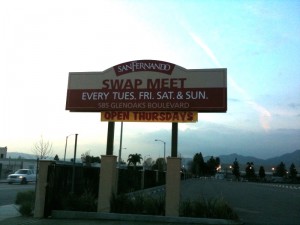
Before I get into that, let me quickly explain what bartering is to those who don’t know. Bartering is simply exchanging goods or services for other goods or services. It is trading without using money. An example of this is I have a neighbor who has a large and productive garden and he has tons of beautiful vegetables that he grows like nobody’s business. I on the other hand have chickens that lay a good number of eggs each day. He has vegetables and my garden is lagging this year. I have eggs and he doesn’t have any source of protein. In a barter situation, I could negotiate with him some of my eggs for some of his vegetables. We would both work out an equitable amount of each (vegetables and eggs) and trade. The terms would be up to us and I would be free to set my prices as low or high as I wanted. My neighbor would be able to do the same.SwapMeet

If the grid goes down, bartering may be how you conduct business.

This concept isn’t new and bartering was actually the way people purchased things for a very long time. Bartering continues to this day, but you can’t go into a Wal-Mart and say, “How about I cut your grass for all these groceries?”. Bartering would work best in small communities with people who know each other I think. Of course outsiders would be able to barter too, but then we get into that risky part of bartering I spoke about in my other post.

Bartering isn’t limited to goods. Services in the form of work or skilled trades can be bartered too. If we had the same grid-down economic collapse scenario I was talking about and my neighbor needed his roof repaired on his house. I could barter my carpentry skills for those vegetables too. One issue I can see coming up quickly in a long term catastrophe would be services of a more personal and physical nature. When you have nothing to trade but your body, I can see very bad things happening and this isn’t a plot from a movie either.

What am I trading for?

Now, we know what bartering is and how it’s done, but before you start stocking up on items you intend to use for barter, you have to ask yourself what you want to barter for? If you have barter items, the implication is that you would trade these for something you don’t have. If you are already planning to trade for something you don’t have, wouldn’t it make more sense to get that item you want instead of purchasing bartering supplies? Maybe that doesn’t work for all things and you would rather be safe than sorry. OK, I understand that, but the supplies listed below aren’t probably going to get you big ticket items. If you plan to barter for guns or ammo, you better have something very valuable to the people you expect to trade with.

  1. Food – This one along with some of the others is a tough one. There will be people without food and I know that decent people will part with something of theirs that you want for food. Maybe if someone is desperate enough, they will barter a weapon for a big chunk of food to feed their family.
  2. Water filters – Clean water is so simple, but immensely important. Disease is one of the quickest killers in any type of natural disaster. People in Haiti quickly succumbed to disease in the quake of 2010 because they had no clean drinking water and sanitation was a major problem. Having some simple water filters like LifeStraw or gravity fed systems like the PointONE could be highly valuable.
  3. Ammo – This probably goes without saying, but ammo will be more valuable than even Gold I think if we really live to see TEOTWAWKI. The supply and pricing is still not back to the levels we enjoyed a couple of years ago. I don’t know if they ever would, but I can always use a little more.
  4. First aid – Antibiotics – Medicine is hard to stock up on unless you have a very understanding doctor. Fortunately, there are sources for antibiotics you can take advantage of now and stock up before the hospitals are overflowing with people.
  5. Toilet Paper – Feminine napkins – One of the first small wins in my quest to convince my wife that stocking up on some things wasn’t crazy. All she had to picture was not having some of life’s necessities on hand and that changed her mind about stocking up.
  6. Candles – Candles are cheap and you can store them just about anywhere and forget about them. I have a box in my supplies and these provide light and potentially warmth to someone who has nothing.
  7. Batteries – Another no-brainer. If you have devices like radios, flashlights, walkies-talkies you will want to have batteries on hand. Bonus if these are rechargeable like Sanyo Eneloop.
  8. Propane – Small propane canisters like the kind for camping grills or lanterns are relatively cheap and could make an excellent barter item.
  9. Alcohol – Cigarettes – I don’t know how long cigarettes would store. If you kept them in a freezer they might last longer, but I wouldn’t devote a lot of space to something I can’t use, although I have said that if zombies take over the world I will probably take up smoking again. Alcohol on the other hand has a few uses. Buy small pint bottles and these may enable you to barter for something really needed if all other sources are gone.
  10. Books – Resource books and even fiction books. Without our modern distractions, a good book will be welcome to someone who has the time to chill out or who needs to learn something.

What about toiletry items for hygiene and cleaning up? I have heard others talk about that and I am sure someone would want those if the situation were ever so dire that people valued getting clean more than eating or protection but I think that is of limited value.

How Much Cash Should You Have If the Grid Goes Down? It Is The Final Backup Plan For A Lot Of Us In The Case Of A Disaster

It is the final backup plan for a lot of us in the case of a disaster. A generous supply of cold hard cash to buy our way out of trouble, pick up as many last-minute supplies as possible or to acquire resources that are unavailable to anyone with a credit card in a world where the electricity is out and the internet is down. We frequently talk about having cash for emergencies, but how much cash should you have if the grid goes down? What will you be able to purchase with your doomsday supply and how long would it last in the first place?

One of our readers made a recommendation the other day to have between $500 and $1000 in cash for your bug out bag and at the time it prompted me to consider again if this amount makes sense. In my personal preparedness plans I have a supply of cash but I am always trying to figure out if what I have is enough or too much. Will it even matter when TEOTWAWKI comes and how can I best use the cash I have to survive?

Why do you need to have cash on hand?

You want to know the time when you will need cash the most? It will be when you can’t get to it. How many of you right now have no cash at all in your wallets or purses? I used to be the same way. I never had cash and relied on the ready availability of cash machines or most often the ability to pay for virtually everything with a debit card. How convenient is it to never have to make change or worry if you have enough cash when with the swipe of a card your bank account funds are at your disposal. This is a great technological advance, but the problem is that this requires two things to be functioning. First, the card readers and ATM machines require electricity. If the electricity is out, neither of these two machines works. The second thing is a network connection. If the network is down, even with electricity the transaction won’t work and you can’t pay for goods or get cash from your bank.

In a disaster, one of the first casualties is electricity. This doesn’t have to be due to some cosmic solar flare that has rendered the grid useless, it could be as destructive and common as a fire, flood, earthquake, tornado or winter storm. It could also be from simple vandalism or perhaps terrorism. A major fiber optic cable was cut in Arizona back in February leaving businesses without the ability to accept payments. When the electricity is out, you aren’t going to be able to access your cash via the normal means so having a supply on hand is going to be a huge advantage for you in the right circumstances.

Even if there is no natural disaster, you are still at the mercy of your bank. What if your bank closes or there is a bank holiday declared because of some economic crisis. In any of these situations, if you are dependent on access to money that is controlled by either technology or physical limitations like a bank office it is wise to have a backup plan should either of those two conditions prevent you from getting cash.

What is cash good for in a crisis?

I think there are two levels to consider when it comes to keeping cash on hand. There is the bug out scenario mentioned above where you would have some “walking around money” to take care of relatively minor needs like food, a hotel or gas. The second is for a longer or more widespread unavailability of funds. Let’s say the economy tanks and the price of everything skyrockets but stores are still open for business. Your bank is one of the casualties, but you had a few thousand dollars of cash stored away that you could use to purchase food, gas and necessary preparedness items for your family. In this scenario, the government is still backing the fiat currency and vendors are still accepting it as a form of payment. For this scenario having a few thousand dollars makes sense.

But what if we have an extreme event where the currency is devalued and is essentially worthless? Your thousands of dollars might only buy you a loaf of bread. Don’t believe it can happen? It did to the Weimar Republic after WWI so it can happen again. That isn’t to say it will, but you should balance how much money you have squirreled away under your mattress with supplies you can purchase now that will last and keep you alive during that same event. My goal is to make sure I have the basics I need to survive at home for several months to a year without needing to spend any cash. This way, if the money is worthless, I still have what my family needs to survive.

If we have a regional disaster where you can bug out to a safer location, your cash should serve you well. Of course if you are in a safer location, assuming electricity was working your access to bank funds should still be working. If this is truly the end of the world as we know it, how long will that cash you have be worth anything?

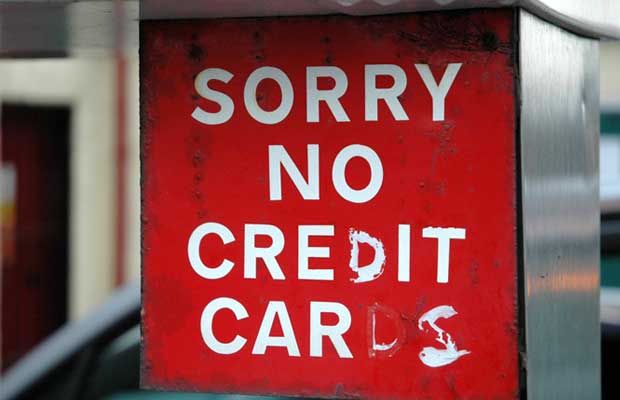
It is surprisingly simple to disrupt all credit and debit transactions. Do you have cash instead?

How much cash do you need?

So the million dollar question is how much cash should you have if the grid goes down? I always try to plan for the worst case scenario. My rationale is that if I am prepared for the end of the world as we know it, I should be just as prepared for any lesser disaster or crisis I may be faced with. The way I see it is if we do have a disaster, you aren’t going to be using that cash most likely to pay your mortgage, student loans, rent, or your credit card bills. Cash will go to life saving supplies and this will need to be used in the earliest hours of any crisis before all of the goods are gone or the cash is worthless. Once people realize for example that the government has been temporarily destroyed, they aren’t going to want to take your $500 for a tank of gas. They are going to want guns, food or bullets.

I also don’t see you using your cash to buy passage to another country, but that’s just me. I know there is a historical precedent for that, but I am not planning on that being something I realistically attempt with my family. I am also not planning on bribing any officials with cash either. My cash is for last-minute necessities and then it is back into the hopefully safe confines of my home to plan the next steps. For that I have only a couple of thousand dollars in cash stored away. I figure if I need more than that I didn’t plan well. Also, I would rather spend my money on supplies like long-term storable food and equipment than having a large horde of cash. With that amount, I figure I can make one last run if needed or be able to weather any short-term emergency when I can’t access cash.

What is the best place to hide cash in your home?

I wrote a post awhile back titled, How to hide your money where the bankers won’t find it that had lots of good ideas for reasonably safe places you could store cash. As I said in that article, you do have risks involved with keeping cash in your house, but I think you have just the same, if not worse risks relying on banks to keep your money safe and give it back when you want it. There are a million places to hide cash, but you can get tricky and buy a fake shaving cream safe to store several hundred dollars in there. Just be careful you don’t throw that away. There are other options like wall clocks with a hidden compartment inside that might be less prone to getting tossed in the trash. Your imagination is really all that is needed for a good hiding place, but I would caution you that you don’t store cash in too many places or you could forget where you hid it. This happened to me when I had hidden some cash behind an item that I ended up giving to my daughter because I thought I didn’t need it anymore. Imagine my surprise when she came into the living room and said, “Dad, I found an envelope with a lot of money in it”. I gave her a twenty for a reward…

What about you? How much cash do you think you need to have on hand and what do you plan on spending it on if the grid goes down?

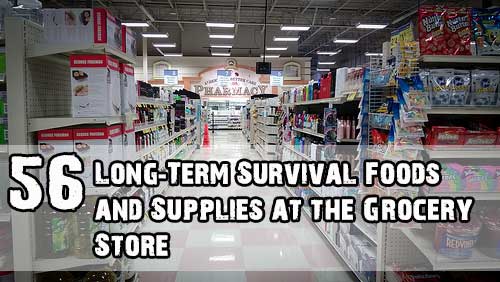
Survival Food – 56 Long-Term Survival Foods and Supplies at the Grocery Store

When disaster strikes, there’s a pretty good chance your local grocery stores are going to be stripped bare in a matter of hours. From panicked people trying to stock up on last-minute supplies to those who failed to prepare for even short-term disasters and now find themselves facing the prospect of starving, your local grocery store is going to look like a battleground in a post-apocalyptic movie.

Most grocery stores have a maximum 3 day supply of goods on hand before they run dry. That means even short-term disasters like hurricanes, floods, and earthquakes can cause supply chain problems that will quickly wipe out their inventory. Now throw in a long-term disaster that cuts off supplies for months, and you have a real recipe for disaster.

To be prepared to face an emergency situation where supply chains start to fail and food supplies are blocked, you need to invest in a long-term food supply. This supply should be made up of six months’ worth of emergency food that has a long shelf-life and is something that you already eat.

With the help of suggestions that have come in from our readers, we have compiled a list of the top food items and emergency supplies that you can buy at the grocery store. The list contains foods with a long shelf-life, items that have multiple uses, and supplies that are great for bartering.

Long-Term Survival Foods

Survival Foods that add flavor & comfort:

Comfort foods can be a huge morale booster during a stressful survival situation, something that needs to be kept in mind when starting to stockpile food. These four things can be stored for over 10 years, and are a great way to add a little bit of flavor to your cooking. If stored properly they will probably last indefinitely.

  1. Salt
  2. Sugar – Brown or White
  3. Raw Honey
  4. Alcohol – Whiskey, Vodka, etc…

Base cooking ingredients with a long shelf life:

The following categories of food make up the foundation of most recipes and are all things that store well.

Hard Grains: Stored properly hard grains have a shelf life of around 10 – 12 years.

  1. Buckwheat
  2. Dry Corn
  3. Kamut
  4. Hard Red Wheat
  5. Soft White Wheat
  6. Millet
  7. Durum wheat
  8. Spelt

Soft grains: These soft grains will last around 8 years at 70 degrees, sealed without oxygen.

  1. Barley,
  2. Oat Groats,
  3. Quinoa
  4. Rye

Beans: Sealed and kept away from oxygen the following beans can last for around 8 – 10 years.

  1. Pinto Beans
  2. Kidney Beans
  3. Lentils
  4. Lima Beans
  5. Adzuki Beans
  6. Garbanzo Beans
  7. Mung Beans
  8. Black Turtle Beans
  9. Blackeye Beans

Flours and Mixes and Pastas: 5 – 8 years

  1. All Purpose Flour
  2. White Flour
  3. Whole Wheat Flour
  4. Cornmeal
  5. Pasta
  6. White Rice ( up to 10 years)

Oils:

  1. Coconut oil – Coconut oil has one of the longest shelf lives of any kind of oil. It can last for over 2 years and is a great item to add to your survival food supply list.

Survival Foods that are great during short-term disasters:

The following items are great for short-term emergencies, and will stay fresh for a long period of time. During most disasters, you’re going to want to have food that requires very little cooking, or can be eaten without any preparation at all. Make sure some of your stockpile includes these types of food.

Other good survival foods: 2 – 5 years of shelf life

  1. Canned Tuna
  2. Canned Meats
  3. Canned Vegetables & Fruits
  4. Peanut Butter
  5. Coffee
  6. Tea
  7. Ramen Noodles – not the greatest food in the world but they are very cheap so they made the survival food list.
  8. Hard Candy
  9. Powdered milk
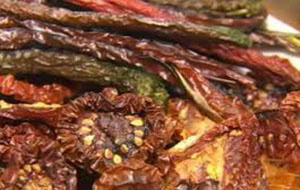
  10. Dried herbs and spices

Items that can be used for more than cooking:

  1. Apple Cider Vinegar – Cleaning, cooking and has antibiotic properties
  2. Baking Soda – Cleaning, cooking, etc…
  3. Honey – Mentioned again for its antibiotic properties and wound healing.

Nonfood items to stock up on at the grocery store:

  1. Bic Lighters
  2. Toilet Paper
  3. Soaps
  4. Bottled Water
  5. Vitamins
  6. Medicines
  7. Bandages
  8. Peroxide
  9. Lighter fluid
  10. Canning Supplies
  11. Charcoal

More Emergency Food Resources

While we always advise the DIY approach to stockpiling food, this way you have the things that you would normally cook and eat and can then rotate them in and out of your normal life, there are some circumstances where commercially made survival food supplies might make sense. Here are some of the top emergency survival foods that can help you quickly bulk up your emergency supplies.

20 Survival Foods That Will Last 20 Years

Humans can live for up to three weeks without food, but the effects of hunger and starvation begin to affect us within days after we cease consuming calories. This is why food storage is critical when preparing for any emergency, be it short or long term.

When planning a food storage system it is advisable to select foods that you will not have to rotate on a regular basis, such as this list of foods that will last at least two decades.

When storing food, the key is to keep your stores in a cool, dry, and dark place. This will mitigate the enemies of food stores that are heat, moisture and sunlight.

The other enemy to food preps is oxygen, so using vacuum sealers or an oxygen absorber in Mylar bags or buckets, will extend the shelf life of your precious food supply by many years.

During a SHTF situation, pain could become an annoyance for some, but unbearable for others.

If doctors are scarce and medicine becomes even scarcer, this one little weed, found all over North America and similar to morphine, could be a saving grace.

This list of foods is complied in no specific order.

1. Pemmican

20 Survival Foods That Will Last 20 Years

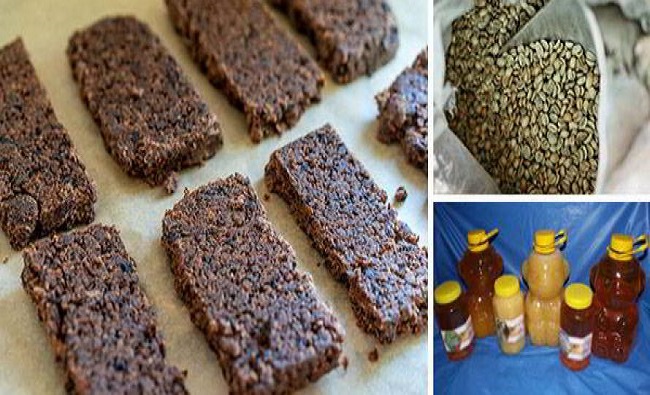
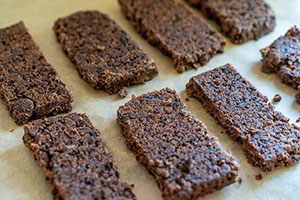
Pemmican is the ultimate survival food and it is something that you can absolutely make yourself in your own kitchen.

Pemmican is pulverized lean meat mixed with equal parts of rendered fat and dried crushed berries.

It is said to be able to last for multiple decades, but as with any other food on this list, you must store it appropriately in order to achieve the full shelf life of this near perfect survival food.

2. Freeze Dried Foods

Freeze drying food is not something that the average homeowner can accomplish without specialized equipment. Fortunately, there are a multitude of companies that offer freeze dried foods both in bulk and also in meal sized packages.

These foods are a staple of the backpacking community and usually don’t taste half bad. Every company is different but most state that their freeze dried food will last over 20 years.

3. Honey

20 Survival Foods That Will Last 20 Years

When we are talking about honey for your survival food stores, we are speaking about raw honey not the stuff in the cute beehive bottles at Walmart.

Raw honey’s shelf life is generally considered to be indefinite so twenty years is a walk in the park for this food.

Archaeologists have found jars of honey in Egyptian tombs that was thousands of years old and was still good.

4. Rolled Oats

20 Survival Foods That Will Last 20 Years

Not all oats are created equal, so the ones you want to be looking for are old fashioned rolled oats, and you are not going to want to be using the packaging that the oats come in.

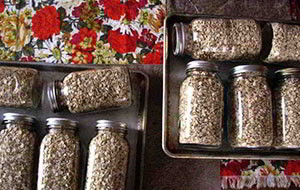
Instead seal the oats in airtight containers using a vacuum sealer or oxygen absorbers, and store in a cool dry dark place. If handled properly rolled oats will last up to 30 years.

5. Dry Pasta

Dry pasta can last beyond 20 years but you can not expect that to happen if you store it in the store bought packaging. Sealing in a vacuum sealer or Mylar with oxygen absorbers, and keeping in the usual cool, dry, and dark places is the key here.

Dried pastas such as Macaroni, Penne, Fusilli, etc are better for vacuum sealing because they are less likely to break during the process.

6. Dehydrated Fruit and Vegetables

20 Survival Foods That Will Last 20 Years

Dehydrating fruits and veggies is not enough to get decades of storage life out of them, you must store them in a moisture and oxygen free environment.

This is where vacuum sealing or Mylar and oxygen absorbers come into play again. If stored correctly and great care is taken to keep them free of moisture, there is little reason that dehydrated fruit and veg will not last decades.

Experts predict that an EMP strike that wipes out electricity across the nation would ultimately lead to the demise of up to 90% of the population. However, this figure begs an important question: if we were able to live thousands of years without even the concept of electricity, why would we suddenly all die without it?

7. Jello Mix

Jello mix is not much of a food per say, but is worth a mention here anyways because the apocalypse shouldn’t stop us from having a sweet treat.

Jello’s shelf life in an unopened box is considered to be indefinite.

8. Water

While not a food, water is still a vital part of your food preps and as long as it is kept clean and free of contaminants it will never go bad.

9. White Rice

No survival food list would be complete without the staple food for billions of people around the world.

White rice should be stored in the usual cool, dry, and dark locations in airtight containers with oxygen absorbers to get the maximum shelf life out of it. Stored correctly it will last indefinitely.

10. Ghee

Ghee is clarified butter which has been processed to remove all the milk solids from it. If it is stored appropriately like most of the items on this list it could last indefinitely but realistically will remain edible for a few decades.

11. Whole Wheat Grains

Whole wheat grains if stored in sealed food grade buckets with oxygen absorbers or vacuum sealed, can last for over 20 years. Not all whole grains are created equal, and you need to do your research to find the right ones for your diet and for the longevity of the food storage that you are wanting.

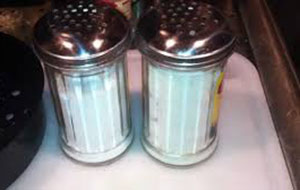
12. Sugar and Salt

20 Survival Foods That Will Last 20 Years

No kitchen is complete without either of these staples.

Both of them have a shelf life that is indefinite.

You must still store them appropriately. It is imperative that these dry goods remain dry.

13. Cocoa Powder

Cocoa powder does not spoil but will loose its flavor potency over time. Even with a shelf life that is indefinite you will find that after two or three decades, you’ll need more of it to get that same amount of chocolate flavor that you would have gotten on day one.

14. Potato Flakes

Depending on the method of storage, potato flakes can last 25 to 30 years; but like everything else, needs to be stored properly.

15. Sourdough Starter

20 Survival Foods That Will Last 20 Years

This takes some time and effort, but a sour dough starter when maintained and fed will last a lifetime and is something that all of us should have on hand.

A sourdough starter can also be stored in the refrigerator to reduce the frequencies of feedings. This is a great source of long term yeast, but requires a consistent supply of flour to maintain.

16. Soy Sauce

When stored in unopened bottles in the appropriate conditions, soy sauce will last indefinitely.

17. Worcester Sauce

Just like soy sauce, if left unopened this condiment will last forever.

18. Maple Syrup

You’ll only want to store 100% pure maple syrup in glass bottles for your food preps. If stored correctly and unopened, it will last for decades if not indefinitely.

Once opened though it will need to be refrigerated or kept somewhere that is very cool like a root cellar.

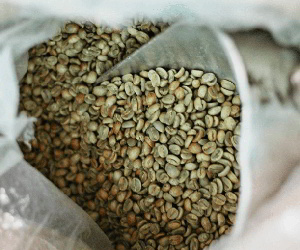
19. Green Coffee Beans

20 Survival Foods That Will Last 20 Years

Instant coffee has a long shelf life, but I hate instant coffee and if the zombies are upon us, then I’m going to need a good stiff cup of joe in the morning.

Turns out the best way to store coffee for the long haul is green coffee beans. Stored in Mylar with oxygen absorbers it should last 20 years, you will need to secure a way to roast and grind them in order to get that cup of wake up juice.

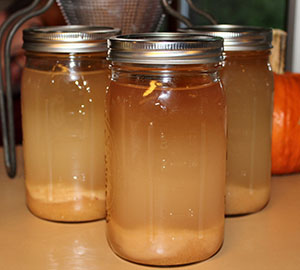
20. Vinegar

20 Survival Foods That Will Last 20 Years

Vinegar is considered to have a pretty much indefinite shelf life.

Vinegar is also an item you should have on hand because of its multiple uses from food preparation, cleaning, food preservation, and even medicinal uses.

Before storing any foods long term, it is critical that you not only invest in the right equipment and storage space.

Also do all of your research and due diligence to make the right and most informed decisions possible.

This list is a collection of some of the foods that have shelf lives beyond twenty years. There are many more out there for you to discover. What would you add to this list?

You might be living in one of America’s deathzones and not have a clue about it
What if that were you? What would YOU do?

In the next few minutes, I’m going to show you the U.S. Nuclear Target map, where you’ll find out if you’re living in one of America’s Deathzones.

This image has an empty alt attribute; its file name is untitled-1.png

17 Things People Will Wish They Have After The SHTF: When That Happens, People With No Survival Skills Or Emergency Supplies Won’t Last Long

This post is a little different from my usual posts. If you’re already a prepper, I don’t expect this article to teach you anything new. Rather, I expect it to serve as a reminder of why we prep. I also hope that it can serve as a warning to those who don’t prep.

For example, you might think it’s unlikely that your home will ever be damaged or destroyed, but you still buy homeowners insurance just in case. It’s the same with prepping. Maybe doomsday will never arrive, but you never know.

And it’s not like we’re preparing for something that has never happened before. Millions of people die in disasters every year, economies collapse all the time, and terrorism is an ever-present threat. Sure, you might luck out where you live and never face a serious disaster. But then again, you might not.

Unfortunately, most people in the Western World are unfamiliar with history and current events, so they have no idea how common disasters really are. They assume they will always have access to modern luxuries: electricity, air conditioning, fresh water, affordable food, and so forth. Consequently, humans are more helpless than ever before. It’s gotten so bad that there are even teenagers who don’t know how to use can openers.

But they won’t find out how helpless they are until the SHTF. When that happens, people with no survival skills or emergency supplies won’t last long. They’ll quickly realize that a few basic survival items can mean the difference between life and death. Here are 17 things people will wish they have and why (in alphabetical order).

1. Barter Items

Hyperinflation is the main reason people stock up on barter items, but there are several other scenarios where they could become necessary. Most people don’t carry much cash anymore, so if the power is out or the Internet is down, they’ll have no way to purchase anything. That’s where barter comes in.

You probably won’t be able to barter at the grocery store, but you could at least barter with your neighbors. If you are desperate for food but you don’t have any barter items, they might take pity and help you anyway. Then again, they might point their guns at you. It’s definitely better if you have something to trade.


2. Bug Out Bags

For most people, everything they own in the world is in one place: their home. But what if your home is destroyed? Floods, hurricanes, earthquakes, house fires–all these things are guaranteed to happen again somewhere. What if your neighborhood is next?

Or what if there’s a pandemic, nuclear fallout, or an invading army on its way and you have to bug out quickly?

These are just a few reasons why you need a bug out bag. Even the most experienced survivalists would be pretty miserable trying to bug out without any supplies.


3. Cooking Gear

Imagine your stomach is growling as you stare at a pile of food you can’t eat because it has to be cooked. Although many modern foods can be eaten out of the box or can, foods like pasta, rice, and some frozen foods are inedible if they’re uncooked.

If the power goes out, it will only be a matter of time before the all the frozen meat thaws out and starts to rot. When that happens, you’ll be wishing you had a way to cook without power.


4. Fire

In this day and age, most people never truly experience the cold. They just wrap themselves in a blanket and turn up the heater. But without power, you’ll need to build a fire if you want to stay warm.

This is more important than you might think. Every year thousands of people die from hypothermia, and that’s during good times! Also, don’t forget that many foods need to be heated up before you can eat them.

Speaking of fire, don’t forget fire extinguishers. After a long-term power outage, some of the people who’ve never cooked over a fire or used lots of candles are going to accidentally set their homes ablaze. And with no fire department to stop it, the fire will spread from home to home. Entire neighborhoods might burn down. If you don’t have a fire extinguisher, you may have to evacuate your home.


5. First Aid Kits

Most people have no idea how fragile their bodies actually are. Millions of us would be dead right now if it weren’t for basic first aid supplies to keep wounds clean and prevent infections. And keep in mind that during disasters, injuries tend to skyrocket because of all the people climbing, doing manual labor, messing around with fire, and consuming contaminated food and water. If hospitals are overrun, people will have to help themselves with a first aid kit.

In addition, you should also have some extra medications and antibiotics. I, myself, would probably be dead right now if it weren’t for antibiotics.


6. Food

When’s the last time you were truly hungry? I don’t mean you skipped breakfast and now your stomach is growling hungry. I’m talking about the kind of hunger where your arms and legs are shaking with weakness, your stomach is in knots, and all you can think about is food no matter how hard you try to concentrate.

Most people have never actually been this hungry, but they will be if the SHTF. Grocery stores only have about three days of food on hand, a week at most, so you need to keep plenty of survival food on hand.


7. Fuel

Gasoline is something we all tend to take for granted. We use it almost every day but rarely think about it (unless the price goes up a little), much less where it comes from. After the SHTF, gasoline will disappear very quickly. Just look at what happens to coastal cities when a hurricane is on the way.

Not only do you need gasoline for your bug out vehicle, you need it for your power generator.

But that is just one type of fuel. You’ll also want to stockpile firewood, propane, isopropyl alcohol, or any other type of fuel you might need to cook food and keep warm.


8. Gardening Supplies

Gardening supplies are essential if during a long-term disaster scenario. For example, if the economy collapses like it recently did in Venezuela, you could have a situation where food shipments are few and far between, or quality food is simply too expensive. People who can grow their own food won’t be nearly as hungry.

In addition to supplies like rakes, spades, hoes, you’ll also want to get plenty of buckets so you can grow food indoors and keep fresh fruits and veggies on the table year round.

You should get some greenhouse supplies as well. A hoop house covered in plastic can significantly extend the growing season. There are countless DIY greenhouse plans out there. Most of them just take a little PVC and plastic sheeting, and they’re not that hard to assemble.

Heirloom seeds are another essential item. They need to be non-hybrid and open-pollinated. Why? Because if they aren’t, they don’t produce as much food or as many seeds, and they usually don’t taste as good (most seeds you buy in stores are hybrids). I recommend these survival garden heirloom seeds.


9. Lights & Batteries

Imagine looking out the window at night and seeing only darkness. Even worse, imagine a pitch black home where you can’t find anything you need and can barely see the faces of your loved ones. Not only would that be unsettling, it could also make you an easy target for burglars. Don’t let that happen, especially when there are so many ways to light your home when the power goes out.

Also, don’t forget batteries. You will need them not only for your flashlights but for any other electronic devices you might need such as radios or medical equipment.


10. Radios

Having no information of any kind from the outside world can be almost as frightening as not having lights. We are so used to having news delivered right to our phones, we forget how frustrating it is to be in the middle of a long power outage and have no idea what’s going on out there.

It’s even worse if we have no way to communicate with our loved ones. If there are people you care about in an area that’s been hit by an earthquake or hurricane, you will be overcome with worry until you’re able to get in touch with them. Don’t let that happen.


11. Sanitary Supplies

Not only do you need to keep wounds clean, you need to keep your whole body clean. When the garbage trucks stop coming, trash will pile up in people’s yards which will attract bugs, rodents, and disease. And when the water stops flowing, people won’t be able to properly clean up after meals or bathe themselves.

Those who don’t know what to do with waste will keep using their toilets and stink up their houses. Eventually, once-clean neighborhoods will be as filthy as the streets of a third world country. In this environment, many people will get sick and die from infections and deadly diseases that could have easily been prevented with proper hygiene.


12. Survival Books

Without the Internet, people will have a hard time figuring out how to do basic things. They’ll wish they’d bought some of those survival books they’ve seen online or at the bookstore.

I know some people who argue that a true prepper should commit survival knowledge to memory and practice survival skills on a regular basis so they don’t have to refer to books. I completely agree, but no one can learn everything. Even the most experienced preppers can keep learning new things.

And besides, what if you just started learning about survival a few months ago and the collapse happens tomorrow? Or what if after the collapse, you have friends and family with so many questions you don’t have time to answer them all? Wouldn’t it be nice if you could refer them to your survival library?


13. Sewing Supplies

In a long-term disaster, it’s possible there won’t be any clothes left in the stores. More likely, however, is you simply won’t be able to afford them. This is what happens during economic depressions–many people live hand to mouth and can’t even gather enough money for new socks.

But back in the day, people didn’t throw away a sock just because it had a hole in it. They would actually repair their socks (it was called darning). They would probably scoff at the idea of throwing away a perfectly good sock with one little hole. After all, they’re not very difficult to repair.

If there’s another great depression, people will have to learn how to start sewing again so they can repair their torn clothes and even make new clothes out of sheets, curtains, and any other fabric they can find.


14. Shelter

This is more of a skill than a thing, but it’s a very important skill. If you have to bug out and you find yourself in the wilderness, one of your top priorities is to build a good shelter. That last thing you want to do is curl up under a tree while the cold air nips at your face and dampness from the ground seeps into your clothes. Do that, and you risk getting hypothermia.

Hopefully, you have a tarp and some paracord in your bug out bag, but it’s possible to build a shelter from scratch.


15. Tools & Home Repair Supplies

After a disaster such as a hurricane or an earthquake, you will probably need tools to repair things around your home. Hammers, screwdrivers, wrenches, shovels, saws, and so forth. Even if your home doesn’t get damaged, you still may want to lend tools to your neighbors, or you may want to board up windows to stop potential intruders, or you may simply need an ax for chopping firewood. You never know.

Tools are no good without home repair supplies. Don’t forget to stockpile nails, screws, lumber, plywood, caulking, wire ties, duct tape, plastic sheeting, etc.


16. Water

You will be shocked by how quickly thirst sets in once there’s nothing to drink. If the power is out for too long, the tap water will stop flowing. And unless you’re able to collect rainwater, you’ll die of thirst in just a few days.

Even if the water is still flowing, you could be facing a disaster where the water is contaminated. The last thing you want to do is drink water that makes you and your family sick, especially if the hospitals are overrun. So make sure you stock up on water and have at least two ways to purify water.


17. Weapons

Every time there’s a riot or a widespread disaster, some people take advantage of the situation and start looting. If the event lasts a long time and the authorities are unable to restore order, you can bet the looters will move from the commercial areas to the residential areas. Especially if they’re starving.

This is why you need to have a good weapon for self-defense, preferably a firearm. Don’t stand there helplessly as criminals kick in your door, attack your family, and steal the things you need to survive. If possible, prevent this from happening in the first place by putting some good home security measures in place.


As I said in the intro, I don’t expect preppers to learn a whole lot from this article. But every now and then we need reminders like this to keep us motivated. And if you’re not a prepper, then hopefully this article will give you the push you need to get started. 

16 Things You Can Do to Survive the Next Great Depression

To say things are a little scary right now would be an understatement, and everyone is holding their breath, wondering if we are headed for the next Great Depression. Experts say that if it happens, it will be worse than the crash in 1929, leaving those of us with families wondering how to survive the next Great Depression.

Things are different now. I know my bills are higher than those who lived a century ago, and most people have higher debts levels. It was just announced this week that the UK is in a recession far worse than the rest of Europe or North America.

Is the United States next?

While our employment rate continues to decline as more people re-enter the workforce, we still have a 10% unemployment rate as of August 2020. People worry that, as COVID numbers increase, the unemployment rate will increase once again.

So what can you do to ensure you and your family can survive the next Great Depression? There is plenty! Many of us had grandparents who survived this period and told us bits of wisdom that we can share with others. My great-grandmother lived on a farm in the middle of the Great Depression, and she shared with me her hardships and the valuable lessons she learned.

Today I’d like to share with you a 3-second survival hack you can use to skyrocket your chances of protecting your loved ones during ANY crisis.
This technique is so powerful it can give you almost superhuman powers during the ugliest nightmares imaginable….
From natural disasters like earthquakes or tornadoes…
To explosive situations like mass shootings or even nationwide martial law.
And It doesn’t matter if you’re out of shape…
Or have no equipment…
Or even if you’re disabled living in a wheelchair.
This technique has been tested and proven by elite soldiers and real world “miracle” survivors from around the world.

16 Things You Can Do to Survive the Next Great Depression

1. Have Multiple Streams of Income

Gone are the days of having one stream of income to support your family, and unfortunately, no job is truly recession-proof. No one has 100% job security, even if we like to think so.

You can have your primary source of income. For our family, that would be my husband’s full-time job outside of the home, but that might look different for your family.

Then, it’s time to find different ways to make money. Think about the skills you have or the education that you have. My husband works part-time as an EMT and firefighter. We sell products that we grow out of the garden and jams and jellies I create in the kitchen. I started a blog to earn money on the side.

You can find numerous ways to make money! Be creative and think about things people will need that you can provide for them.

2. Start a Garden

Food is, without a doubt, the number one concern for any individual when the idea of facing a depression comes up. How would you feed yourself and your family?

That’s why you need to have a garden. You should start small because gardening is a skill that takes time to learn and cultivate, but I suggest stockpiling seeds if an emergency happens before your skills develop.

Be smart about the plants that you grow if you’re gardening for survival. Do you like eggplants? Sure! Can you preserve and feed your family on eggplants? Not really.

Survival gardening means focusing on different staple crops and adding healthy greens that you can grow throughout the year for additional vegetables. Corn, potatoes, tomatoes, beans, and squash are crucial to using your garden to survive. You have to think about foods with plenty of calories.

3. Learn To Preserve Food

If you have all of this food that you have grown, you need to be able to save it. Canning is the most obvious choice for food preservation, but you can also try your hand at dehydrating, freezing, fermenting, salting, and more.

People preserved food for thousands of years before the invention of refrigerators, so it’s definitely possible. Try your hand at it now and find the methods you prefer the most.

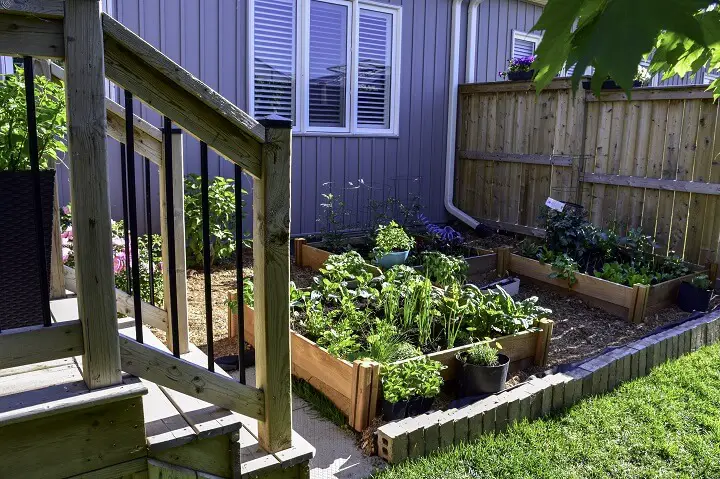
Small Backyard Garden

4. Raise Some Backyard Animals

I remember my great-great-grandmother – yes, really! – and she told me stories about raising chickens and meat rabbits in the backyard of her city home. It wasn’t unusual a century ago to have a few chickens and other poultry or meat rabbits.

My grandfather grew up in the same area and told me that there used to be a cart that came around each day, and you could grab a live chicken off of it to cook. Yes, it came alive, but everyone knew how to butcher back then.

See if your city allows some chickens or rabbits. While I live outside of the city limits, those who do live in the city limits near me are allowed six hens. That’s a few eggs a day, and when food is low, that’s valuable!

Experts predict that an EMP strike that wipes out electricity across the nation would ultimately lead to the demise of up to 90% of the population. However, this figure begs an important question: if we were able to live thousands of years without even the concept of electricity, why would we suddenly all die without it?

5. Take Up Hunting and Fishing

You might live in an area where hunting isn’t possible, or you would have to go too far out of the city to hunt. Not everyone feels comfortable hunting, but fishing is a beloved pastime for many families.

Turn that hobby into a way to feed your family. You might not think about eating the fish that your kids pull out of the small lake, but when food is scarce, you can. Fishing for subsistence happens all over the world, and you can do so right in your neck of the woods.

6. Learn How to Filter Water

While we hope that our access to freshwater isn’t jeopardized by the depression, it’s certainly possible. You might not be able to afford your water bill, in which case you’ll need to start collecting water elsewhere for your family.

I suggest that you build a rainwater collection system to gather the rain that happens throughout the week. Then, learn how to filter that water.

You might also want to learn how to filter water from a creek or lake if you find that you need to learn your home.

7. Stockpile Non-Perishable Foods

While you’re still employed and financially stable, it’s the perfect time to stockpile non-perishable foods. Learn how to store those foods correctly. Foods such as flour should be stored in mylar bars and in buckets to increase their lifespan.

Don’t go too crazy with stockpiling, and remember to only stockpile foods your family really eats. There is no point in storing tuna if your family hates it. It’s wasteful not to eat it at some point.

Also, don’t break the bank. There are dozens of ways that you can stockpile food without blowing your budget.

8. Be As Resourceful As You Can

Something I always admired about my grandparents was their ability to use whatever they had available. Their ingenuity helped them survive difficult times, and we need to find that same spark inside of us.

Instead of buying something new, we need to see what we have that can be a substitute. If we can’t find a replacement, is there a way to make it or a version of whatever we need for cheaper? Buying new should be the last resort.

Frugal Living Money Jars

9. Stop Relying on Credit Cards – Live Within Your Means

Credit cards are the norm for our society, but most usage means you’re living outside your means. If you can’t afford it in cash, it has to wait until you can.

Pay off your credit cards and lock them away. Teach yourself and your family how to save and wait for what you really want. It makes you more appreciative of what you have.

10. Stock Up on Clothing

If the economy is about to tank, you need to think about things you and your family will need, and clothing is on that list. Now is a good time to stockpile essentials like socks and underwear, along with some basic shirts in a variety of sizes.

At the end of seasons, snatch up the clearance clothes in the next sizes up for your kids. It’s one of my favorite ways to reduce how much money I spend on clothing. Go to thrift stores and find used clothes or shop consignment sales.

11. Learn How to Mend

Your clothing will eventually wear out. Mending is a skill that most women had during the Great Depression. They had to fix their kids’ clothing to make it last as long as possible.

You can do the same! Don’t toss out shirts with holes; fix them. You can buy pants that are too long and hem them (then take out the hems later when the child grows). Not only is mending and sewing a valuable skill, but it can help you save money when each penny counts.

12. Find a Tradeable Skill

Skills are nearly as valuable as items. No one can do everything, so having a few tradeable skills is a serious asset. You might understand construction, plumbing, electrical work, or work in the medical field.

Anything can be a skill to someone else. Your ability to garden, can, and preserve food could be something that another person wants to learn. You could teach them the ins and outs in exchange for them to fix your leaky faucet.

It seems like a strange idea, but this was something that worked for centuries. It’s very much the mentality of you scratch my back, and I will scratch your back.

13. Stockpile Medications

When the pandemic first started, I needed some pain medication for my kids; my toddler’s molar popped through, and she was uncomfortable. I headed to the store, and all of the children’s medicine was sold out.

You might not think about medication as one of the first things people buy out, but they do. This was proof that we need to make sure we have all of the medications our family needs on hand.

It’s hard to get a stockpile of prescription medication; it takes time and refilling at the right time, but it can be done. You can focus on stocking all of the OTC medications that you will need.

14. Learn How to Barter

How do you buy things when the value of currency plummets?

The answer is bartering. Bartering was the critical form of currency for centuries, and one day, it will take back over as the primary way to get the items needed for your family.

Right now, we do have time to prepare and get ready for a potential economic crash, so now is the ideal time to stockpile barter items. These items often are luxury items, but they also can be inexpensive items that people don’t think that they will need, but they really do.

Most preppers know things like alcohol, coffee, and chocolate would be barter items, but don’t forget the value in hygiene products and medication. A bottle of ibuprofen would be more valuable than chocolate for many families who want to swap with you.

15. Save Now While You Can

Saving is crucial while you have your primary source of income, but saving doesn’t just have to be in the form of money. I consider stockpiling food and essentials a form of savings because it’s less money you need to spend in the future.

Start living a frugal lifestyle. Don’t eat out (at least not as often) and find ways to save money. Learn to do without for non-essential items, and if you do want something, learn to delay your gratification. Wait a week or two to buy it to decide if you still want it, and search for better prices in the meantime.

16. Find Likeminded People to Help

Last but not least is to find people in your life who are worried about the future just as much as you are. No one can do everything, and you will need a form of community to help you survive.

Family and friends helped each other survive during the Great Depression, and it will happen again in the future. Don’t be surprised if you have to move in with family members or if they need to move in with you. These things were far from uncommon a century ago to help each family survive and live within their means.

You Will Survive

No one wants our worries or predictions about the next Great Depression to come true, but it’s a possibility looming over our heads. We need to be smart now while things are okay for our families. If you’re still employed, count your blessings and start to prepare now.

You might be living in one of America’s deathzones and not have a clue about it
What if that were you? What would YOU do?

In the next few minutes, I’m going to show you the U.S. Nuclear Target map, where you’ll find out if you’re living in one of America’s Deathzones.

This image has an empty alt attribute; its file name is untitled-1.png

How U.S.’s Response to Covid-19 Could Precipitate 2nd Great Depression

On March 10th of this year, there were 290 daily new U.S. cases of Covid-19 (coronavirus-19).

On March 13th, U.S. President Donald Trump declared a pandemic national emergency, because the number of daily new cases was now suddenly doubling within only three days. However, no lockdown was imposed. The policy-response was instead left to each individual. This is in accord with America’s libertarian ideology. Trump even announced that “he was allowing his health secretary to bypass certain regulations to provide more flexibility to doctors and hospitals responding to the outbreak” — outright reducing, instead of increasing, federal regulations, this being his way to address the matter. That’s the libertarian response.

Covid-19 (coronavirus-19) cases started soaring in the U.S., from 600 daily new cases on March 13th, to 25,665 on March 31st. Americans were scared to death, and facemask-usage soared, and independent small businesses started laying people off en-masse. (Restaurants, hair salons, travel agencies, inns, dental offices, etc., were hard-hit.)

Immediately, the alarming rise in new cases halted on April 4th (at 34,480), and the daily new cases remained approximately flat, but slightly downward, from March 31 to June 9th (when it reached bottom at 19,166), but then soared yet again, to 78,615, on July 24th.

But, then, it again declined, so that, on September 8th, it was at only 28,561. This was already returning to around what the new-cases rate had been back on March 31st. So: despite peaking again on July 24th, the rate of daily new cases was little changed between March 31st and September 8th. And, all during that 5-month period, people were coming back to work.

The key immediate and direct economic variable affected by Covid-19 is the unemployment rate. Here, that economic effect is clearly shown:

U.S. unemployment: March 4.4%, April 14.7%, May 13.3%, June 11.1%, July 10.2%, August 8.4%

Though the daily-new-cases rate went down after March 31st and after July 24th, the unemployment rate progressed far more gradually downward after March 31st: the small businesses that had been panicked by the explosion of new cases during March were now gradually re-opening — but they remained very nervous; and, so, unemployment still was almost twice what it had been during March.

Here, that experience will be compared with two Scandinavian countries, starting with Denmark, which declared a pandemic national emergency on March 13th, just when Trump also did. “Starting on 13 March 2020, all people working in non-essential functions in the public sector were ordered to stay home for two weeks.” The daily new cases fell from the high of 252 on March 11th, down to the low of 28 on March 15th, but then soared to 390 on April 7th, and gradually declined to 16 (only 16 new cases) on July 9th. Then it peaked back up again, at 373, on August 10th, plunged down to 57 on August 26th, and then soared yet again back up to 243 on September 8th. The new-cases rates were thus irregular, but generally flat. By contrast against the experience in U.S., Denmark’s unemployment-rate remained remarkably stable, throughout this entire period:

Denmark: March 4.1, April 5.4, May 5.6, June 5.5, July 5.2

Sweden’s Government pursued a far more laissez-faire policy-response (“The government has tried to focus efforts on encouraging the right behaviour and creating social norms rather than mandatory restrictions.”), and had vastly worse Covid-19 infection-rates than did the far more socialistic Denmark, and also vastly worse death-rates, both producing results in Sweden more like that of the U.S. policy-response than like that of the Danish policy-response, but far less bad than occurred on the unemployment-rate; and, thus, Sweden showed unemployment-increases which were fairly minor, more like those shown in Denmark:

Sweden: March 7.1, April 8.2, May 9.0, June 9.8, July 8.9

That was nothing like the extreme gyration in:

U.S.: March 4.4%, April 14.7%, May 13.3%, June 11.1%, July 10.2%, August 8.4%

Why was this?

Even though Sweden’s policy-effectiveness was more like America’s than like Denmark’s at keeping down the percentages of the population who became infected, and who died from Covid-19 (i.e., it was not effective), Sweden’s policy-effectiveness at keeping down the percentage of the population who became unemployed was more like Denmark’s (i.e., it was effective, at that). Unlike America, which has less of a social safety-net than any other industrialized nation does, Sweden had, until recently, one of the most extensive ones, and hasn’t yet reduced it down to American levels (which are exceptionally libertarian). Therefore, whereas Swedes know that the Government will be there for them if they become infected, Americans don’t; and, so, Americans know that, for them, it will instead be “sink or swim.” Make do, or drop dead if you can’t — that is the American way. This is why Swedish unemployment wasn’t much affected by Covid-19. When a Swede experienced what might be symptoms, that person would want to stay home and wouldn’t be so desperate as to continue working even if doing that might infect others. Thus, whereas Sweden’s unemployment-rate rose 27% from March to May, America’s rose 202% during that same period. Americans were desperate for income, because so many of them were poor, and so many of them had either bad health insurance or none at all. (All other industrialized countries have universal health insurance: 100% of the population insured. Only in America is healthcare a privilege that’s available only to people who have the ability to pay for it, instead of a right that is provided to everyone.)

On September 9th, Joe Neel headlined at NPR, “NPR Poll: Financial Pain From Coronavirus Pandemic ‘Much, Much Worse’ Than Expected”, and he reported comprehensively not only from a new NPR poll, but from a new Harvard study, all of which are consistent with what I have predicted, and which seems to me to come down to the following ultimate outcomes, toward which the U.S. is now heading (so, I close my fourth article on this topic, with these likelihoods):

America’s lack of the democratic socialism (social safety-net) that’s present in countries such as Denmark (and residual vestiges of which haven’t yet been dismantled in Sweden and some other countries) will have caused, in the United States, massive laying-off of the workers in small businesses, as a result of which, overwhelmingly more families will be destroyed that are at the bottom of the economic order, largely Black and/or Hispanic families, than that are White and not in poverty. Also as a consequence, overwhelmingly in the United States, poor people will be suffering far more of the infections, and of the deaths, and of the laying-off, and of the soon-to-be-soaring personal bankruptcies and homelessness; and, soon thereafter, soaring small-business bankruptcies, and ultimately then big-business bankruptcies, and then likely megabank direct federal bailouts such as in 2009, which will be followed, in the final phase, by a hyperinflation that might be comparable to what had occurred in Weimar Germany. The ceaselessly increasing suffering at the bottom will ultimately generate a collapse at the top. Presumably, therefore, today’s seemingly coronavirus-immune U.S. stock markets, such as the S&P 500, are now basically just mega-investors who are selling to small investors, so as to become enabled, after what will be the biggest economic crash in history, to buy “at pennies on the dollar,” the best of what’s left, so as to then go forward into the next stage of the capitalist economic cycle, as owning an even higher percentage of the nation’s wealth than now is the case. Of course, if that does happen, then America will be even more of a dictatorship than it now is. Post-crash 2021 America will be more like Hitler’s Germany, than like FDR’s America was.

The Democratic Party’s Presidential nominee, Joe Biden, is just as corrupt, and just as racist, as is the Republican nominee, Donald Trump. And just as neoconservative (but targeting Russia, instead of China). Therefore, the upcoming November 3rd elections in the U.S. are almost irrelevant, since both of the candidates are about equally disgusting. America’s problems are deeper than just the two stooges that America’s aristocracy hires to front for it at the ballot-boxes.

Design a site like this with WordPress.com
Get started