The One Thing You Need To Do Right Now To Prepare For Collapse and Chaos- When a SHTF event comes to pass it will take years…perhaps even decades…for society to return to “normal,” if it does so at all.

There have been numerous articles that I have penned regarding home defense and also what to do when you’re either in a rural/suburban or an urban setting pertaining to hunkering down and defending your home and family.  There have been quite a few comments posted and e-mails received that naysay some of the actions suggested, and I will further clarify those suggestions.  Most of the naysayers have said that such actions in an urban setting (such as escaping an apartment building and heading to a predetermined location, such as an abandoned building) are either “unrealistic” or “impossible.”

Food for thought

The reason for such suggestions is this: they are last-ditch attempts, to be made only when there is not another option available.

The purpose for articles such as these posted on this venue is to provide you with ideas to be used as tools and food for thought that may make what most consider impossible to become a real possibility.

How you may either stay in place or, conversely, run for your lives is going to depend on a lot of variables that do not pertain to each and every reader.  Such is because everyone has their own unique situation, family structure, and problems associated with those two factors and the locale in which they reside.  I recently received an e-mail from a reader who will remain anonymous asking specifically what to do in a running situation, that is a situation when running from the home is the only option.

Combat the uncertainties with organization and planning

As you can see and perhaps either understand partially or relate to entirely, there are many who, when faced with the only option (for whatever reason) of having to leave their home, still do not know what to do, where to go, and how to arrive there.  My first piece of advice is this:

Combat the uncertainties by being well-organized and formulating tentative plans as far in advance as you can.

There is another piece of advice I wish to share.  My wife and I have the sixth season of the “Walking Dead” on DVD and we just finished watching it.  She and I like watching it not for the zombies, but for the situations that arise that are very realistic and true to form involving human behavior.  One of the dislikes that she mentioned to me was that there seems to be no end to the amount of mistakes the characters make over and over again, and she becomes tired of these situations arising so many times.  I told her that I understood, and I gave her the same words I’m giving to you, now:

When a SHTF event comes to pass it will take years…perhaps even decades…for society to return to “normal,” if it does so at all.

Consider the fall of the Roman Empire.  The succeeding centuries were not termed the “Dark Ages” for nothing.  It was a time of lawlessness, a time when great kingdoms and small petty ones arose and fell…a time of alliances and broken alliances, a time when robbery, rapine, and slaughter were the norm rather than the exception.  I wrote a book review of a work entitled “The Coming Dark Age” by Roberto Vacca that emphasizes such a return to lawless times and neo-feudalism, where communities form around a central leader, and where either civilization or barbarity, one or the other are upheld and protected by these communities by force of might, not simply by legislative dictate or philosophical mindset.

An excellent example of such neo-feudal communities can be found in the movie “The Postman,” a post-apocalyptic movie starring Kevin Costner (from the novel by David Brin) in which he encounters many different communities, some organized along lines of a free and voting democracy, and one group in particular run by a warlord whose dictates were enforced quite brutally by his band of fighters.

Eventually, no matter how well-ensconced or remote we are, we may all have to become “nomads” and refugees, living each day as it comes, until we can meet up with like-minded others to form some kind of societal organization.  This is why I continuously recommend “pop-culture” disaster and collapse movies and series for observation…to understand the realities of what we will be facing when the SHTF.

By seeing these situations that are similar to what we will face, we have a better understanding of the way societal collapses occur.  I highly recommend the nonfiction works of Jared Diamond, such as “Guns, Germs, and Steel,” “The Third Chimpanzee,” and “Collapse,” for in-depth studies and analyses that delve into things deeply from a social and anthropological perspective.  The first work characterizes driving forces of disease and warfare, the second is an anthropological treatise on man and his history and nature, and the third takes models of societies that have collapsed and explores the underlying reasons for their downfall.

My final piece of advice regarding these studies: Do not discount what is possible merely because it is improbable.

Has it happened before?  It is written that nothing new is under the sun, and what has happened will happen again, just not remembered from when it happened before, in a nutshell.  How close is it to happening?  What plans do you have in place if you are going to defend where you live, or if you have to run?  Have you examined the types of situations you may face at home or on the run, factors such as marauders, a hostile government, a plague, or an area that has been rendered radioactive?

Study nonfiction to learn what situations have arisen, and study the fiction to see what will arise in the future.  You can best prepare by immersing yourself in study, familiarizing yourself with the situations that can arise, and either as an individual or as a family unit coming up with plans to follow that can smooth things out and enable you to arrive upon a solution.  Prepping needs material and training to work, but also a discipline of the mind, and the realization that our minds need constant study and reinforcement in order to be at our best.  So, do the best you can in the fight, and study what has happened and the possibilities of what is to come in order to better prepare yourself.

Post-Collapse Survival Bartering: 10 Items That Will Be Worth Their Weight in Gold- In a post-collapse society, bartering will be the #1 way to find and obtain needed items

As a nation, we are faced with a host of different problems from many directions, both domestically and internationally.  The statistical improbability of a disaster occurring (such as war or economic collapse) decreases with the passage of time and the addition of other factors that lead into such.  For a couple of good “primers” on collapse and warfare (overall effects on societies and civilizations).

When any kind of society or civilization becomes unraveled, usually the nation’s cash loses its value within days at the most.  We’re going to cover a few general categories of items to keep for barter (meaning “regular” or frequent trade), citing individual examples within each category.  In The Prepper’s Blueprint, the idea of bartering was covered extensively and it isn’t always acquiring tradable goods, but also tradable services.

If a long-term emergency causes an end to our existing monetary system and an end to the exchange of fiat currency that our world currently operates in, people will resort back to bartering for skills and services in order to make transactions.

Living in a bartering environment means one must possess certain goods or skills that others find value in. As Brandon Smith writes on the subject, ‘If you wish to survive after the destruction of the mainstream system that has babied us for so long, you must be able to either make a necessary product, repair a necessary product, or teach a necessary skill.’”

Do Not Barter The Following Items:

Before I “hit the list,” I’m going to mention what I will not barter or only in an emergency, and why.

  • Ammunition, Firearms, or parts for firearms: The first two can be used against you, and the latter can be employed to fix something that can be used against you. [I will not barter with them ever]. That said, in a previous article, I mentioned the importance of knowing how to repair firearms. This is a barterable skill and one that will be of high importance in a post-collapse scenario.
  • Medicine: I need that for me and mine…and will not barter with it regularly [Only in an emergency…and never any antibiotics].
  • NBC gear and supplies: This takes the form of masks, suits, survey meters (Geiger counters), dosimeters, anti-rad tablets, and so forth [I will not barter with them ever].

10 of the Best Items for Bartering

  1. Fire Starting Materials: Books of matches, disposable lighters, wicks and flints for Zippo’s. All these guys are worth their weight in gold in the event of a collapse.  Check out some of these fire starting materials for ideas. The great thing about this is they are always needed, simple to trade, and they don’t take up a lot of space to store.
  2. Over-the-Counter (OTC) First-Aid supplies: Small tins of band-aids, aspirin, Tylenol, antacid tablets, gauze bandages, first-aid tape, alcohol prep pads, cough and cold supplies. These are differentiated from “medicine” as I mentioned not to trade, in that they are small, sundry-type articles that are valuable and in short supply when times are tough.  They are also easily affordable and do not take up much storage space.
  3. Multiple Toiletry Items: Hotel-types of small individual soap bars, shampoo bottles, towelettes, toothpaste, and shave cream. These you can ask a hotel or motel manager to order you an extra case: pay him beforehand and give him some extra.  In this way, they’ll all be in a big cardboard box and individually packaged up and ready to trade.
  4. Batteries: Will always be in short supply when you need them. It will be that way for others as well.  Just be careful to protect them from moisture when you store them and inspect them frequently to make sure there aren’t any leakages. There are certain batteries that are best for off-grid retreats. Having an excess of these will be a good investment. As well, there are ways to make a battery last (practically) forever and this could be great knowledge to possess when TSHTF.
  5. Sewing supplies: Yes, needles, threads, thimbles, and safety pins. Sewing kits cost almost nothing when you buy one in the discount stores.  Clothing repair will be very important, as good serviceable clothing will be in short supply.
  6. Small tins and cans of meat: This is always usable as your own supply, of course, and can be bartered. 3 to 6-ounce cans of things such as sardines, herring, chicken, tuna fish, and the likes…they are small enough to be able to trade, and they’ll be worth their weight in gold for their portability.
  7. Candles: especially in the form of tea-lights, and small candles (of the types listed as “emergency” candles). They are inexpensive and easy to barter for when there’s no electricity.  Remember to store them vertically, as if you lay them on their side, the wick will gradually “migrate” toward the bottom…and then the candle will be messed up.
  8. Miniatures of alcohol: Alcohol has many, many uses in a long-term emergency and it is excellent for trading, whether someone wants a drink or wants it to tincture something. We’ve already had discussions on this “WCTU-sensitive” subject.  If you’re against alcohol, once again, that is for you to decide.  Others may need the alcohol to deal with the vehemence of the “righteous indignation” of others.  Whatever the case, they will be easy to trade and in a “controlled” fashion.
  9. Tobacco: Once again, to paraphrase “Alice ‘N Chains,” it’s your A couple of cartons of cigarettes are easy enough to store, as well as a box or two of good cigars.  Remember: they have anti-helminthic properties…they’ll fight intestinal worms.  They’ll definitely trade. 
  10. Sweets and other luxuries: This to include some chocolate, powdered cocoa, honey (I recommend a big box of the individual packets for personal use), packaged jellies and syrups. They’ll trade, and they’ll be more than sought after.

This list is not meant to be exhaustive.  For instance, seeds are not covered in this list but would make a good bartering item too. I gave you what my personal favorites are.  I didn’t include precious metals, small tool sets, and about a thousand items you can mention or list.  I listed the top ten that I would want to use to barter that will be in short supply.  Use your best judgment and set your own standards for yourself, and stock up on what you need for an economic collapse of its own or one that is subsequent to another thing such as a war.  Afterward, you may find that you’ve made some sound investments…

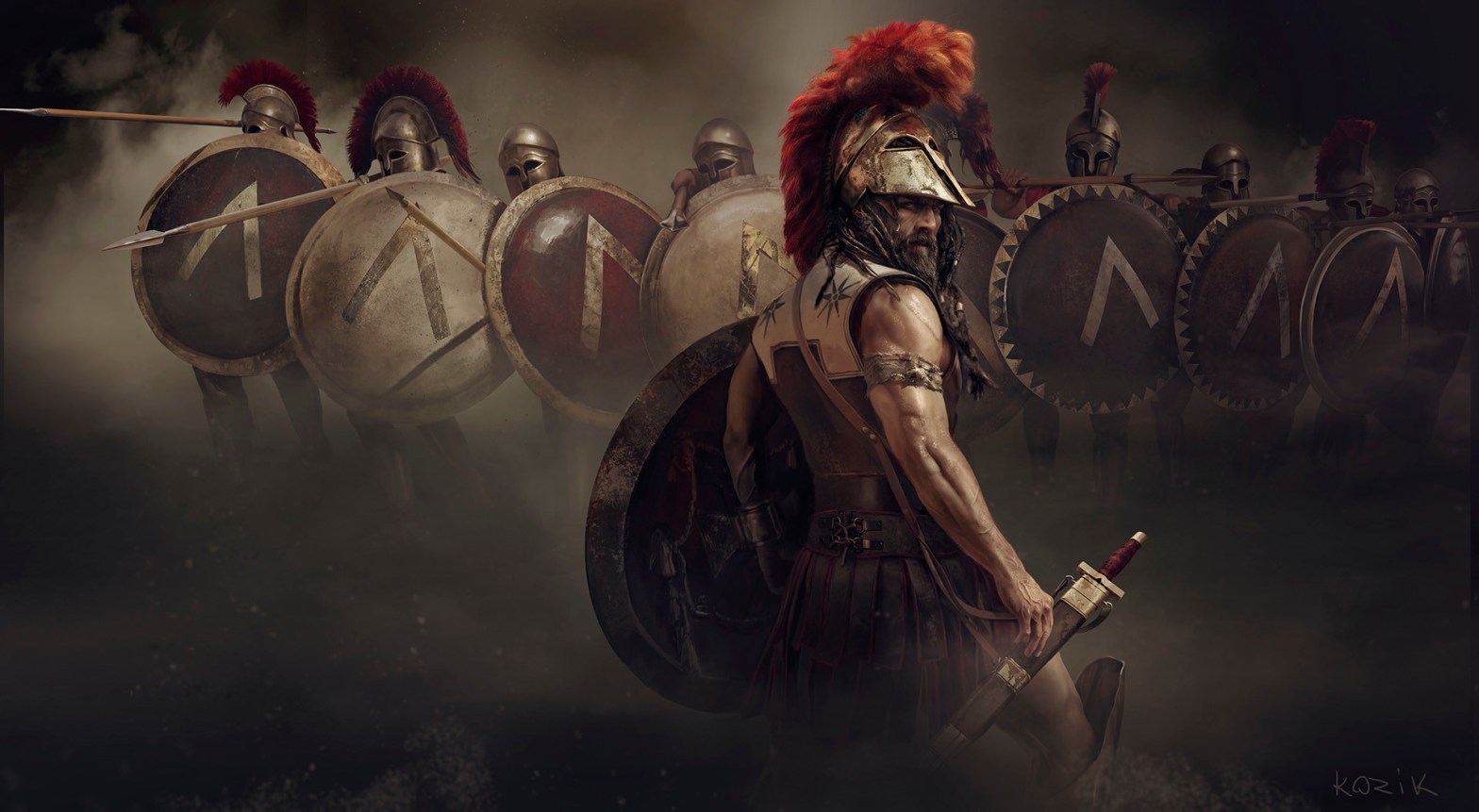
Lessons from the Roman Army for Post-SHTF Combat Operations- Small unit tactics are more than just a matter of either superior arms or numerical advantages

Alright, we have done a couple of articles on “Knowing Yourself,” and “Knowing Your Enemy.”  Now that everyone knows one another, let’s take it to another level.  As a single individual, as a family member, or operating in a group, after it hits the fan, you will have to fight eventually.  You will not be able to avoid it and hunker down until the cavalry comes, because it will be in your neighborhood and the cavalry isn’t coming to your rescue.

We’ve discussed “Fabian Tactics” in previous articles.  These were based on the exploits of Quintus Fabius Maximus in the First Punic War between Carthage and Rome. “Hit and Run” tactics exemplify their description: strike a numerically superior larger force at a time and place of your choosing, and then break contact.  Fade back into the forest, hide, and avoid further combat until the next engagement of your choice.

Guns have been referred to as “the great equalizer,” and there’s no weapon which can come close to them in that regard.

A lot of the popularity of firearms is due to the fact that anyone can use them effectively, not only the strong and agile. The young, the old, men, women and child can take up firearms in defense of home and family and do so effectively.

But what do you do if you can’t use a gun – or if you don’t have a gun — to protect yourself?

Lessons from the Roman Army for Post-SHTF Combat Operations

Let’s “fix” ‘em: set the enemy up and zap ‘em!  Let’s do a few things that the Romans were famous for…using these techniques here and now.

  1. Choose the Ground: Yes, you choose the place you will engage them.  Along with this, you pick the time of day, the formation of the attack, the objective, and the criteria for withdrawal.  You choose it.  As an individual, you would be sniping.  As a group (depending on your numbers and composition), you can engage in operations limited by your size.  Choosing the ground means also to actively recon the enemy and not allow him to choose it and catch you unawares.
  2. Prep the Ground: The Roman Army were masters of this task. They scouted the area and with thorough intel, they knew where their enemies were, actions these people planned on taking, and avenues of approach.  They cut timber and created obstacles of logs interlaced with natural “barbed wire” in the form of thorns and thistles…along with spikes and stakes, to limit enemy cavalry.  Long before William Wallace of “Braveheart” was ever a thought, the Roman legions spread out hay soaked with pitch and oil in areas where enemy foot soldiers would move, and applied flaming arrows when the time was right.  They always took the high ground when possible, and used the natural terrain features (cliffs, rivers, etc.) to form boundaries to help them channel the enemy.
  3. Always Fight with the Sun at your Back: The Romans positioned themselves and attacked to place the sun in the eyes of their enemies. I know, I know: the enemy has “Ray-Bans,” right?  No, it worked for the Viet Cong as well.  When they’re looking into the sun, they’re at a severe disadvantage.  Use the sun.  Use the terrain.  Live with the land and live.
  4. “SPECVLATORES”- the Speculatores…the deep-cover operatives…the Special Forces and Reconnaissance warriors of the Roman Empire. You need operatives in your “unit” with the ability to do “deep penetration” of an enemy’s defenses…whether in their midst unsuspectingly or observing them from a nearby locale…operating on their own ground unbeknownst to them.  You need one or two people who can get the job done…and provide you with the deep-cover intel you’ll need to make decisions.
  5. Alliances – “The enemy of my enemy is my friend.” Not always so, but you can use such rifts to your advantage…with other groups who your enemy is at odds with.  Here is where diplomacy, teamwork, and political acumen/savvy comes into play.  These “non-combat” skills are just as important to “fixing” your enemy as any of the actual missions you will undertake to defeat him.  Be skilled at making alliances, and do not make them just for the sake of socializing.  It is an art that we will cover more in-depth in future pieces.
  6. Feed Them Disinformation: Yes, the Romans were very adept at sending messages or planting information that was false. This regarded their strengths, their movements, supplies, and reinforcements.  Sun Tzu was not the only one with a knowledge of how to monopolize disinformation, and he wasn’t the first to employ it.
  7. Lure Them and “Stake” ‘Em – the Roman Army would plant different things out in front of an approaching enemy force in order to delay and distract them…making them ripe for an attack or ambush. You can do the same, and make it fall “in line” with the enemy you’ll be facing.  Quick question: How many of you have Russian or Chinese canned delicacies, such as Borscht or caviar for the former, or imported Chinese canned foods and fineries for the latter?  Because you may be able to use it to lure such if they ever come to this country…and set a trap on or in it, or place shooters in an overwatch position overlooking it.  Because you may need prisoners, and what better way to lure them in than with a carton of their own cigarettes, their own liquor that they would think to be safe?      Be advised: SAVE YOUR RECEIPTS FROM THE STORE YOU BOUGHT IT!  This is because in the times to come if anyone ever suspects you of collaborating with them…you can show the receipts that you bought it all long before the conflict began, and give them an explanation of why you bought it all.  This may keep you from being shot by your own countrymen.
  8. The Violence of Action in a Controlled Manner – the Romans did not win their mastery over all of Europe and most of the Middle East by conducting drill and ceremony. They were trained, skilled killers and understood that the thing that made the Empire possible was the discipline and aggression of the individual legionnaire.
  9. A Perfect Chain of Command – Modern militaries all have a chain of command and an order of succession for someone to fill the “vacancy” at all levels when a commander “buys the farm,” so to speak. You need to enable each member of your team to be able to step into the shoes and position of the leader and take charge to continue with the mission.
  10. Discipline: this encompasses all areas. A “guerrilla fighter,” whether fighting off marauders from a neighboring town post SHTF, or a tyrannical, oppressive government, or a foreign invader…the guerrilla needs to be disciplined.  Physical toughness, adherence to standard operating procedures (SOP’s), a cool head and iron nerves, and endurance…the ability to keep this up for years…to go the distance.  These are the things that the Romans kept focused upon and central to their legions for many centuries.

In conclusion, small unit tactics are more than just a matter of either superior arms or numerical advantages.  They are based on common sense and knowing how to plan out your objectives, as well as a plan of attack.  You will have to be the “David” going against the Goliath, and although not shirking from battle, picking the time and place of your engagement, and the conditions and standards you will set to achieve those objectives.  It is no guarantee of success, but you are guaranteed to perform better with the proper planning, training, and clarity of purpose prior to a battle.  It can mean the difference between success and failure, life or death.  In this vein, I highly encourage you to study more about the Roman Army and the warfare in ancient times.  Take the time to clean the tarnished pitcher and you may just find a silver piece made by Revere.  The knowledge is there: seek after it and make your future rather than just allowing it to happen to you.

You might be living in one of America’s deathzones and not have a clue about it
What if that were you? What would YOU do?

In the next few minutes, I’m going to show you the U.S. Nuclear Target map, where you’ll find out if you’re living in one of America’s Deathzones.

This image has an empty alt attribute; its file name is untitled-1.png

SHTF Preparedness: How to Mask Noise and Light Signatures- In a true shtf event, you must exercise noise and light discipline in order to avoid being obsequious and potentially to evade a pursuer. Here is all you need to know to gain insight into these shtf skills.

This article is an introduction on how to mask the signatures of light and noise that are given off if not controlled.  We are talking primarily about a scenario taking place in the forest, but the techniques can also be applied to an urban setting.  The tougher one of the two to overcome is the noise; however, each poses a challenge that if not handled can lead to a problem when you wish to remain incognito in the field.

How to Diffuse Light in SHTF Environments

First let’s deal with light.  The reason light poses a problem is we need light to see optimally, but in using it at night, the light can be seen by others, giving our position away.  Flashlights and any kind of hand-held lantern, battery powered or otherwise are the main problems here.  There are a few simple ways to cut down on these signatures, and all of them take practice.

  1. No white lenses with movement: you need to obtain a red lens for your flashlight. This will not defeat NVD’s (night vision devices), but it will cut down on being compromised by the unwanted naked eye considerably.
  2. When using the flashlight, cover it up: preferably a poncho over top of yourself and the flashlight, to perform whatever task you need to accomplish when moving at night, such as checking your position on the map, or fooling with equipment of some kind. Keep that light covered.
  3. Adjust your eyes and learn to move in the dark without a flashlight: this will take some practice, and some people may not have the night vision abilities to perform it, especially those with eye problems. For everyone else, practice makes perfect.  Most nights have a little illumination and are not pitch dark (except for the New Moon and a day before and after).
  4. Smokers: you must hide the signature of the end of your cigarette. Through NVD’s it appears to be a flare going off from a distance.  Either cup it within your hands, or inside of an aluminum pouch, such as found with MRE’s (Meal Ready to Eat).  When you light that cigarette you also tend to give off a big signature.  Best thing I can tell you is to quit smoking and really nip it in the bud.  Not to mention the fact that you can smell a cigarette from several hundred feet away.

How to Minimize Noise Levels in Dangerous Situations

Noise is an entirely different animal.  We make noise as we walk.  We can’t help it.

What we can do, however, is control the amount of noise we make…and reduce the amount that would give away our position.  You must practice noise discipline in order to perfect it!  Looking where you walk and where you take your next step is key.  Be keenly observant of where you are moving and through what.  Are you facing a large area covered in dry leaves, with dry weather?  Are there dried branches and twigs strewn all over the place?

How about sticker bushes and nettles in the summertime?  If you’re not crushing them underfoot, how about if one of them whips you across the face?  Unless you are prepared to take the pain of it, you may yell, curse, or cry out.  You should practice moving through all of these different types of substances.  In addition, how about the noise made just as a consequence of your movement?

Many people carry so much stuff, such as keys, change in their pockets, etc., that they mimic a tambourine when they walk.  Let’s not forget our happy, singing, laughing, chirping tracking devices…our cell phones.  Your cell phones: I don’t use one.  You can believe when Uncle Ed tries to reach you or you get a call from Gram-gram, or some other family member, and you’re out in the woods?  The whole world (animal, vegetable, and human) will hear that ringtone.  Clattering gear that is rattling around, the sounds of trampled branches and vegetation, the occasional grunt in fatigue or pain…all of these will give you away.

Any and all of your rattling gear needs to be silenced.  Everything that is loose must be tied down and secured.  This is not just prudent: this is survival.  “What is the situation?” you may ask.

The situation is anything: our happy “Betty Crocker/Holly Hobby” society can change with the blink of an eye into “The Road” by Cormac McCarthy.

Choose the situation.  The situation is unimportant.  What is important here is that you ensure noise and light discipline in order to avoid being obsequious and potentially to evade a pursuer.  Practice walking at night in the woods, and listen to yourself.  When you’re stationary, practice listening to the things that are around you.  If you’re patient and open your eyes, ears, and mind, the woods will come alive for you. Your senses will experience what your normal Western-Consumer marketing environment deadens them to.

Learn to pace yourself by the amount of noise you make and also practice leaving fewer tracks and/or a trail.  Practice negotiating close (thickly-vegetated) terrain and making as little noise as possible.  Skills need practice in order to master them.  Now that the weather is warming up, try some training that won’t cost you anything except time and effort to master these skills.  JJ out!

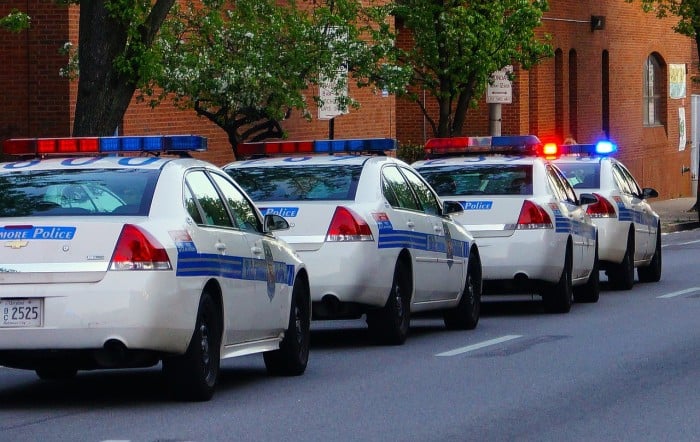
How Will FEMA and the Government Handle SHTF? (Only by knowing what to expect will you be able to properly react, no matter what the situation is.)

Preppers spend a lot of time figuring out what they’re going to do when the SHTF, where they’re going to go, how they’re going to get there, what they’ll take with them and who, hopefully, will be there waiting for them.

When disaster strikes, and I mean real disaster, you had better have your affairs in order. A real crisis will quickly separate the prepping rockstars from the groupies.

Also just as important, some preppers invest a lot of time trying to figure out what the government and FEMA in particular are going to do during the same SHTF event. This is not the idle speculation of enthusiastic conspiracy theorists.

The declaring of any state of emergency at the federal and even down to the state level grants the government certain extraordinary powers, and also curtails some of your rights as codified by the Constitution of the United States.

Every prepper should know what to expect out of the government response to a major disaster or crisis.

In this article, we will attempt to cut through some of the static and noise surrounding the issue, and give you just the facts so you can better plan your own response based on what Big Brother will be up to during the same event.

The ‘S’ Has Truly Hit the Fan: Understanding a State of Emergency Declaration

Every prepper is familiar with the acronym ‘SHTF’, meaning, colorfully, that “s*** hits the fan.

This is prepper shorthand in the survival vernacular that simply means something has happened which causes your emergency survival plan to activate. It is a sort of Line in the Sand Event- “Toto, we aren’t in Kansas anymore.”

Of course you won’t catch government agencies using that sort of breezy language, no matter how succinct it is. What we call an SHTF event the government will simply call, in their dry and bland way, a state of emergency.

When a state of emergency is declared at the state or federal level that opens up the door for extraordinary government powers to engage.

The effects of a state of emergency being declared are far-reaching and though I know we do not see many abuses here in the United States, at least not yet, there are some very worrisome passages in the law regarding it.

A state of emergency is defined as a situation in which the pertinent governmental body is empowered to authorize and perform actions that would not normally be permitted under its charter.

What does that mean? Well, for you, it means the government will be wielding extrajudicial authority; the ability to temporarily or for the duration of a crisis suspended the civil rights of citizens, and curtail other freedoms normally guaranteed.

When a state of emergency is officially declared, citizens are supposed to be alerted and notified of what they can expect from the governmental body handling the crisis.

This will naturally come with a set of new rules, regulations and guidelines for what you can and cannot do during the state of emergency.

It is important to note that a state of emergency is not martial law; the two are not synonymous. That being said, a state of emergency is almost always a prerequisite for martial law and the two go together like fish and chips.

You can rest assured that in the truly cataclysmic events that see a state of emergency declared, natural or man-made, martial law will probably follow close behind.

What Powers Does the Government Have Under a SoE?

This is the part that most often, rightly, worries concerned citizens.

While a state of emergency does not necessarily mean a society toppling event has occurred- after all, the mayor of a town can declare a state of emergency and seek aid from the state government if he chooses.

it does mean that the government will be able to flex their muscles more than usual to get things done.

Let’s leave all the local yokel stuff behind for a moment. Most preppers are concerned about a sweeping national-level state of emergency and what that will entail for citizens.

I have some bad news for you, reader. Are you ready for it? As of the year 2020 there are currently more than 30 federal-level, independent states of emergency in effect.

It’s true. Many of these concern themselves with the halting of nuclear weapons proliferation among hostile nations, debarring of hostile governments from accessing their property in the United States and of course a general, heightened alert status as a result of ongoing terror attacks.

Well, that must not be so bad then, right? Maybe, maybe not. At the federal level, the president of the United States only needs his own executive order to authorize a national-level state of emergency.

This is not unchecked, as more than 500 laws curbing and regulating the government’s power will engage when that happens, but it does grant the president several unique abilities including allowing him to declare war without Congressional approval.

Some other provisions are equally scary. Most egregious of all and the one you will hear interested parties quote the most when discussing government overreach and power run amok is that a declared state of emergency effectively lets the government suspended habeas corpus for the citizenry if they choose.

In case you’re legal Latin is a little rusty, habeas corpus means that the government could imprison you without having you brought into court first and formally charged.

It is this more than anything else that fuels fears of mass incarceration with no probable cause or even official court proceedings should the government decide to turn on its citizens.

State of Emergency Declared: What Happens Next?

Let’s say for whatever reason, a state of emergency has been declared by a local mayor, a state governor or even the president of the United States himself- The Big Cheese.

This will be done when the governing authority determines that whatever natural or man-made disaster has occurred has done enough damage or will strain logistics enough that they think it is a good idea to call in the cavalry.

This is usually only done when a lack of resources or manpower would result in additional loss of life or ongoing damage in a persistent event. As a rule, most states of emergency get declared to make resources available to the governing party faster and nothing more.

But there’s a catch. A declaration of a state of emergency will help more resources get into the affected area quicker, resources that will typically provide medical care, evacuation and food to victims…

It also allows the government party that issued a state of emergency to close governmental offices in their jurisdiction, curtail freedom of movement, employ curfews and even, most radically, put a hard-stop on the sale of commodities among citizens.

All that applies at the state and local level. If you were to be living under a federal state of emergency, all of the above applies but the federal government will also be able to legally summon the militia, freeze assets as it sees fit, completely halt trade and seize private property.

I already mentioned the suspension of habeas corpus above. What’s worse, federally declared states of emergency can last for years, even decades.

Everyone alive today is familiar with the states of emergency declared in the immediate aftermath of the September 11th attacks; they are all, almost without exception, in force to this very day.

Timeline of a Declared State of Emergency

Governments at the state and federal level will follow a sort of playbook when state of emergency is declared. If you know the scope of the disaster that has affected your state or area, you can better predict when and what the federal government will do.

Step 1: Disaster Occurs, Preliminary Disaster Report Ordered by Governor.

The president of the United States will only provide aid and assistance to the state government after the governor of that state has officially requested it.

Note that a state governor does not have to wait for a disaster to strike before submitting a preliminary disaster report; if a disaster looks bad enough on the approach they might submit it early, allowing the federal government to declare a state of emergency ahead of time.

Step 2: Local or State Government Reacts to Disaster.

At this time, state and local governments will begin coordinating rescue and response efforts at the local level.

The entire time, the breadth and extent of the damage is being assessed to determine if more federal assistance will be required. Any local or state level disaster preparedness plans might be enacted depending on the nature of the disaster.

Step 3: State of Emergency Declared, FEMA Activated.

After the state governor requests aid from the President, the President will declare a state of emergency and activate FEMA, who will then deploy to the site of or area around the incident as quickly as possible.

The immediate near-term goal of FEMA is to provide relief to anyone and everyone who has been affected by the disaster, as well as better ascertain the scope of the issue.

Step 4: FEMA Makes Determination on Implementation of Federal Response Plan.

There is a crucial fork in the road before state-level and local governments can gain access to Federal funding and more resources.

FEMA must make the determination that the disaster and its effects are so severe there’s no way local and state-level governments can deal with the situation of their own volition.

If that is the case, FEMA will implement the FRP, or Federal Response Plan, which will authorize the state to work with FEMA to gain access to the mentioned Federal resources.

Step 5: Federal Funding Expedited to State and Local Level Governments, FEMA requisitions additional federal agencies.

At this point the president will be able to channel funds directly to state and local level governments in order to help with anything they see fit.

It is at this time that FEMA will begin requisitioning a couple of dozen federal agencies and smaller departments in order to start getting a handle on a disaster.

Note that anytime the federal government declares a state of emergency at a state or local level you can take this as a surefire indicator the disaster is quite severe and almost completely beyond the abilities of local and state governments to mitigate on their own.

Interestingly, the President also has the authority to provide assistance to privatized relief efforts as well as public sector ones.

Step 6: Additional Federal Assistance Deployed. The federal government will make available for the duration of the crisis loans, federal grants, specialist personnel, supplies and equipment that may be necessary for rescue, relief and mitigation efforts in the aftermath of the disaster.

For most disasters, the federal government will focus on providing the technical assistance necessary to shore up state and local level operations.

Remember that all of the above can actually take place prior to the onset of a disaster, if it is something big and slow moving like a hurricane that you can see coming and prepare for several days or even a week in advance.

This might have significant second- and third-order effects if the federal government acts rashly and forcefully in advance of an approaching disaster.

What about Martial Law?

Martial law could be implemented on the backside of any state of emergency declaration, and if that happens the legal landscape is going to change for you, and in a big way.

Martial law is the military assumption of control over civilian law enforcement and government functions. That means that military law and order will now apply to you and the rest of the citizenry for the duration.

You will be expected to obey and subject to the authority of any military personnel involved , and can expect searches, checkpoints and other regimented methods of control for access and movement.

If you are detained and formally charged with a crime (assuming you are not detained indefinitely without benefit of habeas corpus as described above) you will be subject to a military tribunal for all proceedings, not a typical civilian court.

At best under martial law, you can expect typical policing functions of government to be replaced by military equivalents. In theory, this will be no more obstructive or intrusive than a typical day.

At its worst, however, you will be subject to invasive inspections, searches and plenty of hoop-jumping in order to get through your day. It is not out of the question that citizens will be confined to their homes, all other considerations secondary.

When martial law is declared, you can “temporarily” say bye-bye to the following civil rights. Remember, reader, that there is nothing so permanent as a temporary government initiative:

  • 1st Amendment – Freedom of Speech, Assembly and the Press
  • 2nd Amendment – The Right to Keep and Bear Arms
  • 3rd Amendment – Freedom from Housing Soldiers
  • 4th Amendment – Protection from Unreasonable Search and Seizure
  • 5th Amendment – Protection of Life, Liberty and Property

The declaration of martial law is a rarity in the United States, and anytime you hear it done you can be sure you will be dealing with a big problem.

Federal Response to SHTF and You

Knowing what you know now after reading all the above and seeing the typical state level and federal response to various disasters when a state of emergency is declared, you might think it is a bit fantastical to believe that the federal government would choose to abuse its power under such circumstances.

Well, reader, if history teaches us anything it is that the inevitable outcome of government accumulation of power is abuse. It might not happen this year, or next, but it is as inevitable as a rising and setting of the sun.

Remind yourself that the broadest possible use of any declared state of emergency and the accompanying powers on the federal level is for the government to restore order.

In tandem with extraordinary powers granted by a declared state of emergency.

This could allow our government and government agents to imprison en masse anyone who they saw as agitators, political partisans, domestic terrorists or any other political buzzword that the government slaps on people who make life inconvenient for them.

This will all be couched under the auspices of police action and keeping the peace.

At the minimum, if things start to get out of hand and the feds have declared a state of emergency you can expect the following mandates to be implemented and enforced at the local level:

  • Government-mandated fixing of prices for various goods and commodities. This will be done under the auspices of eliminating scalping and price gouging.
  • Federal forces may be mobilized to confiscate property, supplies and equipment from citizens in order to assist with emergency relief efforts.
  • Citizens themselves may be conscripted in order to provide manpower for federal government initiatives.
  • Curfews will be put into place, widespread and strictly enforced.
  • Citizens may be relocated at the whim of the government with no say-so in where they are heading. This will be carried out by force if necessary.
  • Federal government is likely to institute hard bans on travel in, around and even potentially out of areas affected under the umbrella of the state of emergency.

All of the above paints a pretty grim picture by itself. But it gets worse. Oh yes, reader, it can always get worse.

During a declared state of emergency, the federal government and all of its agents or any others conscripted to act on its behalf are completely exempt from all civil liability.

Read that again and let it sink in. If that does not make your stomach turn with the possibilities of abuse, then I don’t know what will.

That’s what makes some folks who don’t trust governments so wary of investing the federal government with emergency powers to assist with local issues.

As a prepper, you should never, ever outsource your safety to anyone else, including the supposedly benevolent federal government.

You can never get lazy, trust that someone else is handling it, or believe that the authorities will have the situation sewn up as neatly and as equitably as you pleas once they come on the scene.

History has furnished us with too many examples of simple human errors in judgment and lapses in critical thinking resulting in near atrocity for the people affected.

Do not be lulled into a complacent state by the presence of any uniformed officials sent by the government. You must always be putting in work to achieve a positive outcome when disaster strikes.

Conclusion

The federal government relies on clearly established procedures for declaring and implementing a state of emergency at the national or local level.

Knowing these procedures, and the timing thereof, can give you a leg up on the situation prior to the arrival of federal aid and agents.

It will also pay to know what extraordinary powers the federal government is granted during a declared state of emergency, and how these will curtail your own rights.

Only by knowing what to expect will you be able to properly react, no matter what the situation is.
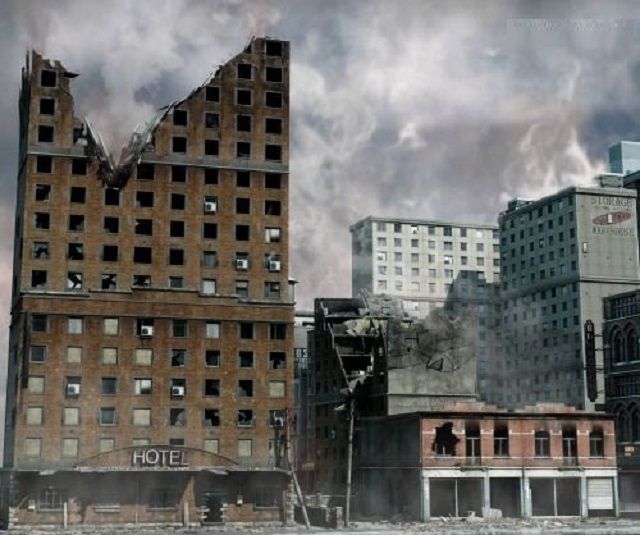

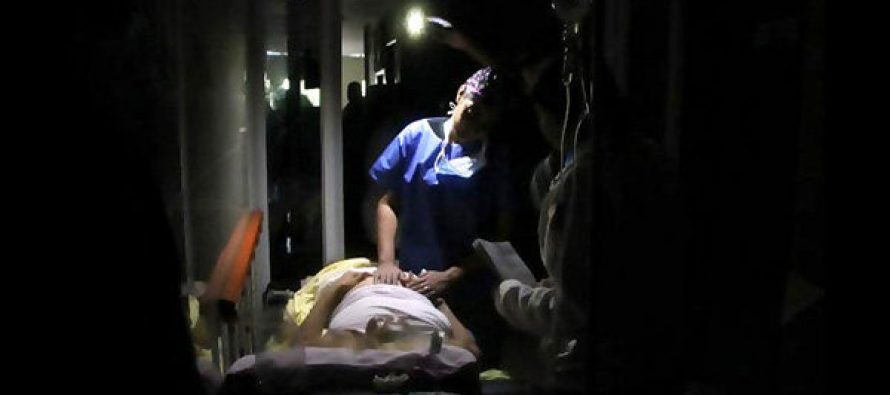
I Lived In A Post-SHTF World For 3 Years, And This Is What I Learned

As a professional physician having always lived in a big city, I never imagined that at some point in my life, the social and economic situation of my country, Venezuela, would lead me to learn and use survival skills that I had read about but never even thought of applying.

Without being in a declared war or a formal armed conflict, we have experienced different situations of chaos for about 10 years in Venezuela. But in the last three years, the country has become a true SHTF scenario, where the only way to move forward is to learn how to survive.

I feel that the lack of food, clean water, and, at the lowest point of the situation, electricity, has given me new skills that have undoubtedly prepared me for any catastrophic situation.

After three years in this contingency, I can now share every situation that took me by surprise and the techniques I had to learn by doing.

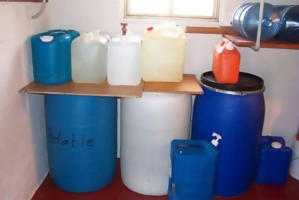
There is no such thing as “too much” stored water

I Lived In A Post-SHTF World For 3 Years And This Is What I Learned

Water is one of the most important resources we need for life. Unlike other supplies, it is not interchangeable with another product, and to be ingested, it must go through a purification process.

I have never been prepared for a water shortage before. Now I know it is important to keep water stored safely in closed containers. If water is not drinkable, it must be purified before ingesting it since contaminated water can cause serious gastrointestinal diseases.

Water is not just for drinking but is used in many other activities, such as cooking and cleaning, so I had to learn some purification techniques that can be done at home.

One of the most popular techniques to decontaminate water is to boil it for three minutes. Purification tablets are also very useful, not that expensive, and easy to use.

Adding five drops of chlorine per liter of water as an emergency measure is another way to clean the stored water.

Grains are my friends

To eat properly, it is necessary to consume proteins, fats, and carbohydrates.

The moment I realized that animal protein was scarce—in addition to the fact that the electricity problems spoiled it—I had to investigate the nutritional content of other foods in order to keep myself well-fed.

Lentils are grains that are easy to store, non-perishable, and high in protein. Together with a cereal like rice, they make a complete meal that keeps us well-nourished and in good health.

Let there be light: candles, matches, flashlights, and batteries

I Lived In A Post-SHTF World For 3 Years And This Is What I Learned

After spending more than four hours without power, I began to worry. I had some candles saved, but I did not know where they could be. I also had a couple of flashlights, but I had removed the batteries to prevent them from being sulfated.

Candles and matches must be in several easily accessible places. Likewise, the batteries should be in the same place where the flashlights are kept, and we must be sure that they have a charge.

During this year, the country suffered the most serious electrical crisis. In several areas, there were blackouts of up to five days.

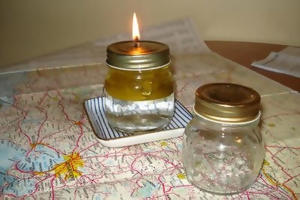
After a couple of days without electricity, the candles will not be enough, so learning to make oil lamps becomes a vital skill in this situation.

The lack of electricity can lead to a state of anguish that grows with the passage of time. It is important to do everything possible to minimize that effect.

Be prepared with medicines, but it’s better to learn from nature

Due to my profession, I am always very attentive about keeping basic medications, such as anti-inflammatories, analgesics, and antibiotics, in the cabinet.

When I had to live in an SHTF situation, my medical supplies became insufficient, and I couldn’t find any in the pharmacies or they were too expensive. So I had to learn a little more about natural medicine, its uses, and its benefits.

I must say that this is one of the most important things I learned during that time.

Many anti-inflammatory drugs and synthetic analgesics damage the stomach mucosa as a side effect. In situations of stress, there is a large production of acids in the stomach, so using drugs that further damage this organ is not the best idea.

Roots such as ginger and turmeric are excellent anti-inflammatories. They are easy to get and easy to store. Likewise, garlic is a potent analgesic.

In the case of presenting wounds or cuts and not having antibiotic ointments, honey, ginger, and cloves are foods that have scientifically proven antibiotic properties.

Chamomile and lavender are natural relaxants and help fight stress and insomnia.

No matter how big the supply of medicines we have, it will always be more economical, favorable, and easy to store the natural product, with equal and, in some cases, greater effects.

Cash

Banks have made life easier for us with the use of debit and credit cards. However, there are situations in which having a lot of money in the bank does not help much, and I learned it the hard way.

When there is an electrical fault, despite the fact that light and other electrical services have been restored already, the digital communication of the points of purchase become so affected that it is impossible to buy anything in this way.

For this reason, I understood that it is always important to keep some amount of cash for this type of contingency.

Take advantage of any time you get to replace supplies

I Lived In A Post-SHTF World For 3 Years And This Is What I Learned

Although during those years I did not have to be locked in a bunker without being able to leave, the feeling of confinement was quite similar. When, in spite of having the money, you can’t find what you need to eat or, despite having a private vehicle, you can’t move for lack of gasoline, the situation becomes desperate.I understood that in those moments in which there was an opportunity to replace the supplies I had at home, especially water and non-perishable food, I had to do it.

The situation in my country has improved. Although still not at the best economic and social level, and with many problems of scarcity and lack of some supplies, society has been regularized.

However, I appreciate the years that taught me these valuable lessons that I still apply.

The most important thing I learned was to be prepared for when an SHTF situation strikes again.

Best Bug Out Vehicle: 7 SHTF Vehicles for Sale- When it comes to sh-t hits the fan scenarios, whether it be a plague, nuclear attack, natural disaster or the next pandemic, it’s a lot easier to cruise to your safe haven that is 100 miles away than it is to walk there

You are stuck in an urban collapse and all you can think is “I gotta get outta dodge”.

When it comes to sh-t hits the fan scenarios, whether it be a plague, nuclear attack, natural disaster or the next pandemic, it’s a lot easier to cruise to your safe haven that is 100 miles away than it is to walk there. In this circumstance, you are going to need a reliable and efficient bug out vehicle.

There has long been talk of what bug out vehicles are. Some might have a more romantic view of the world and picture a diesel loaded four-wheel-drive dune buggy complete with exterior spikes and the rest of the apocalyptic decor that you would see on the standard Mad Max vehicle. Other bug out vehicle designs are more practical, because when we’re looking at a vehicle that’s going to save our necks and get us out of trouble, we need something that’s reliable, fuel efficient, able to fit our supplies, that blends in, is low in maintenance and won’t leave you broke.

As much as we would all enjoy looking at wasteland designs to find the best apocalyptic rover, this list is going to consist of the real bug out vehicles that you can get, on a budget, and what to look out for if you are in the market for not only a bug out vehicle but a vehicle that you can take to enjoy the outdoors, and still blend in the urban environment. Essentially, I hope for this piece to act as a buyer’s guide for those shopping around for a second-hand vehicle that you can turn into a practical and affordable multipurpose ‘get out of dodge’ vehicle.

What is a bug out vehicle?

There are a lot of different shapes, sizes and makes to describe what a bug out vehicle is, but what it isn’t is a Ferrari sports car. Instead, if you have ever been to a farm you will notice that most have that one vehicle that has been lasted for tens of years and has been used to carry things, to chase things, to pull things and to drive over a lot of difficult terrain. On top of that, it’s this sort of vehicle that is reliable because it has simple parts that can be replaced in an instant, and doesn’t take a rocket scientist to actually fix. That’s what a bug out vehicle is.

The use of a bug out vehicle is simple. It’s the transport you can rely upon to get you and your family to safety when the SHTF. More simply put, it’s a vehicle to bug out with. Although we might have this vehicle, not all circumstances require us to bug out, and if you haven’t already got the prepper basics sorted for when the SHTF, you might need to organize that before you start considering a bug out vehicle.

Of course, when you get to the point where you are choosing bug out locations, forming a bug out plan, and coordinating rendezvous points and default actions for you and your community, you are definitely going to need to choose a vehicle that is sturdy, reliable and will last. So let’s take a look at what we need in a bug out vehicle.

What are the things we need to look for in a bug out vehicle?

Considering its purpose, the bug out vehicle isn’t any normal vehicle. Not only should it be reliable and easy to fix, but it should be able to keep you and your family safe, should there be any imminent threat. Because we are using this type of vehicle to both get out of the city and urban areas, and then to be effective in its operation as an end-of-the-world vehicle, there are certain characteristics that makes a bug out vehicle a certain breed.

The things you need to look out for when choosing a bug out vehicle are:

Low maintenance – Having a low maintenance vehicle is important when it breaks down as you will be able to fix it yourself, or will easily find someone that has enough experience to lend a hand and get it working again. This also means that it has readily available parts, should you need them. For most people, buying a bug out vehicle will be in the form of a second-hand buy which may require some replacements before it is reliable. Do the work in advance and find out if you can get the parts at local retailers. If they are widely available then that saves you the money and the time to get that part.

Being low maintenance also means choosing a vehicle with limited electrics, especially if you are concerned about having your car hacked, as you can see in this video on a hacker remotely hacking and shutting down a Jeep on the highway.

Fuel-efficient – Depending on the event you may need to bug out over quite some distance without stopping at any fuel stations (which will either be full or closed), so you need something that has a good gas mileage.

Space – Always have more space than less. With the way family vehicles have been developed, there are options that fit the bug out vehicle’s characteristics. Even if you are a lonesome prepper, there’s no telling who you might meet when you bug out, or what friend might call you saying “I know you’re into survival, do you have a plan?” – this will happen. At this point you can choose to be a hero or continue on your way to safety, your call. Having that space will also help for when you come across any extra supplies you might want to pick up.

For the number of people you are traveling with, size of an issue. Sure if you are just one person, a four-seater vehicle is perfect. But when you are a full family, the space will be quickly filled with bug out bags, water, food and other supplies. You need to have a rough idea of how much space you need, plus extra, when shopping around.

Speed – We’re not entering the Grand Prix with this thing but it can’t be slow. Some military trucks are known for this. They are efficient at crossing a variety of terrain and can carry big loads, but they’re essentially turtles on the road. You need something a bit faster.

Noise – Sure, it’s nice to have a loud car if you want the attention with a sports car or a nice loud easy rider motorbike when you are roaring down the street, but they are also vehicles that can be heard from miles away and through thickets of trees. Anyone in a 5-mile radius is going to be easily able to find your bug out location, and they’re also going to be able to hear when you leave so that they can raid your food, water and ammunition supplies. Having something more inconspicuous is tough, I know, but it helps when you are trying to be a little more covert.

All-terrain – No matter what you are preparing for, there may be a chance where you will need to go off-road, through different terrain and through various types of weather. It comes with no surprise that you need a vehicle capable of traversing different terrain environments, and for many preppers and survivalists, this is why the bug out vehicle is generally the vehicle you use when you go camping and 4WD’ing through the outdoors. Don’t get me wrong, as soon as you start bugging out you’re not going off-road straight away, but as many bug out locations will be located in regional areas, and supply caches might be outdoors, you are going to need a vehicle that can work in those environments.

7 best bug out vehicles for when the SHTF

So we have a list of things we need in a vehicle, but what on earth fits that specific type? These vehicles are not meant to break the bank, so that should you look into starting a project bug out vehicle, you can instead be a little more budget-savvy with your vehicle, and in-turn, have an extra amount to spend on extras that would make good additions to the vehicle, or any necessary repairs that need to be made if you are purchasing your bug out vehicle as a second-hand car.

So let’s take a look at the most suitable bug out vehicles with what we identified above:

Mercedes G-Wagon – These vehicles are beasts. This is why they are used by a number of militaries around the world. There are several models of the Mercedez Benz G-Wagon. The more modern versions of the car are a more luxury 4WD made for city environments. There are two G-Wagons that make great bug out vehicles. The first is the classic 1980s and 90s G-Wagon. They’re simple in their design and parts and have been described as workhorses of the countryside. The 80s original G-Wagon has no electronics in the engine and with its back side seating, can seat up to seven people. If you take a good look around car sales sites, you can find one of these for a bargain.

The more modern type of G-Wagon, and one that I have used in the military, is a rigid vehicle capable of driving through any terrain and is highly customizable. The problem is with the G-Wagon it is a bit more of a fuel guzzler than the average SUV, with its fuel usage at an average of 13mpg in the city and 14mpg on the highways.

bug out vehicle g-wagen

Jeep – The Jeep Wrangler series is a very customizable 4×4 city that performs well as an urban everyday drive vehicle as well out in the wilderness. One of the things a lot of outdoors goers love about the Jeep is its capacity to pack a lot of weight. That extra cargo space is important when considering bugging out as you will need to carry supplies with you, and for the duration of your bug out period. That is of course, unless you haven’t already cached a supply at your bug out location. The fuel usage on these is for a 2014 3.6L model is 17mpg in the city and 21mpg on the highways.

bug out vehicle jeep wrangler

Humvee – The Humvee is another military service vehicle that has never failed to impress in its operation, as well as carriage and hauling power. While some of the newer models of the Humvee are more for the preppers’ ‘dream’ budget, the 1998-2001 models, both surplus, and civilian, are more affordable with people snagging these up for $20,000-$30,000 for ex-service models. There are some auction sites where survivalists have scored themselves a lucky win of $10,000 for a Hummer, so it pays to shop around, especially when you’re looking for these types of timeless vehicles. The fuel usage on these is for a 2006 3.5L model is 14mpg in the city and 18mpg on the highways.

bug out vehicle humvee

Ford 4×4 F-Series – Everyone knows someone that owns an F-Series truck. Whether it be an F350, 250 or even a 150, they’ve all got the power, space, and functionality for any family to be safely moved from point A to point B. These trucks are common on American roads as they are reliable and are pretty fuel efficient for the power that they have. There is a reason why worksite carparks are full of series vehicles, they are a big, powerful, affordable, family truck with a big tank, enough storage space in the back for jerry cans, and if you need it to, it can tow big objects. The fuel usage on a an150 5L is 15mpg in the city and 22mpg on the highways.

bug out vehicle f150

RAM Outdoorsman – These beasts are such a budget vehicle with many second-hand options available for under $20,000 and needs very little work to maintain. Any type of RAM truck is useful as a bug out vehicle. The Outdoorsman is a good bug out vehicle for its big amount of space with a flatbed trailer, and the ability to easily tow a trailer as well (be it a horse float packed with supplies or a pop-up camper trailer. These vehicles are also very suitable as a day car, as they are fuel efficient and spacious for everyday use. The fuel usage on these is for a 5.7L is 18mpg in the city and 25mpg on the highways.

bug out vehicle dodge

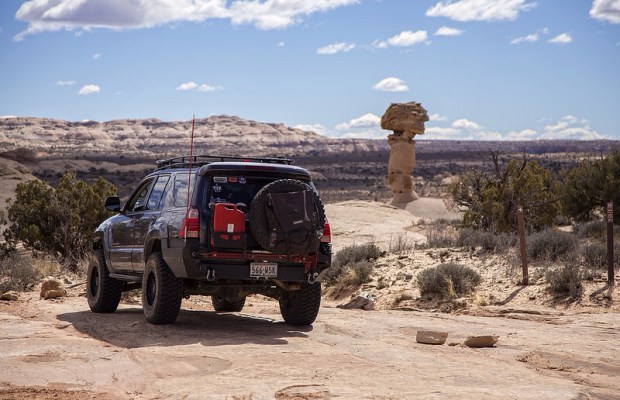
Toyota 4Runner – Toyota is one of the most popular vehicle makers for campers and outdoors lovers, and one of its outdoors favorites is the 4Runner. That suits us when we’re looking for a bug out vehicle because we’re after the same thing, a reliable vehicle for the outdoors. Out of all of these vehicles, I’d choose the 4Runner as there are a few very attractive options it comes with for such a low price of under $40,000. First, it fits seven people on board, which when you’re packing supplies, is much-needed extra space. When you fold the back seats down you also have a huge amount of cargo space, as well as on the top of the roof racks (which you can do with all of these vehicles). The fuel rate for the 4Runner is at an average for these SUVs at about 17mpg in the city, and 21mpg on the highway.

bug out vehicle toyota

Toyota Tacoma – The Tacoma is another one of Toyota’s great outdoors SUVs but comes with a few different specifications. Where the 4Runner is a more family-based vehicle, the Tacoma is more of a power-based vehicle to be used to tow things, carry a lot, and do more over difficult terrain. I like the Tacoma quite a lot, especially because even though it is quite similar to the 4Runner, it is several thousand dollars cheaper in average pricing, and it has the benefit of a more fuel-efficient system with a 19mpg for city areas and a 24mpg for highways.

bug out vehicle tacoma

Best bug out vehicle accessories

Just getting one of these vehicles on its own is a big step in your bug out plans. All of them fit the needs we have when we are bugging out as they are have the size we need to pack supplies, gear and fit our loved ones in, they are able to perform well off-road, should we need it to, and they’re fuel efficient and budget options for bug out vehicles. But when you do get a bug out vehicle, there might be some additions you want to consider to really perform the duties that a bug out vehicle needs to. This would include great survival tires, which you can find comparisons on Auto Clown. After all, we’re planning on using this vehicle when the SHTF, and whatever that might be, some of these things are going to come in handy.

Lightbars and work lights: having bright LED working flood lights on the side and the back of your vehicle are going to help a lot. There may be situations where instead of bugging out, you might want to provide a helping hand to a nearby town, or your local area, whether it be after a horrible storm or the much-needed repair and assistance after a flood. As some of these incidents can cause blackouts, having working lights for evening work on the side and rear of your bug out vehicle turns it into a workstation. That, and when you are outdoors and are setting up camp or at your bug out location, these lights give you the chance to have an all-around visibility to ensure the area is clear, and to allow you to see your surrounding area to set up camp at night. A good option for work lights on your bug out vehicle is Lite-Way’s Cree LED lights, and Yitamotor’s light bar.

bug out vehicle gear

Roofracks – Of course, anything you can do for extra storage space is going to help. Every good bug out vehicle should have roof racks. They’re the perfect way to store extra water jerries, solar panel systems, containers with food supplies or extra fuel. Whatever you are packing consider if you need it on the trip, or whether it’s to use when you arrive at your bug out location. If it is to use when you arrive, pop it on the roof so that you have more space inside your bug out vehicle. Having steady roof racks with a hard surface can also be used to implement a popup tent that you can climb up into and be off the ground.

rooftop tent bugout

Storage tanks – If you are bugging out, you are going to need some supplies. As for most of us, staying in the home is the most favorable option. When you do bug out, you’re going to have to take a lot of supplies with you, and most of it is going to be food, water, and fuel. When it comes to water and fuel, some basic additions you should make to your bug out vehicle are jerry cans. Most decent jerry cans can be picked up from army surplus areas, or you can buy them new. They should be clearly marked either ‘water’ or ‘fuel’ so as to not confuse their contents.

bug out gear
shtf vehicle gear

In-car organizers – Okay, so this isn’t absolutely necessary, but if you are like me and you’re love having everything organized well, these Smittybilt tactical front seat covers are the perfect thing to use in your bug out vehicle. Even if you don’t carry a firearm, these in-car organizers are for your outdoor tools, survival gear, first aid equipment, knives, communications accessories and snack bars for the family and yourself for while you are traveling. 

Over to you…

Bug out vehicles are a certain breed, but when you get one, it doesn’t just mean its purpose is for when the SHTF. For me, I am an outdoors regular as I enjoy camping, hiking and exploring the outdoors, and when I first chose a vehicle for that purpose I was not even thinking of a bug out vehicle. So as you can see, the two go hand-in-hand, and whether you are a hunting enthusiast, into fishing, or just love the outdoors like me, one of these vehicles will give you everything you need to do that, as well as to act as a bug out vehicle, should the need arise.

The extra gear that I have mentioned at the end of this post, is also stuff that I use when I go camping, and are things that will no doubt be useful for any practical prepper and survivalist.

In writing this post, I hope I have given you some ideas of what it is you might be looking for in a good bug out vehicle, so that should a natural disaster, or a worst-case scenario warning be aired, you will be ready to jump in your bug out vehicle, and get out of dodge to keep you are your family safe.

If you already have a bug out vehicle, let me know in the comment section below what type you have!

When the SHTF People Will Start Panicking and Looting: 72 Items That Will Disappear First When the SHTF

There are many “xx items that go first after SHTF” lists out there on the internet. Most are the same old outdated stuff rehashed over and over. Some are just terrible, written by bloggers looking for something else to write, and some are decent but usually contain items specific to one scenario or another that may not apply to other situations.

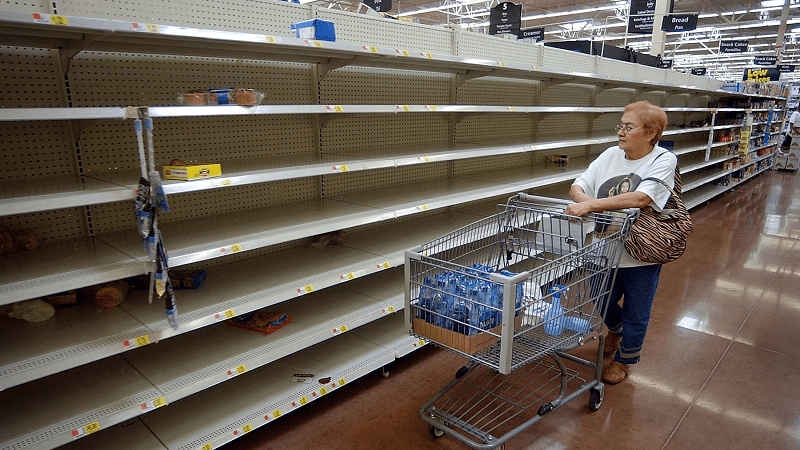
Eventually everything will be gone if you wait long enough, but if you look at actual events such as a major hurricane here in the USA, the Greece financial meltdown, the collapse of USSR, the war in Syria, the situation in Venezuela, or any poor country that has been hit by a major disaster you’ll quickly see a pattern of items that disappear at the very beginning of a panic buying rush.

have tried to condensed this pattern down to only 72 items and categorized them, here they are in no particular order.

Food & Supplies

  • Bottled Water will be the first to go without fail.
  • Canned Foods. People will just shove them into their carts without even looking at the labels. Another good barter item.
  • Rice, Beans, Wheat, Flour and Yeast. All these basic ingredients will be traded in mass and quickly hoarded.
  • Other grains whether marked for human or animal consumption will be hoarded quickly.
  • Water Filters/Purifiers including bleach will be impossible to find after the first few days.
  • Charcoal. Anyone without access to firewood will begin hoarding this immediately as they will see it as the only way to cook their food.
  • Deer and wild game may be shot and wiped from your local area quickly. This is a heavily debated topic but at the very least all the non-hunters trampling through the woods will make them harder to find.
  • Chickens, goats, cows, pigs and all other other forms of livestock will be worth their weight in gold, if not more. They will be hidden, hoarded, stolen, slaughtered, traded and sold quickly.
  • Cooking Oils will go fast. They can also be used to make oil lamps.
  • Milk,  both powdered and condensed.
  • Salt is a precious and portable commodity. Salt has long been a cornerstone of economies throughout history. Greek slave traders often bartered salt for slaves, giving rise to the expression that someone was “not worth his salt.” Roman legionnaires were paid with salt—salarium, the Latin origin of the word “salary.” It is a vital nutrient and is used to preserve meat. At less than $.40 a pound salt makes a great barter item to stock up on, especially if it goes back to its pre-modern prices.
  • Cast iron pots and dutch ovens are long lasting and are made to be used over an open fire.
  • Gardening Supplies such as seeds, books, and tools.
  • Canning supplies including the jars, lids, pressure cookers, pectin, and other supplies. Most stores do not many canning supplies (even walmart has at best one shelf full?) so just a small handful of people could easily clean out an entire store.
  • Jerky and other long lasting meats. Could snappin’ into a slim-jim save your life? Doubt it, I think roadkill has more nutrients (and more meat).
  • Teas, Coffee, Gatoraide and Koolaides. Instant, ground, bagged, and the pouches will go fast but not as fast as other items.

Medicine & Health

  • Hygiene supplies such as shampoo, toothbrushes and toothpaste, feminine hygiene products, mouthwash, floss, etc
  • First aid kits
  • OTC meds. Tylenol, Advil, cold & flu, cough syrup. Caffeine and sugar withdrawals are going to make everyone feel like crap at first. Expect heavy pain reliever use the first few weeks (especially for headaches and general soreness).
  • Toilet Paper, Kleenex, Toilet Paper, Paper Towels, and Toilet Paper. Did I mention toilet paper?
  • Vitamins and Herbal Supplements. Taking a daily vitamin could mean the different between surviving comfortably or dying from a nutrient deficiency disease such as scurvy.
  • Wine/Liquors will not be on the shelves for long. They are also good bartering tools, can be used medicinally,  and are useful for making many herbal medicines (vodka is good for this).
  • Gas masks, if they can be found, will fly off the shelves because of tear gas etc, and for the non-preppers, the “cool factor” of having a piece of actual survival gear will compel them to grab one.
  • Baby/Toddler Supplies Things like formula, cloth diapers, wash cloths, and even cheap toys can mean a lot as barter items if you do not need them yourself.
  • More Advanced Surgical and Medicinal Items. I’m dealing mostly with store bought items in this list but hospitals, urgent care, and veterinary clinics will be cleaned out quickly once they are shut down.

Camping & Outdoor

  • Guns, cleaning kits, ammo, misc hunting and camping supplies. Pretty much anything in hunting and camping isles will be cleaned out and gone almost immediately.
  • Flashlights, lanterns, and glowsticks. And don’t forget the batteries or fuel.
  • Bow saws, axes and hatchets, wedges, machetes, hunting knives, sharpening stones and honing oil.
  • Fishing supplies/toolsHunting wild game requires more knowledge than fishing.  Everyone knows or can quickly learn how to fish.
  • Camo and hunting clothes, kevlar body armor.
  • Bug traps and sprays, and mice traps. mmmmm, rat stew.
  • Tarps, plastic rolls, stakes, duct tape, twine, nails, rope, hammers and spikes or anything that can be used to fasten down something or improvise an shelter.
  • Survival and medical related magazines, books and guides. All those lacking even the basic skills needed to grow food and survive will look for any information available.
  • Wagons, wheelbarrows and carts (including shopping carts) will become a great way to transport things around.
  • Gasoline Containers or anything that could be a gas or water container.
  • Lumber and other building supplies.
  • Clothes pins/line/hangers are often overlooked but important prepping items. They make life without a washing machine and dryer much easier.
  • Insulated ice chests are half decent makeshift baskets and can keep items from freezing in the winter.
  • Gloves. Gloves, gloves, and more gloves. They can keep you warm and protect your hands.
  • Work boots, belts, blue jeans, thick socks.
  • Cold weather clothing and weather clothing. Look for wool or polyester. Avoid cotton in the winter.

Household Odds & Ins

  • Candles Lots of them, but unscented and long burning. Stocking up on scented candles can be a real mistake. That fresh linen smell or peppermint orange will really get annoying after several weeks of daily use.
  • Bleach. Make sure you get plain, NOT scented: 4 to 6% sodium hypochlorite bleach. Read the labels because, yes, you will be using this to purify your drinking water.
  • Knives & Sharpening tools are worth mentioning on their own. Carbon steel knives are better than stainless. Sharpening stones are a must. Possibly the best all around knife you could ever buy is a high carbon steel Mora knife ($10 on Amazon with free shipping). The material is harder than stainless steel and they have a Scandinavian grind that makes them extremely sharp, durable, and even easier to resharpen than most knives.
  • Backpacks, Duffel Bags. Don’t miss this. Everyone in your house should have at least one good quality good backpack or even a hiking bag. Hauling, supply runs, and bugging out are some of their many uses. Duffle bags might be cheaper but are a real pain to walk with compared to a backpack.
  • Large garbage cans and garbage bags can be used for trash, storage, water collection, hauling goods etc. Garbage bags have dozens and dozens of uses, the thick 55 gallon size being the best.
  • Cleaning and disinfecting supplies
  • Paper, pads, pencils, sharpeners, pens, and solar calculators
  • Sleeping Bags, Blankets, Pillows, Mats and Inflatable Mattresses. A manually operated handheld pump is a must if you want an inflatable mattress.
  • Buckets of all sizes and shapes. They will be used extensively.You never know how bad you need a container until you do not have one.
  • Plastic Wrap and Insulation
  • Glue, duct tape, nails, nuts, bolts, screws
  • Portable Toilets or 5 gallon bucket toilet lids.
  • Weapons, not just guns and ammo but also pepper spray, knives, clubs, bats, tasers, slingshots, pellet rifles.
  • Washboards, plungers, mop buckets with a wringer for your laundry.
  • Aluminum foil. The regular and heavy duty kinds can be used for cooking and to harness some power from the sun for purifying water and cooking.
  • Brooms, shovels, rakes, pitchforks, pick axes, hoes, general gardening tools.
  • Animal Control Products such as cage traps, dog collars and runners, etc.

Other Items Worth Having

  • Bibles. 83% percent of Americans identify themselves as Christians, and many more will find their religion when the SHTF. Bibles will be in demand and can be used to barter items. A box of 100 small Bibles cost about $20.
  • Prescription medications. How will you continue your medications without a pharmacy?
  • Duct Tape and Electrical Tape can fix just about anything.
  • Bicycles with tires, tubes, repair kits, pumps, chains, etc Bikes will become extremely valuable as they are the most efficient method of transportation.
  • Hand pumps & siphons for gas, water, oil.
  • Cigarettes A good bartering item, but salt is probably a better one.
  • Generators will fly off the shelves. Buy now cause nothing will be available when they are needed. Options include solar, gas, diesel, propane, and kerosene. Generators are loud and people will kill over generators.
  • Seasoned Firewood seasoned for 6 – 12 months.
  • Lighters, matches, flint and steel fire starters, fire pistons A good rule of thumb is get 3x more than you think you will need. And just in case you never heard of  fire piston, it is a handheld device that can start a fire with just air,so it makes a great addition to any plan.
  • Batteries Buy all sizes and look at the expiration dates. Rechargeable batteries are ideal but more costly. Don’t forget about 12v car batteries and solar recharger stations.
  • Solar Power Most people cannot go full solar but a basic (and portable) system could be built for a few hundred dollars and could power a few basic necessities when necessary.
  • Smoke house and a root cellar can be invaluable for processing and storing food
  • .
  • Gold and Silver will be the new currency when things begin to settle but not so much during an ongoing situation. Gold and silver coins don’t matter much when you have no food.
  • Motorcycles cheap(er), easy to maintain and gas goes a long way.
empty store shelves after shtf

Extra items worth mentioning

A good manual or belt operated grain grinder would be a valuable tool. Put together a bug out bag (BOB) for every member of your family and set up multiple meeting areas around your neighborhood.

Walkie Talkies are great but remember to buy rechargeable batteries and a solar battery charger. Print out or copy any important documents you may need (especially ones online) now instead of later. Build any buildings you need ,such as a smoke house or root cellar, now instead of later. Stock up on some motor oil, it can be used to lubricate and protect metal items and tools.

Final Thoughts

These items will become so much more valuable after a SHTF situation happens, so now is the time to stock up on these things before something was to happen.

Think about when a hurricane is heading towards the United States. How quick does water, bread and other supplies sell out? When the SHTF people will start panicking and looting. All these items will be gone super quick so this is very important to go ahead and get some of these items. Plus they are good for bartering. So win-win.

Will The United States Government Survive When the SHTF? Our government would crumble at every level if faced with a widespread disaster, and they may not be able to recover from it after the fact.

Tell me, if someone mentions “The United States of America”, what do you picture in your mind? The American flag? The White House? Mount Rushmore? Or perhaps you see a map of the Unites States, like this.

United States Map1

What you’re looking at is the sovereign territory that is both claimed and incorporated by the United States Federal Government. But in reality, that is not the United States. Would you like to know what it really looks like?

United States Map military bases

That’s more like it. What you’re looking at is a map of every military installation in the lower 48 (that we know of) according to Google Maps. There are a few more in Alaska and Hawaii, and hundreds more across the globe.  Now imagine a map of every police station, capital building, post office, courthouse, and every other federal and state agency. That, is the real United States.

To some of you that may sound obvious, but hear me out. Every government on Earth has a territory that they claim as their own. They have certain boundaries that legally exist as their jurisdiction. But then there are places that are disputed like Eastern Ukraine or the Senkaku Islands, and there are places that no employee of any state has ever set foot in like the depths of the Amazon Rainforest. They may legally belong to a government, but practically speaking is another story.

In truth, the government is not a series of lines on a map. It is the sum total of people who work for that government, and the areas where those people can successfully wield influence. I personally experienced this reality several weeks ago when I went hiking in a national forest. I was 15 miles away from the nearest cell reception, nobody knew I was there (long story) and there were small trees sprouting in the middle of the gravel road that led into the park. It was clear that not only had nobody been to my particular location in several months, but there had been no members of the park service there either in a very long time.

If you look at a map it would say that this place belongs to the United States Government, but the situation on the ground said otherwise. If someone attacked me in the park, my safety lies solely in my own hands, and what I do after the fact (if I survive) is totally up to me.

I suppose I could call the police, but if I didn’t nobody would know, and if I lost that particular fight, it’s unlikely anyone would be punished. There is no legal recourse for either party at that particular time and place. That piece of land, for all practical purposes, belongs to no one.

The reason I’m bringing any of this up is to illustrate a point about our government’s ability to survive a major disaster. I’m not very confident that they could. I’m sure they have an extensive series of bunkers that will shield the political and financial elite of our nation during any disaster, but when they emerge months or years later, will they have the infrastructure and personnel to enforce the boundaries they claim as their own?

I’m sure it would depend on the disaster, but in this case I’m talking about something catastrophic. Think EMP attack or nuclear war. Heck, even a major financial correction might get the dominoes tumbling into a wider disaster.

Most preppers would assume that they will quickly lose control of large swaths of the rural countryside. I would have to agree. If you look at most wars that have occurred over the past 100 years, one fact stands out. The cities have always been bastions of government authority, while the countryside is quickly overrun by rebels or foreign invaders. This can definitely be said of our own military.

When you compare our wars in Vietnam and Afghanistan, you’ll see the same situation. Our forces clung to cities and far-flung outposts, while occasionally sending patrols into a countryside that they would never successfully control. Cities are just easier to manage, plain and simple. But it’s hard imagine them maintaining control over a vast countryside that is filled with people who don’t like the government, who have lived without their help for many years, and are now dealing with an influx of desperate people who have fled the cities.

However, they do have those urban areas, and once they make contact with what’s left of the local authorities in small towns across America, they might be able to start exerting their previous control over those regions. The only problem is, they may not be able to keep the lid on our cities. You have to ask yourself, if they can’t control an area that is traditionally easy pickings for a government, will they be able to raise a flag anywhere else?

As of now, our cities are already bursting at the seams. In cities like Chicago, the number of police in their gang enforcement division is actually outnumbered by gang members with a 500-1 ratio. In other major cities, you might hear stories about certain neighborhoods that police just flat-out refuse to enter without extensive backup (again, is it really the United States if their employees can’t show their faces in that neighborhood?).

Their ability to solve murders has been declining for years, and the public’s trust with the police is in the toilet. Simply put, our government’s authority has been slipping at the local level for a long time, and this doesn’t even account for the mobs of panic-stricken citizens that might emerge after a disaster. It also doesn’t account for situations like Hurricane Katrina, where numerous police officers abandoned their posts in the wake of the storm.

If you ask me, it looks like our government would crumble at every level if faced with a widespread disaster, and they may not be able to recover from it after the fact. The police will be outmatched, and the military will either be stranded in overseas outposts, or tied up with the police in our urban areas.

Really, it boils down to this. If there is an event that is so catastrophic, that it shatters our police and military into isolated units with little communication to the outside world, will they be able to survive? And for those cops and soldiers who do survive, will they be willing to pledge allegiance to our current politicians and bankers, when they emerge from their fortified bunkers?

At the end of the day, our government is nothing more than the people who work for it and their ability to enforce the law in any given area. It’s hard to say if they would prevail in their current form during any widespread disaster.

So what do you think? If it hits the fan, will the federal government weather the storm, or will they be completely overwhelmed by the chaos?

8 INDUSTRY EXPERTS PICK THEIR MUST-HAVE SHTF GUN:Our panel of experts answers the age-old question ‘If you could only grab one gun when SHTF, what would it be?’

Our panel of experts answers the age-old question “If you could only grab one gun when SHTF, what would it be?”

The question is pretty commonly heard at gun shops, barbecues and shooting ranges. Every shooter knows it, and every shooter thinks about it. What gun would you choose if you could only have one gun? It seems simple, but experts and enthusiasts alike know how difficult it can be.

The question gets a little trickier when we add a caveat: What if it’s during the apocalypse? Now you have to consider ammunition; if you run out of ammo, will you be able to scrounge some up? What about hunting and self-defense?

Answering this question can be difficult, but that’s why we’ve assembled an assortment of industry experts to offer their opinions. On top of learning more about each of these gurus, these answers can also help you formulate your own.

Nick Collier

  • Affiliation: DoubleStar Corp.
  • Position: Senior Executive, DoubleStar, Training Academy Instructor
  • SHTF Gun: AR-15

I’d choose an AR-15 for an SHTF situation. That’s an easy choice. I have had this conversation many times with industry associates as well as family members and friends. With the thousands of variations available, the AR-15 is the best choice. My decision is based on the following: training, reliability, ease of use, size, and ammunition.

I have spent ample time training on this firearm. I feel like I would be able to handle the weapon in a variety of situations. Whether I am in a rural setting taking distant shots or a densely populated area, the AR-15 is capable of kill shots in excess of 300 yards, and it’s short enough to maneuver in urban terrain.

The reliability of the AR-15 is only as good as the sum of its parts. When built with quality components, the AR-15 will perform in almost any condition, as proven by our military and law enforcement over the years. I adhere to the “buy once, cry once” principle when buying gear. Go ahead and pay for the good stuff and you won’t have to buy it again.

Ease of use is another big factor. Not everyone is a trained firearms enthusiast, so you may encounter situations where you are unable to fire and need to teach someone in your group to return fire or hunt for food. The AR is very basic and easy to use. My 9-year-old son has been shooting one since he was big enough to hold it up, and in my training experience, it doesn’t take much to get the average person up to speed safely.

The size of the AR-15 makes it easy to carry. If you have ever covered a long distance on foot, you know every ounce you are carrying counts. Moving through obstacles also requires a small, compact firearm. Any hunter can tell you that climbing over fallen trees and rough terrain is easier with a smaller, shorter rifle, and the AR-15 can be made short to carry and adjusted for the correct length of pull with collapsible stocks.

The last and maybe biggest factor is ammunition. The AR-15’s standard 5.56mm cartridge is big enough to put down small- to medium-sized targets with well-placed shots. Whether it’s a zombie horde or a whitetail dinner that comes into the scope, the 5.56mm cartridge can handle it. Carrying six to ten 30-round magazines on your plate carrier or in your backpack still leaves room for things like water, food and medical supplies on your trek without adding too much bulk or weight. Other factors include caliber conversions for larger ammunition and parts availability. The AR-15 is the most popular rifle in America, and it should be easy to find ammunition and parts while scavenging. For these reasons, the AR-15 is the ideal SHTF firearm.

Mike Detty

  • Affiliation: Mad Dawg Global Marketing, Inc.
  • Position:President
  • SHTF Gun: AR-15 carbine

Guns are tools, and each of them has been designed to perform a certain job. Unfortunately, an event of apocalyptic proportions can limit our choices, so the selection of just one gun is extremely critical. To me, this means choosing a gun that has a great degree of versatility. My pick would be an AR-15 carbine.

For many years I competed in USPSA competition and considered myself an above- average shooter, and I own many nice, custom 1911 pistols. But I have enough experience behind a carbine to know that no matter how much I practice with my pistol, I will never be able to shoot one as accurately as one of my AR-15 carbines. AR-15s are accurate while the 5.56mm cartridge is light on recoil, making this combination especially effective and easy to shoot for all family members.

Besides the precision of a carbine, there is also the capacity factor. Thirty-round AR magazines are abundantly available at bargain prices. My own home-defense guns all use 40-round Magpul 5.56mm magazines.

Flattop carbines are especially versatile and offer the shooter the ability to use folding backup sights, reflex sights or a scope depending on the task at hand. Free-floating handguards make it easy to attach lights, lasers, and other accessories to aid the shooter.

The AR’s modular design also makes it easy to switch uppers—i.e., convert the gun from a short M4-style carbine to a long-range precision rifle with ease. Guns can even be converted to hard-hitting calibers like the .458 SOCOM or inexpensive .22 LR.

The ubiquitous of the AR-15 makes its choice a logical one in a doomsday scenario. Parts, magazines, and ammunition should be easier to find with such a popular gun. Unwanted parts or accessories should also make for good trading fodder.

My own choice for home defense is an AR-15 SBR with a 7-inch barrel, a flash suppressor, and a red dot reflex sight. In the event of an unimaginable catastrophe where I can only grab one gun before I leave my home, I would feel very well protected with my AR-15!

Mykel Hawke

  • Affiliation: U.S. Army Special Forces veteran, survival instructor, author, star of the Travel Channel’s “Lost Survivors”
  • Position: Founder and Director of SpecOps Adventures and Training
  • SHTF Gun: Scavenger 6 by Ralston Arms

Like any skilled person, I prefer to use the right tool for the task. However, sometimes you have to make do and improvise. As a survival guy, I live with a long machete, large, medium and small knives and a backup. The same principles apply to my weapons; I have sniper rifles, shotguns, AR-15s, pistols. But if I must choose just one weapon, I want the one that will give me the biggest bang for the buck, which means it has the most utility and versatility.

So, for me, the best all-around weapon to carry in a bug-out situation would be the Scavenger 6 by Ralston Arms. Designed by one of the most creative survival inventor/designer guys I’ve ever met, Tim Ralston, it’s a weapon that can shoot 21 different calibers. In a survival situation, you never know what kind of ammo will be available. It’s very likely you’ll sooner or later expend whatever ammo you have stored and you can’t always carry all the ammo with you, but if your weapon will shoot whatever is around, you’re well ahead of the power curve, and in a crisis, that could be the difference between surviving and pushing up daisies.

Jared Hinton

  • Affiliation: Vista Outdoor
  • Position: Communications Coordinator for Firearms & Ammunition
  • SHTF Gun: Savage 11 Hog Hunter

I’m a bolt-action fanatic, and a gunsmith first. Somewhere deep down inside me, I still believe that the autoloading firearm is a passing fad; lever actions, bolts, and revolvers are simple mechanical mechanisms that still rise to the top of my list if SHTF. Don’t get me wrong—I play with the AR platform, and I’ve assembled more ARs than I can count. The AR-15 is a great option if you expect a firefight. My primary concern is a simple rifle that anyone can operate and maintain should I become immobilized. Backup iron sights are mandatory. If anything happens to the optic, I can’t be stuck guessing where I am shooting. I need to be able to harvest game while having the ability to stop two-legged varmints. No excess hanging off the gun, waiting to get caught in the brush while moving. Simplicity.

I value the ability to make one shot matter, and believe the Savage 11 Hog Hunter rifle in .223 Remington would be tough to beat if things got bad in a hurry. The Model 11 Hog Hunter comes in at 7.25 pounds, so it’s no flyweight, but I’ll take the extra weight of the medium-contour barrel for better off-hand control on target. Pre-threaded for a suppressor, the medium-contour barrel won’t submit to point-of-impact shifts that a sporter-weight barrel will with a suppressor out front. I’d top the rifle with a Weaver Classic 1-3x24mm optic in Weaver rings. Light, simple, reliable and the adjustable LPA sights ensure I can hit what I’m aiming at no matter the situation. With an optic, I can keep the entire package under 10 pounds, which is a reasonable threshold for days on the move.

Moving parts and reciprocating mass are more likely to wear, raising concerns over long-term maintenance. Autoloaders have a tendency to make a person waste ammo with extra trigger pulls. The Hog Hunter is compact, made to be hauled through the stuff no one wants to move through, precisely where I’ll be lurking. The Savage action is extremely strong, and should I come across ammo that is questionable, I know that the chances of the action failing are all but nonexistent. The zero-headspace system of the Savage barrel nut and floating bolt head give me a 100-percent reliable lockup that guarantees maximum accuracy and safety.

By choosing the .223 Remington as my caliber, I can carry a high volume of ammo. I need to pack as much ammo on my person as possible. While we’re at it, make it 69-grain Federal Gold Medal rounds; I need to know I’m hitting exactly where I’m aiming. Federal’s Gold Medal Match ammunition is sufficient to engage targets out to 600 yards while I make evasive maneuvers. It also doesn’t hurt that I have a large stockpile of it cached at the farm. It’s not designed for expansion, so it doesn’t excessively damage rabbits, pheasants, and vermin that I may need to eat. I also have a decent supply of Fusion ammo stashed around; the 62-grain bonded bullet is more than sufficient for the biggest Minnesota deer I’ll encounter.

If SHTF, my goal is to avoid a close-range confrontation. I don’t need to eliminate most threats—I just need to slow them down long enough for me to get out of the area. Being discreet is my go-to plan, and getting to and holding our farm ground would be my top priority. The Model 11 Hog Hunter is versatile enough that I could trust my life with it when the going gets tough.

Jason Morton

  • Affiliation: CZ-USA
  • Position: Vice President of Marketing
  • SHTF Gun: CZ Scorpion EVO

If SHTF, I can assume that I’m not expecting a typical self-defense scenario, which our daily-carry pocket dump anticipates in these pre-apocalypse times. Instead, I have to assume that we can expect multiple encounters with multiple targets. Since my first choice, air support, isn’t an option, I’m reduced to choosing only one gun.

Whatever I choose has to accomplish three goals: have adequate stopping power against multiple targets, be easy to carry with lots of ammo and, given the likelihood of a target rich environment, be common enough in caliber to have a reasonable expectation of finding more ammo when necessary. The multiple-target expectation means that for me, I need the semi-auto capability. It also needs to be maneuverable both indoors and out. I think an SBR is just the ticket here. Assuming there is no government at this point, an SBR won’t require a tax stamp—just a hacksaw.

Caliber-wise, I like the .22 LR because I can carry lots of ammunition with me. Unfortunately, I have to find that ammo first and haven’t had very good luck doing that for several years. I know bunches of people are hoarding it in their basements, but if I try to scavenge it from there, I’m very likely to become one of their targets. Let’s say that the .22 LR won’t work due to ammo availability, and we don’t even need to consider stopping power for this one. The 5.56mm and 9mm calibers are going to be the most commonly encountered rounds. They are close enough to the same overall bullet weight that we can call choosing one over the other a draw. For stopping power though, the 5.56mm  NATO has to get the nod, assuming I can come up with something other than FMJs, but that’s not a guarantee.

The 5.56mm gives me more range over the 9mm, but I’m more concerned with multiple close targets, so a 9mm carbine or submachine gun is probably going to be my go-to gun in this scenario. It’s got plenty of magazine capacity, good stopping power with the defensive loads most commonly found in the caliber, and it generates low recoil. The 9mm is lighter in weight than a 5.56mm carbine and with a folding stock, and it’s easily concealed. Some might accuse me of being a little biased here, but my top pick has to be the CZ Scorpion EVO for my SHTF gear bag. The Scorpion is fast and reliable. Add a red dot and a suppressor and it’s even better.

Sean Murphy

  • Affiliation: Nightforce Optics
  • Position: Marketing Communications Manager
  • SHTF Gun: DEVGRU “RECCE” carbine

In the event of a true SHTF situation, we must accept that our “normal” day isn’t so normal. If I am limited to taking just one firearm to help me solve problems in an SHTF environment, it’s going to be a rifle.

In my eyes, it is hard to beat the all-around qualities of a good AR-15 carbine. My personal favorite for “the one” is a modern interpretation of the DEVGRU “RECCE” carbine. This upgraded AR-15 has a medium-contour, 16-inch, stainless steel, match barrel; a slim, 15-inch handguard; a muzzle device to accept a suppressor; a collapsible buttstock; and a match trigger. When paired with a good optic/ammo combination, you now have a very effective platform to deliver rounds accurately on target at any practical distance.

Topping off the carbine would be a Nightforce 2.5-10X riflescope, attached to a Nightforce Ultralite Unimount. This piece of glass is a perfect all-around optic that enables close/fast firing at low power, and up to 10X power for target identification and shooting at longer-range targets. Quality ammo with heavy 69- to 77-grain projectiles or a premium- the bonded bullet would be fed through the rifle for the best balance of accuracy and maximum terminal effect downrange.

The moderate weight and overall handiness of this package make it easy for such a combination to accompany me on many trips hunting for deer, ridding fields of prairie dogs, competing in field/action rifle matches and countless trips to the range. The carbine is not too heavy to carry in hand or in a sling and is a good size to stash in a vehicle. I can deliver precision fire out to 600 yards with reliability (and a little farther on good days), but also engage targets at CQB ranges with ease. Other qualities to like about this setup are the plethora of magazines available, light recoil, ease of operation and perhaps most importantly, reliable operation. As higher-level maintenance or repairs become necessary; the parts availability and limited tools required make it an easy task for a competent person to handle.

Additionally, lights, lasers, bipods, night-vision devices and a whole range of other accessories can be added or removed to suit a particular use or environment. Chambered in 5.56mm NATO, this setup can also accommodate nearly any .223/5.56mm ammo one had stashed or had to scrounge.

If things go seriously wrong in my part of the world, my anticipated threat levels are going to go up, and my armament levels will go up to match. While a handgun provides an easy solution to carry all day, the energy on target, effective range, ammunition capacity and modularity of an AR-15 rifle cannot be ignored. My preference for an “accurized” carbine provides a balanced set of features for nearly any use, from hunting to defense or even limited offense if needed. I like having options to deal with problems, and my “RECCE” gun would be the one to grab.

Robin Sharpless

  • Affiliation: Redding Reloading
  • Position: Executive Vice President
  • SHTF Gun: Marlin 1894C

This is a very fun question to answer. It gives insight into both professional and personal preferences. Many will look at personal interest and or a favorite cartridge. Others will think about the sexiest gun to have during this time. For me, I’ll be driven by practicality.

As an avid hand loader, my decision will be driven by something that is effective on wild game for food and predators, be they two- or four-legged. But it also must conducive to being hand loaded and offer real versatility. Therefore, my choice is a .357 Magnum lever-action rifle, the Marlin 1894C. With its 18-inch barrel, it can generate enough energy to kill a deer, disable an attacker and handle coyotes but is also compact and convenient enough for easy carrying. Mine would sport a peep sight that works very well for my eyes, and the rifle’s overall handling characteristics make it a good choice for instinctive or point shooting when necessary.

From the reloading front, the choice of the .357 Magnum allows for the use of a variety of powders and, most importantly, the ability to simply and easily cast bullets for future use. Hopefully, I’ll have a large stock of good projectiles on hand, but if that’s not the case, this caliber is a simple one to cast bullets for, regardless of what that dark future may hold.

Recommended article:

Since the .357 Magnum has a straight-walled case, I won’t need to have lube for sizing. It is extremely easy to load for, and long case life is positive. Additionally, in a future where we may have to scrounge for components. With that in mind, .357 Magnum and .38 Special brass is going to be relatively easy to find. Through creative loading, we can create a range of offerings from quiet, low-velocity, low-flash defense loads to heavy-bullet loads capable of taking a deer-sized North American game for food. While I would not tackle a grizzly bear, I would have confidence with this rifle on a black bear, which, by the way, could produce lube for my cast bullets if needed, with a heavy bullet and slower powder.

Bill Wilson

  • Affiliation: Wilson Combat
  • Position: President and Founder
  • SHTF Gun: Wilson Combat Tactical Lightweight .308 (rural), Wilson Combat AR9B (urban)

I think there are two different answers to this question based on where I am geographical. If I’m living on my ranch in rural Texas when SHTF and I can only have one firearm for the foreseeable future, my pick would be a lightweight .308 Winchester AR with a 14.7-inch barrel. I’d hopefully also have two additional upper receivers—in 6.5 Creedmoor and .338 Federal—with 18-inch, crowned-muzzle barrels for longer-range defense and more killing power for hunting. I’d really feel pretty naked without a handgun on my side since I carry one 24/7, but the question was one gun, and a .308 Winchester AR would handle most any defensive situation I would likely encounter in rural Texas and still put meat on the table as needed. Also, .308 ammunition is pretty common in this neck of the woods—not that I don’t always have plenty on hand!

My setup would be as follows: I’d choose a Wilson Combat Tactical Lightweight .308 with a 14.7-inch barrel and a permanently attached Q-Comp flash suppressor. I’d add a top-quality optic like a Leupold 2-12x42mm VX-6 riflescope as well as a Streamlight TLR-1 HL weapon light and a sturdy Blue Force Gear Vickers two-point sling.

If allowed, my extra 6.5 Creedmoor upper would have a mid-weight, 18-inch, crowned-muzzle barrel and a Leupold 2-12x42mm VX-6 scope. The .338 Federal upper would have a light “Hunter” 18-inch, crowned-muzzle barrel and the same scope.

If I am in a large city on business (I would never live in a city!) when SHTF and I can only have one firearm for the foreseeable future, my answer changes. For this one, I’m assuming total society breakdown and chaos in the city. For that, the need for concealed carry is a thing of the past. That being said, I’d go with one of our new AR9B 9mm carbines that uses Beretta 92/M9 magazines, which I normally take with me when I travel. In a true SHTF situation in an urban area, I want to be prepared for multiple assailants at relatively short ranges.

A light and short carbine that is easy to carry and deploy in tight places would be very handy. A 9mm carbine would also allow me to carry a lot of ammunition, and use subsonic loads, it would be almost as quiet as a suppressed 5.56mm. An additional plus would be the very likely chance that eventually I would be able to acquire a 9mm pistol, and ammunition compatibility would be a good thing.

Wilson Combat AR9B

For this setup, I’d choose a Wilson Combat AR9B with a fluted, 14.7-inch barrel and a permanently attached Q-Comp flash suppressor. I’d use a Leupold 1-6x24mm VX-6 scope and an Aimpoint CompM4s, both in QD mounts, as well as a Streamlight TLR-1 HL weapon light and a Blue Force Gear Vickers two-point sling.

Design a site like this with WordPress.com
Get started