What Is Agenda 21? Depopulation Of 95% Of The World By 2030 (Most people are unaware that one of the greatest threats to their freedom may be a United Nations program which plans to depopulate 95% of the world.)

According to Wikipedia– Agenda 21 is a non-binding action plan of the United Nations with regard to sustainable development. It is a product of the Earth Summit (UN Conference on Environment and Development) held in Rio de Janeiro, Brazil, in 1992. It is an action agenda for the UN, other multilateral organizations, and individual governments around the world that can be executed at local, national, and global levels. One major objective of the Agenda 21 initiative is that every local government should draw its own local Agenda 21. Its aim initially was to achieve global sustainable development by 2000, with the “21” in Agenda 21 referring to the original target of the 21st century.

Agenda 21- Depopulation Of 95% Of The World By 2030

The United Nations (UN) for some people conjure up images of a benevolent organization intended for the preservation of human life wherever conflict occurs, and of encouraging international cooperation and peace.

Far from this peaceful image, however, is their little-publicized plan to depopulate 95% of the world by 2030. Or as they have called it, Agenda 21.

United Nations plot to depopulate 95% of the world by 2030

Agenda 21 was United Nations Department of Economic and Social Affairs, Division for Sustainable Development and was apparently developed as a means of restructuring the world population to lessen environmental impact and achieve an improved quality of life.

One of the main ways of achieving this, however, is through encouraged and direct depopulation.

As the UN put it:

“comprehensive plan of action to be taken globally, nationally and locally by organizations of the United Nations system, government, and major groups, in every area in which humans have impact on the environment.”

Although the language used in the original 70-page report (National Implementation of Agenda 21 – A Summary) that the UN published on Agenda 21 is vague and open to interpretation, as well as plausible deniability, the intentions in certain sections are clear:

Depopulation to lessen environmental impact and stop overpopulation leading to instability.

While this sounds like a positive thing in some aspects, mere policy changes at governmental level alone cannot create an environment where big enough changes can come about in a short space of time.

To achieve such huge scale depopulation with a relatively short deadline the actions were taken would have to be drastic. Either a world war, global epidemic or some kind of widespread starvation caused by massive crop failures would be the only likely ways of achieving this.

The idea also raises the question of,

  • Which 5% of the global population would be saved? 
  • Would these be those strong and hardy enough to survive the conditions placed on the earth that would kill off the remaining 95%? 
  • Or perhaps the survivors would be chosen selectively from the elite and wealthy?

Whether such a plan could ever actually be successful is another matter.

Plans of this size and scope would require the collusion and agreement of at least every first world government in the world, not to mention that the amount of resources and effort that would have to go into keeping something like this covered up would be astronomical.

If you have any dissatisfaction with my content, you can tell me here and I will fix the problem, because I care about every reader and even more so about your opinion!

The Fall of the Soviet Union- Eastern European Economy, Economic Collapse, and Foreign Trade

For nearly three decades, the Berlin Wall was a tangible representation of the so-called Iron Curtain and the political divisions in Europe. When Mikhail Gorbachev took control of the Union of Soviet Socialist Republics (USSR) in 1985, he did so with the intention of revamping the country’s economy and government. He dismantled the secret police and introduced perestroika (economic restructuring) in an attempt to begin mending relationships with Western European countries and the United States. By studying the consequences of the collapse of the USSR, students today can gain an understanding of how the end of the Cold War affected U.S. and Soviet relationships, and how it led to the current political and economic climate between the two countries.

The Fall of the Soviet Union

In order to understand the consequences related to the collapse of the Soviet Union, it is critical to first examine the overarching causes for the USSR’s downfall. Gorbachev’s loosening of governmental power created a domino effect in which Eastern European alliances began to crumble, inspiring countries such as Estonia, Lithuania and Latvia to declare their independence. The Berlin Wall fell on November 9, 1989, leading East and West Germany to officially reunite within a year, ending the Cold War. Once the Berlin Wall fell, citizens in Eastern European countries such as Czechoslovakia, Bulgaria and Romania staged protests against their pro-Soviet governments, hastening the collapse of communist regimes across the former Soviet bloc. Other countries—such as the Republic of Belarus, the Russian Federation and Ukraine—followed suit, creating the Commonwealth of Independent States. By the end of 1989, eight of the nine remaining republics had declared independence from Moscow, and the powerful Soviet Union was finally undone. By the summer of 1990, all the formerly communist Eastern European officials had been replaced by democratically elected governments, setting the stage for the region’s reintegration into Western economic and political spheres.

The dismantling of the Soviet Union had many long-lasting effects on the global economy and the region’s foreign trade. Its downfall increased the United States’ influence as a global power and created an opportunity for corruption and crime in Russia. It also prompted many cultural changes and social upheavals in former Soviet nations and smaller neighboring communist countries. Between 1989 and 1991, the gross national product in Soviet countries fell by 20 percent, ushering in a period of complete economic breakdown.

Eastern European Economy, Economic Collapse, and Foreign Trade

By the time Gorbachev took office in 1985, the Soviet economy had been stagnant for 20 years and was badly in need of reform; to wit, the country’s gross national product (GNP) went from 5.8% in 1940 to 2.6% in 1970. Grocery store shelves were often empty, and lines for food were long. The Soviet economy historically had relied little on foreign trade because of the region’s large energy and raw material base; in 1985, exports and imports accounted for just 4 percent of the Soviet GNP. The trading the Soviet Union did engage in was mostly with communist countries, many of which were in Eastern Europe. In 1988, Soviet trade with socialist countries amounted to 62 percent of the country’s total foreign trade, while 15 percent of its foreign trade was made with Third World countries. Soviet trade with Western countries largely consisted of currency and Soviet oil exports, as well as trading one manufactured good for another (Pepsi for Stolichnaya vodka, for example).

In September 1990, Gorbachev rejected Russian economist and politician Grigory Yavlinsky’s 500-day economic reform plan, which lost the former any remaining support he had from the Soviet people, leaving him with few allies. Gorbachev’s attempts to modernize the Soviet system failed, in part, because he was unable to implement a complete overhaul, instead of making a series of minor reforms. For example, he tried to stop the production and sale of alcohol, forcing the industry underground. He also began leasing state-owned land to farmers and cut state spending on the military. Gorbachev’s continued promises that his reforms would drastically improve living conditions alienated citizens who didn’t see the promises come to fruition. Gorbachev’s failed plan for a slow, gradual economic reform negated any positive effects the reforms may have had, and the economy fully collapsed.

A few years prior, in April of 1988, Soviet and American trade delegations met in Moscow to examine possibly expanding trade relations. The Soviet government’s hope was to gain an understanding of Western management and marketing processes and learn new manufacturing skills. That same year, the Soviet Union signed a normalization agreement with the European Economic Community. Gorbachev’s economic policies of Soviet expansion and cooperation with the Western world changed the attitude of the country from one that regarded foreign trade as a means to compensate for short-term scarcities to one that considered imports to be long-term alternatives to domestic production. This helped open the door to Soviet expansion into the world market, bolstering relations with not only former Soviet bloc nations, but also Western powers such as the United States and the United Kingdom. In the mid-1990s, Russian President Boris Yeltsin and U.S. President George H.W. Bush signed trade agreements designed to make it easier for U.S. citizens to conduct business in Russia. In 1997, for the first time, Russia participated in economic discussions at the G7 summit in Denver, Colorado. The following year, Russia was integrated as a full member, and the G7 became the G8. By the early 2000s, Russian President Vladimir Putin was working to create a free-trade zone in Russia, and the country eventually joined the World Trade Organization in 2012.

Crime, Cultural Changes and Social Upheavals

The Soviet Union’s collapse not only threw economic systems and trade relations throughout Eastern Europe into a tailspin, it also produced the upheaval in many Eastern European countries and led to increased crime rates and corruption within the Russian government. When the Soviet government fell, the Russian mafia, which had struggled to survive during the height of communism, stepped in to fill the power void. Government infrastructure—ranging from basic public utilities to police services—mostly evaporated during the collapse. Additionally, government payroll services almost completely disappeared, so ex-KGB officers, police officers and Soviet Army soldiers flooded the mafia’s ranks in search of steady employment. Mafia oligarchs seized state-owned assets and enterprises throughout Russia, such as telecommunications and energy networks and industries, and the mafia extorted the public in exchange for providing security and enforcing laws wherever the Russian government was unable to. Though the current Russian administration has had some success combating organized crime, the Russian mafia is still extremely powerful and well-connected. However, in an autocratic society such as that of Russia, anyone who speaks in opposition to government corruption will be arrested, exiled or even murdered under mysterious circumstances. This oppression stymies Russia’s chances of establishing a true democracy and allows government corruption to continue to expand.

The fall of the Soviet empire also had far-reaching effects on the world as a whole, particularly among its former Soviet satellite nations. For some countries, such as Azerbaijan and Kazakhstan, oil and natural gas exports have created prosperity but have also enabled corruption. Countries such as Lithuania and Latvia underwent dramatic transformations by quickly turning to the West, adopting Western ideals and political leanings, while other countries, such as Armenia and Tajikistan, have struggled to flourish in the post-Soviet era and many citizens remain poverty-stricken while the states and their politics remain in flux.

The Soviet Union’s collapse also affected countries outside the former Soviet bloc; for instance, since the end of the Cold War, China has expanded to become a major world superpower and the European Union has extended its influence into areas that Moscow once controlled. In the quarter-century since the Soviet Union collapsed, U.S.-Russia relations have been tenuous. While the United States under President Bill Clinton provided assistance to Russia, policymakers at home feared Russia could re-emerge as an enemy if nationalists were allowed to regain power.

US Power

While the United States was able to become the dominant global superpower in the years following the Soviet Union’s collapse, Russia has gained ground in the past several years. A recent study by the U.S. Army War College’s Strategic Studies Institute indicates that the United States’ power is declining because the world is entering a new phase in which the authority of traditional governments worldwide is destabilizing, stating that the United States “can no longer count on the unassailable position of dominance, supremacy, or pre-eminence it enjoyed for the 20-plus years after the fall of the Soviet Union.” The dissolution of the USSR left the U.S. as the only true world superpower, freeing the U.S. government from the constraints imposed by the existence of any threat from a powerful rival. This allowed the U.S. government to intervene militarily and otherwise in foreign countries without fear of major retaliation.

Though the collapse of the Soviet Union allowed the United States to gain power, recent years have seen Moscow take a stronger stance in world affairs—by forgiving $10 billion of Soviet-era debt due from Pyongyang, for example, and selling oil to North Korea—in an attempt to, as Samuel Ramani, journalist and international relations expert, noted in the Washington Post, “once again project itself as a global power.” Achieving that superpower status, according to Ramani, would make it far easier for Russia to directly influence conflicts across the world.

By studying the immediate effects of the Soviet Union’s collapse, and keeping current on the effects of post-Soviet development, historians and students can understand how the end of the Cold War, Russia’s fall from dominance and its recent bid to return to the stage as a global power have all affected the United States and the course of the current geopolitical climate.

If you have any dissatisfaction with my content, you can tell me here and I will fix the problem, because I care about every reader and even more so about your opinion!

Gun Control Is One Of The Most Divisive Issues In American Politics- Most Important Facts About Gun Control In The US

Gun control is one of the most divisive issues in American politics. With each mass shooting — defined as four or more victims having been killed indiscriminately — antagonism grows between both sides of the gun control argument.

Proponents of stricter gun regulations fear for their safety in a country where there is an average of 88 guns per 100 people, according to the 2011 Small Arms Survey. The Brady Campaign to Prevent Gun Violence estimates that around 114,994 people are shot each year in the US. This includes murders, assaults, accidents, police intervention, suicide attempts and suicides.

Opponents of regulatory arguments, however, also fear a loss of safety. They argue that restricting the right to bear arms would leave citizens unable to protect themselves in their daily lives or, in a worst-case scenario, from a government turned against the people.

Though regulations vary from state to state, there are a few key conditions for obtaining guns in the US.

1. Is there a minimum age?

The Gun Control Act of 1968 (GCA), which regulates firearms at the federal level, requires that citizens and legal residents must be at least 18 years of age to purchase shotguns or rifles and ammunition. All other firearms — handguns, for example — can only be sold to people 21 and older.

State or local officials may implement higher age restrictions but are not allowed to lower the federal minimum.

2. Who’s restricted from purchasing or possessing firearms?

Fugitives, people deemed a danger to society and patients involuntarily committed to mental institutions are among those who may not purchase firearms. People with prior felony convictions that include a prison sentence exceeding one year, or misdemeanors carrying sentences of more than two years, are also prohibited from purchasing firearms.

Federal law also blocks the sale of guns to people who have been found guilty of unlawfully possessing or using controlled substances within the past year. This includes marijuana, which, though legalized in many US states, remains illegal under federal law.

Other restrictions apply to people who have been issued restraining orders by courts to prevent harassment, stalking or threatening; people who have renounced their citizenship; dishonorably discharged military personnel; unauthorized migrants; and people temporarily visiting the US on nonimmigrant visas, for example as tourists.

3. Does the federal or state government regulate firearms?

The Second Amendment serves as the legal basis for the “right of the people to keep and bear arms.”

Though state and local governments regulate whether residents may, for example, carry guns in public, laws regulating who may receive or possess guns are set out at the federal level.

The Bureau of Alcohol, Tobacco, Firearms and Explosives (ATF), a division of the Department of Justice, administers the GCA. The ATF also regulates the standards for issuing licenses to gun vendors.

Shotguns, rifles, machine guns, firearm mufflers and silencers are regulated by the National Firearms Act of 1934. The purchase of semi-automatic weapons is legal in most states, as are automatic weapons made before 1986.

4. Who may sell firearms?

Like handgun owners, dealers interested in obtaining a Federal Firearms License (FFL) must be at least 21 years of age. They must have premises for conducting business and must alert a local law enforcement official at the time of submitting their applications to the federal bureau that regulates firearms. Just like gun owners, they must fulfill the same criteria regarding their history of prior convictions and mental state. The license fee costs $200 (€170) for an initial three-year period and $90 for each subsequent three-year-long renewal.

Selling firearms online also falls under these regulations. Although the purchase may be paid for online, the gun itself must be shipped to a registered FFL holder, who then conducts the necessary background check before handing the firearm over to its owner.

However, the law is unclear on what constitutes selling guns for profit. Any individual may sell firearms without a license if his or her motive isn’t to make profit for livelihood through repeated and regular sales.

5. Is a background check required to purchase a firearm?

Yes. The amendment to the 1968 Gun Control Act — known as the Brady Handgun Violence Prevention Act of 1993 — requires holders of FFLs to conduct a background check. Potential firearm purchasers fill out a federal form known as the ATF 4473, which checks for prior convictions and other red flags. FFL holders then use the information provided on the form in the background check.

States may decide whether the background check is carried out solely by the FBI’s National Instant Criminal Background Check System (NICS) or a combination of the NICS and state agency information. Roughly 30 states rely solely on the NICS.

Estimated to take under 10 minutes by phone or online, the check gives the FFL holder an immediate answer: approve, delay or deny. A delay indicates the need for further research for three business days, after which point FFL holders can act at their own discretion if the research proves inconclusive.

The Brady law, however, does not apply to someone who is obtaining a firearm from an individual without an FFL.

6. Do states require permits to purchase firearms?

Only a dozen of the US’s 50 states require purchase permits for handguns. Of those states, only three — California, Connecticut and Hawaii — require permits for the purchase of rifles and shotguns.

California, for example, requires applicants to pass a written test and enroll in a gun safety class to obtain purchase permits. States with this requirement do not recognize the “concealed carry reciprocity” policies of some states, which allow gun owners licensed in one state to bring their weapons to another.

7. Do states require permits to carry firearms?

Most states require permits to carry handguns. Concealed carry and open carry vary by state. Some states allow residents to carry handguns without permits.

By contrast, virtually no state requires a permit to carry rifles and shotguns. Massachusetts and New Jersey require people carrying rifles and shotguns to bring along a form of ID or a firearms identification.

8. What is the ‘gunshow loophole’?

The law on selling, receiving and possessing firearms is clear. Yet not every individual providing the gun in a transfer requires an FFL, which in turn means that not every buyer is legally subject to a background check. This potentially enables guns to fall into the hands of users who might otherwise not be allowed to own a firearm. 

According to the ATF, anyone can sell a gun without an FFL from their home, online, at a flea market or at a gun show as long as he or she is not conducting the sale as part of regular business activity. One example would be someone who sells a firearm from his or her personal collection. Others who are exempt include those giving guns as gifts. Only individuals whose “principal motive” is to make a profit via sale must obtain an FFL. 

Commonly referred to as the “gunshow loophole,” this ambiguity also explains how a purchase can occur without a background check — and without breaking the law. A 2017 survey by Harvard and Northeastern universities estimates that roughly one in five transactions occur without a background check.

A gun may also be purchased on behalf of a third party as long as it is a gift and as long as the recipient does not violate federal restrictions on gun ownership to the best of the gift giver’s knowledge. The same applies to the general transfer of guns. Children younger than 18 may possess guns that were given to them by parents or guardians as gifts provided that they have written permission.

The First States That Will Go Down In A Collapse. Do You Live In The Red Zone? (Is the USA going to collapse? Nobody can say. There are a few things that could cause a collapse, but who knows if any of them will?)

Is the USA going to collapse? Nobody can say. There are a few things that could cause a collapse, but who knows if any of them will?

What we can be sure of, though, is that if a crisis comes it won’t affect the whole country equally.

If one of the doomsday scenarios preppers fear happens, even if it’s a national event the effects will hit some places sooner, and harder, than others.

Some states will collapse almost immediately, and things there could get very bad, very quickly. Other states will hold up better, and even if they do completely collapse the process will be slower, giving people time to prepare, adapt and survive.

If you want to maximize your chances of making it through a crisis you need to know what states to avoid. Here are the top five:

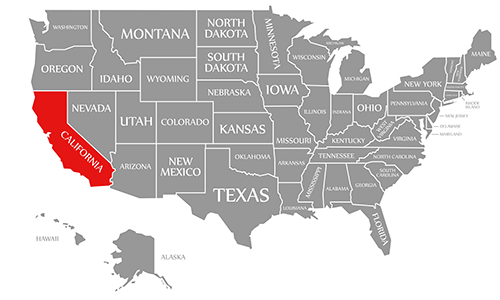
California

This one probably won’t surprise anyone. California is famously vulnerable to natural disasters – earthquakes and wildfires are common, and huge parts of the state are vulnerable to tsunamis as well – but that’s only half the problem. California has some other massive vulnerabilities, too.

For a start, it’s densely populated. Compared to the likes of New Jersey or Rhode Island it isn’t that densely populated – it ranks 17th in the nation – but a combination of relatively high density and very high population makes it very vulnerable.

California’s big cities are incredibly reliant on supplies from outside. San Diego and Los Angeles bring in up to 90% of their water from Northern California; if the infrastructure that carries that water breaks down (and it isn’t in any better shape than the rest of our infrastructure) the cities will collapse into chaos within days.

San Francisco is a lot smaller and has a cooler, wetter climate, but it isn’t in the clear either. Over 85% of the Bay Area’s water comes from the Hetch Hetchy Valley in the Yosemite National Park, 150 miles to the east, and if that stops flowing San Francisco will be just as screwed as the big cities.

California isn’t helped by the fact it’s such an obvious target for attackers.

The First States That Will Go Down In A Collapse. Do You Live In The Red Zone?

Silicon Valley and the San Francisco area is the center of the global tech industry; an EMP attack on California is a quick and easy way to devastate the US economy – but it would also cause a rapid and massive collapse as the bankrupt state’s crumbling infrastructure simply broke under the impact.

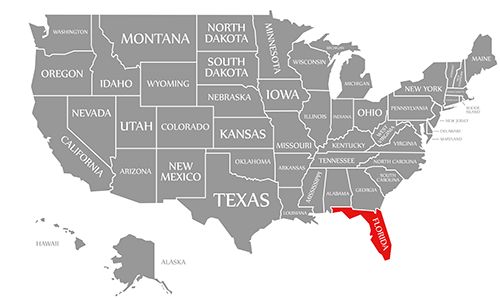
Florida

Florida’s politics might be different to California’s, but unfortunately, its vulnerability to collapse is similar.

It also suffers a lot of natural disasters – hurricanes, this time – and it’s also densely populated. In fact, Florida’s people are packed in a lot more densely than California’s, although that’s balanced by the fact there aren’t as many of them.

Like California, Florida is highly urbanized – about 92% of Floridians live in an urban area. That makes them very dependent on outside supplies that probably won’t come in a crisis, and as the old saying goes, civilization is never more than three missed meals from anarchy.

If disaster hits, life in Florida is going to get ugly in a hurry.

The First States That Will Go Down In A Collapse. Do You Live In The Red Zone?

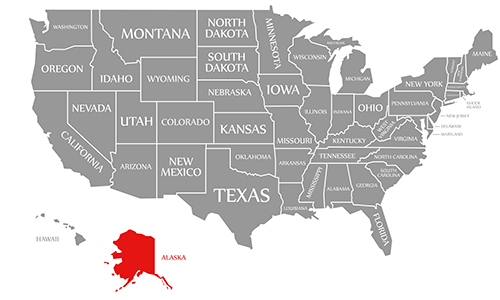
Alaska

You’re probably wondering what Alaska is doing on the list. After all, it’s about as unlike highly urbanized California as you can get.

Alaskans are self-sufficient, many of them hunt and they don’t rely on vulnerable infrastructure for such basic necessities as water.

Unfortunately, Alaska does rely on imports of some other necessities, with gasoline and heating oil being the most important. It also buys in most of its processed food and almost all its manufactured goods.

And, while Alaskans can easily supplement their diet by hunting and fishing, farming is another story.

A harsh climate and short growing season mean the state is nowhere near self-sufficient in grains, fruit and vegetables, and true self-sufficiency is pretty hard to achieve.

The First States That Will Go Down In A Collapse. Do You Live In The Red Zone?

Alaska might not be torn apart by urban riots in the first days of a crisis, but it will still collapse within weeks as food stocks run down and gas disappears.

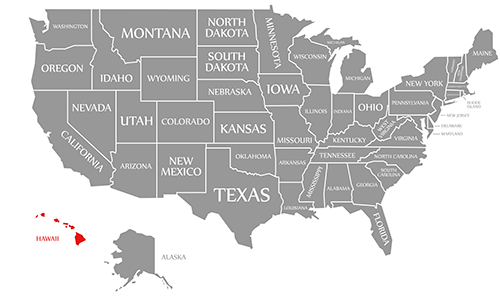
Hawaii

All the things that count against Alaska also count against Hawaii, and there are a couple of other issues, too.

While Hawaii has more agriculture than Alaska, the biggest crops are sugarcane and pineapples – not exactly staple foods. The climate means it’s a bit more feasible to grow your own food there, but on the downside, land is scarce and expensive.

Hawaii is also heavily urbanized, with almost 92% of the population living in cities. Like California or Florida, as soon as supplies from out of state stop arriving those cities will collapse fast and hard.

The First States That Will Go Down In A Collapse. Do You Live In The Red Zone?

There’s another serious problem with Hawaii, too – it’s an island chain in the middle of the Pacific. At least if you’re in Alaska when the collapse comes you can get to Canada. If you’re in Hawaii, plan on being there for a long, long time.

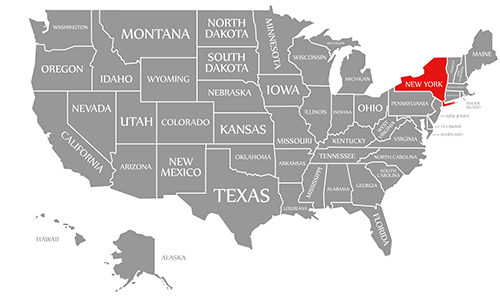
New York

If the power goes off and supplies of food and water stop coming, the Big Apple will rot in a hurry.

The state of New York contains the USA’s most populous city, over eight million people with basically no ability to be self-sufficient.

While New York does have some agriculture, including a lot of basic foods – the state is the largest cabbage producer in the country, for example – in a crisis not much of that food is going to make it into the city, so you can expect hungry mobs to fan out into the rural parts of the state looking for food.

New York

Along with the city’s already high crime levels, the collapse of New York is going to be fast and brutal.

The Alternatives

If you live in one of these collapse-prone states, the best advice is to be ready to bug out as fast and as far as you can.

The ideal solution is to move to a more rural state where any collapse will be slower and less violent, giving you time to adjust to the new normal.

The Great Plains states are a good choice – large, sparsely populated and heavily agricultural.

It’s easy to be self-sufficient there, and you’re a long way from the chaos that will erupt when America’s helpless cities start to starve.

“Collapse at Any Time”? We might expect the New World Order to be set up in order to restore economies around the world, but it will involve compulsion to false worship–giving man’s government something owed to God, Rev 13:14-16.

The Bible says, Rich men [will] weep and howl, for your miseries that shall come upon you. Your riches are corrupted… Your gold and silver cankered..You have heaped treasure for the last days,” James 5:1-3, King James.

In 2008 the new moon was in the sky as the US Senate approved $760 billion on the eve of October 1 and the stock market crashed for 10 days. In Bible times, they blew trumpets for those 10 days till the Day of Atonement, Leviticus 23:24-28. It was a biblical parallel to Revelation 8:7 which suggests economic collapse on the Feast of Trumpets because, when the first trumpet blows, “all grass is burnt up.”

This decodes to the economy because when we compare passages, “as the flower of the grass, so shall the rich man fade,” James 1:9-11 King James. This doesn’t mean they die-they just aren’t rich any more.

This author was expectant of economic crash last fall, also on the Feast of Trumpets. No crash occurred, but the government was shut down on that date re the debt ceiling, suggesting the date could have had “sign quality” as a warning for this year.

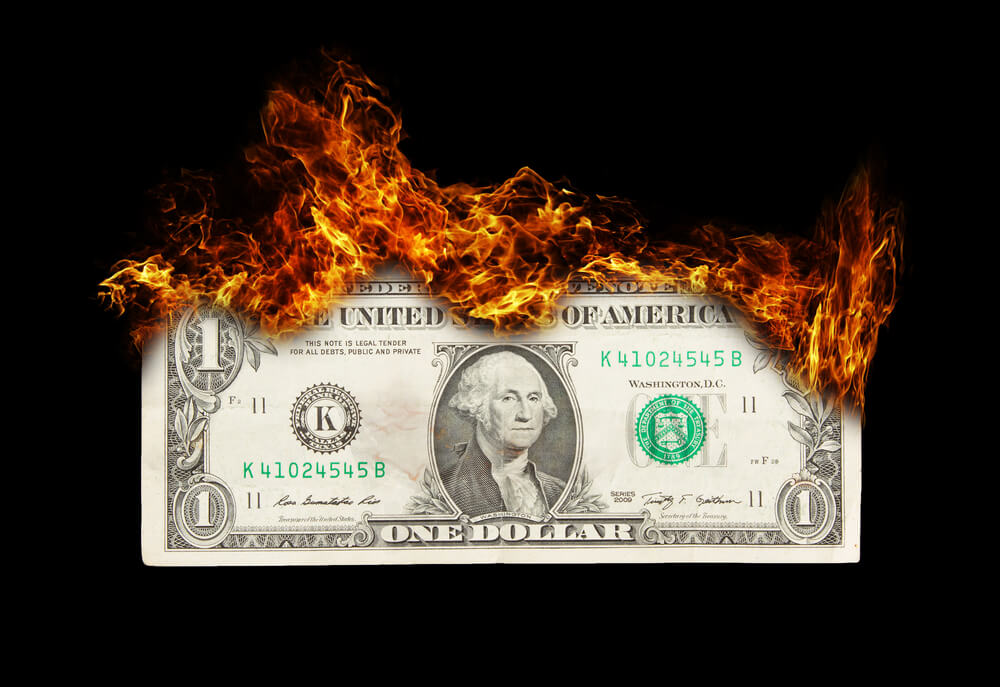
Economic collapse is also seen as a necessary step towards martial law and a New World Order (Novus Ordo Seclorum) under the pyramid on our $1 bill.

This year the time frame for the Feast of Trumpets, (new moon crescent) occurs September 26. Black Friday? That would seem as good a pick as any, at the end of the 3rd quarter and at end of the week when often there is a sell-off in the markets. Hearing Robert Prechter’s interview with Rick Wiles suggests getting out early!

When God got ready to deliver His people from Egypt, He attacked the gods of Egypt. They worshipped the Nile; it turned to blood. They worshipped cattle; they got disease. They worshipped frogs that came out of the Nile; frogs were everywhere.

Worship means worth-ship–and we are prone to giving things more worth than they deserve, especially when it comes to money. That being so, we should expect money to go as we have interpreted the first trumpet of Revelation 8:7 with the grass referring to rich men.

We might expect the New World Order to be set up in order to restore economies around the world, but it will involve compulsion to false worship–giving man’s government something owed to God, Rev 13:14-16.

The prophet Isaiah warns us that in the last days God is going to “turn the world upside down.”

The prophet Isaiah warns us that in the last days God is going to “turn the world upside down.” He declares, “Behold, the Lord maketh the earth empty, and maketh it waste, and turneth it upside down” (Isaiah 24:1).

According to this prophecy, sudden judgment is coming upon the earth, and it will change everything in a single hour. Within that short span, the whole world will witness fast-falling destruction upon a city and a nation, and the world will never be the same.

If you are attached to material things — if you love this world and the things of it — you won’t want to hear what Isaiah has prophesied. In fact, even to the most righteous of God’s people, what Isaiah says might seem unthinkable. Many would surely ask, “How can an entire world be stricken in one hour?”

If we didn’t believe the Bible is God’s pure Word, few of us would take Isaiah’s prophecy seriously. But Scripture makes it clear: in a single hour, the world is going to change. The church is going to change. And every individual on earth is going to change.

The apostle John gives a similar warning in Revelation. He speaks of destructive judgment coming upon a city and nation: “In one day, death, and mourning, and famine; and she shall be utterly burned with fire: for strong is the Lord God who judgeth her…. For in one hour so great riches is come to nought” (Revelation 18:8, 17).

In Isaiah’s prophecy, the city under judgment is cast into confusion. Every house is shut up, with no one coming or going. “The city of confusion is broken down: every house is shut up, that no man may come in” (Isaiah 24:10). The entire city is left desolate: “In the city is left desolation, and the gate is smitten with destruction” (24:12). All entrances and exits to the city are gone. The passage indicates that a fire has come, a blast that has shaken the very foundations of the earth (see 24:6).

We who live in New York City know something about this kind of scene. When the Twin Towers were attacked, the ominous fires and smoke could be seen ascending to heaven for miles. Recently, New Yorkers panicked as a mass of steam erupted from below a city street. People ran in all directions screaming, “Is this it? Is this the end-all attack?”

Today, multitudes of secular prophets are saying a nuclear attack is inevitable. The target they mention most often is New York, but it could happen in any major city: London, Paris, Tel Aviv, Washington. Neither Isaiah nor John names the city upon which destructive judgment falls.I don’t intend this message to frighten anyone.

Let me make clear at this point: I don’t intend this message to frighten anyone. Paul tells us that as disciples of Jesus Christ, we have already passed from death into life. We who call on Jesus as Lord should be confident that no matter what happens in this world, his shed blood saves and redeems us.

Therefore, we are not to fear any newscast, but rather to be attentive to what the Lord is doing in the world. Like many people, I hear grievous reports that make me want to tune everything out. But the truth is, God moves in the midst of such times, and through them he speaks warnings to all who would hear his voice.Isaiah’s prophecy points clearly to our generation.

I believe, along with many eminent Bible scholars, that Isaiah’s prophecy points to the last days. By that, I mean our present time. In short, sudden judgment is coming, and Scripture strongly indicates it is now at the door.

At this point you may be wondering: “How can we be sure we’re the generation this prophecy points to?” We can know by two reasons that such judgments are imminent:

1.A growing number of prophets warn of an apocalyptic disaster at the door. When I use the word “prophets,” I speak not just of those in the church. I’m talking also about “secular prophets.”

There are several precedents for secular prophets in Scripture. God used Assyria as his rod of correction with Israel. And he appointed King Cyrus as his servant to assist Israel: “(The Lord) saith of Cyrus, He is my shepherd, and shall perform all my pleasure” (Isaiah 44:28).

Likewise today, God uses secular prophets to send warnings. These become “his prophets” for a season. And their prophecies can be harder than those delivered by believers. The message I’m writing here is mild compared to the prophecies being delivered by all manner of secular voices. Just check your newspaper or radio reports.

“Surely the Lord God will do nothing, but he revealeth his secret unto his servants the prophets” (Amos 3:7).

2.Sudden destruction comes when the cup of violence overflows. Sensuality, perversion and greed are running rampant throughout our society. Yet, when God sent the Flood upon the earth, it was because of a worldwide eruption of violence: “The earth also was corrupt before God, and the earth was filled with violence” (Genesis 6:11).

Right now, there are numerous wars and bloody uprisings taking place around the globe. Yet foremost in my mind is the violence being waged against children worldwide:

  • I think of the sexual violence of pedophiles. Children all over the world are being raped, kidnapped and forced into enslavement in the global sex trade. Recently, a pedophile in the U.S. was discovered running a web site that advises other pedophiles on the easiest places to pick up children. There is no law in place to stop this man. The world’s largest church denomination has spent hundreds of millions of dollars to settle the claims of those who were molested in childhood by clergy. Tell me, how long will God endure the pitiful cries of children who are molested by those who would represent Christ?
  • Thousands of children in Africa are being slaughtered in tribal wars, hacked to death by machetes. Young boys — even those under ten years of age — are enlisted into tribal militias and forced to murder men in initiation rites.
  • Here in the U.S., the blood of millions of aborted babies cries out from the ground.
  • Reports of school murders no longer shock many of us but continue to terrorize our children. We may grow hardened to such reports, but God’s heart is grieved by them.

I tell you, there is no worse violence than the brutalizing of children. Heaven is crying out, “Woe, woe! Your judgments have no cure.”1. In one hour, God is going to change the whole world.

A sudden cataclysmic event will strike, the first of the final judgments of God. This great event will cause the earth to reel. And Isaiah says that when it hits, there will be no place to escape: “The lofty [proud] city, he layeth it low…even to the ground; he bringeth it even to the dust” (Isaiah 26:5). “The inhabitants of the earth are burned” (24:6).

Once this happens, utter chaos will erupt. All civic activities will stop, and society will descend into massive disorder. Government agencies will be helpless to restore any kind of sanity. No state troopers, no national guard, no army will be able to bring order to the upheaval.

You well remember that when the Twin Towers were destroyed, help poured into New York from all over the world. An army of people came to assist in whatever way they could. But the scene in Isaiah’s prophecy is different: this calamity is clearly beyond humankind’s capacity to respond.

Once this judgment strikes, it will devastate the economy. Rich merchants will stand by watching in torment, weeping and mourning, as they face bankruptcy. In an instant, all the wealth they amassed will be reduced to nothing. John describes the scene: “The merchants of these things, which were made rich by her, shall stand afar off for the fear of her torment, weeping and wailing, saying, Alas, alas that great city… For in one hour so great riches is come to nought” (Revelation 18:15–17).

Overnight, all buying and selling will cease. Every restaurant and bar will be shut down, and all drinking and music making will end. Indeed, every trace of mirth and delight, joy and gladness, will vanish: “All the merryhearted do sigh. The mirth of tabrets ceaseth, the noise of them that rejoice endeth, the joy of the harp ceaseth. They shall not drink wine with a song…. The mirth of the land is gone” (Isaiah 24:7–9, 11).

Yes, this is a picture of gloom and doom. But it is not my prophecy. This word was given by the Holy Spirit of Almighty God, to be delivered by his righteous prophet Isaiah. Even the secular world is preparing for it to happen. Billions are being spent on homeland security in the U.S., England, Europe and Israel. Why? Military experts warn that a world-impacting terrorist attack is sure to come.

You may ask: “Why would the whole world change, if a nuclear attack occurs in just one city?” It will happen because of the fear of retaliation. If a rogue nation sends such an attack, you can be sure that within hours that nation will be wiped out. Consider the plan Israel has in place, known as the Samson Option. The moment a nuclear warhead is launched against them, within moments Israel will unleash nuclear missiles to devastate the capital cities of all enemy states.

The world has become a ticking bomb, and time is quickly running out.2. In one hour, God is going to change the church.

This hour of devastation will suddenly change churches, whether they are alive or dead. Isaiah writes, “There shall be the shaking as of an olive tree” (Isaiah 24:13). The image is of God shaking an olive tree after it has been picked of fruit. In short, he’s going to shake everything that can be shaken, sparing nothing. It will be a time of cataclysmic destruction and overwhelming darkness.

So, you ask, “What about God’s people in the midst of all this? What will happen to the church?” Isaiah gives us an incredible word about what will happen with believers.

In the midst of the terrible shaking, a song will be heard, and its sound will grow steadily stronger. Suddenly, in that darkest of hours, a worldwide chorus of voices will sing praises to the majesty of God: “They shall lift up their voice, they shall sing for the majesty of the Lord, they shall cry aloud from the sea” (24:14).

Do you get the picture? There will be panic everywhere. Men’s hearts will fail them for fear, as fires belch smoke seen for hundreds of miles. Disorder and chaos will reign on all sides. Yet amid the devastating fires and calamity, the world will hear a glorious song being sung: “Glorify ye the Lord in the fires, even the name of the Lord God of Israel… From the uttermost part of the earth have we heard songs, even glory to the righteous [One]” (Isaiah 24:15–16).

A holy remnant is going to awaken, and a song will be born in the fire. Instead of panicking, the people of God will be praising his awesome majesty. Imagine it: in the darkest hour of all time, a collective voice will rise by the millions out of every nation, not in fear or agony, but in joyful praise to the Lord.

How will this happen, you ask? In one hour, God is going to regenerate and restore his church. Dry bones will shake and rattle, and the righteous will be awakened, as the Holy Spirit calls multitudes of lukewarm believers back to their first love. In his mercy, he’s going to rouse those who have neglected him, ignoring his Word, avoiding prayer, perhaps even contemplating divorce. Suddenly, their souls will be flooded with pangs of remorse and godly sorrow. And many will fall on their knees, crying out in repentance.

There will be a revival of glorifying God’s majesty. And the song of this revival will be heard from the uttermost parts of the earth. East, west, north and south — from Arab lands to China, Indonesia, Africa and all parts of the earth — a glorious song will rise up from the midst of the fires. In one day’s time, those who survived the fires are going to be singing a new song throughout the world.Isaiah 25 tells us wonderful miracles will come in this time, as “God makes all things new.”

All around the world, the Lord’s people are going to “feast” on his Word: “In this mountain shall the Lord of hosts make unto all people a feast of fat things, a feast of wines on the lees, of fat things full of marrow, of wines on the lees well refined” (Isaiah 25:6).

“And he will destroy in this mountain the face of the covering cast over all people, and the veil that is spread over all nations” (25:7). Right now, in this time of prosperity, the world’s masses seem to be covered with a veil, unable to see the truth of Jesus Christ. But when God rises up to shake the world through judgment, the shrouds covering the minds of billions will be cast aside. The veil of darkness will be removed, and many will see the Lord in his glory. The Holy Spirit won’t force Christ upon these opened eyes and hearts; rather, a remnant is going to rise up from among them.

I believe the darkest shroud-coverings today are over the eyes and hearts of youth worldwide. This is especially true of college-age students, whose faith has been bombarded for up to four years. Over that time their minds have been indoctrinated by godless professors in classrooms where belief is attacked, mocked and scorned. Now these young men’s and women’s faith has been shipwrecked. They leave college convinced God is dead.

But in one hour of devastation — nuclear, economic and social — all such hypocritical veils are going to fall away. Those same professors who mocked them will realize, as they face the possibility of death, a choice must be made: “What about eternity? Is there life after death?” They’re going to look for someone to explain to them all that’s happening.

When the song is sung, it’s going to be heard by young people from every walk of life, from every nation under the sun. Many will harden their hearts and curse God at the sound of this song, but multitudes of others will join in singing of his majesty.3. In one hour, God is going to change us as individuals.

In a single hour, the focus of our lives will be changed. We’ll no longer obsess about our own adversities and troubles. Suddenly, so many things that we held dear will no longer be of any value to us. Why? In that hour, everyone will be in the same boat:

“It shall be, as with the people, so with the priest; as with the servant, so with his master; as with the maid, so with her mistress; as with the buyer, so with the seller; as with the lender, so with the borrower; as with the taker of usury, so with the giver of usury to him” (Isaiah 24:2).

The sudden judgment that comes will not be a respecter of anyone. Rather, it is going to touch all who are within the realm of its fury. Presidents, kings, the world’s richest and most famous — all will tremble just like the poorest of the earth. And this cataclysmic event will bring to naught every idol, purging iniquity and tearing down all false altars:

“By this [the calamity] therefore shall the iniquity of Jacob be purged; and this is all the fruit to take away his sin; when he maketh all the stones of the altar as chalkstones that are beaten in sunder, the groves and images shall not stand up [be left standing]” (Isaiah 27:9).

The world’s most prominent idol is money, and right now America is facing a monstrous financial disaster. Investors are scrambling to move their money out of high-risk funds, and mortgage companies are going bankrupt. One recent financial headline read, “Abandon Ship!” Everyone is selling and nobody is buying. Many households are in a panic, as overnight their lives are changing. I think of the president of a multi-billion-dollar hedge fund, who recently put up for sale his 142-foot yacht and his sixteen-bedroom mansion in Aspen, Colorado. His fund had dried up virtually overnight.

The day is coming when sports will be the last thing on people’s minds. I have nothing against sports, but soon there will be no more 250-million-dollar deals for athletes, when so much of the world is starving. All idols will come crashing down, crushed to dust, and the playing field will be leveled. The richest and the poorest alike will face the same conditions.

It will all happen within a day. “When they shall say, Peace and safety; then sudden destruction cometh upon them, as travail upon a woman with child; and they shall not escape” (1 Thessalonians 5:3).Why such apocalyptic warnings?

You may wonder: what good can come of these prophetic messages? Why should anyone have to live under such anxiety?

I remind you, Jesus warned Jerusalem of sudden devastation to come upon that city. It was going to be burned to the ground, with over a million people murdered. Christ explained his warning: “I have told you before it come to pass, that, when it is come to pass, ye might believe” (John 14:29). He was saying, in essence, “When it happens, you’ll know there is a God who loves you and forewarned you.”

Paul calls such warnings “light,” insights that expel darkness. He says, in short: “You are children of light, because you know what’s coming in the future. So, when destruction comes, and there’s panic all around, you will have the calm of the Holy Spirit. Something will quicken inside you, and you’ll remember, ‘God warned me.’ This prophecy isn’t a message of wrath to God’s people, but a wakeup call to begin preparing.”

“God hath not appointed us to wrath, but to obtain salvation by our Lord Jesus Christ, who died for us, that, whether we wake or sleep, we should live together with him” (1 Thessalonians 5:9–10). Paul is speaking here of a time of possible destruction. Therefore, he says, “Comfort yourselves together, and edify one another, even as also ye do” (5:11).

In this day of prosperity, nobody wants to hear a message like Isaiah’s. I certainly don’t want to hear it. But we cannot ignore it, because it is here at our door. In such times, Paul says, when we have knowledge that sudden destruction is coming, we are not to tremble or sorrow as the world does. Instead, we are to comfort one another in faith, knowing that God rules over every aspect of our lives.

“Be sober, putting on the breastplate of faith and love; and for an helmet, the hope of salvation” (5:8). Paul instructs, “Arm yourself with faith. Build up your belief now, before the day comes. Learn your song, and you’ll be able to sing it in your fire.” “Glorify ye the Lord in the fires, even the name of the Lord God of Israel” (Isaiah 24:15).

This is the hope of our most holy faith: our Lord causes a song to come out of the darkest of times. Start now to build up your holy faith in him, and learn to praise his majesty quietly in your heart. When you sing your song, it will strengthen and encourage your brothers and sisters. And it will testify to the world: “Our Lord reigns over the Flood!” ■

The First 3 Things To Do When SHTF In An Economic Collapse

As a survival expert specializing in urban survival, I often tell people what to do to prepare for an economic collapse or other SHTF (“Sewage” Hits The Fan) scenario. Unfortunately, most people don’t carry through on their good intentions to be better prepared.

So what if someone asks me how to prepare for an economic collapse and then doesn’t take my advice? Well, instead of rubbing their nose in it, I then tell them what are the first three things that they should do when the SHTF and they haven’t prepared. At least that way they will have some knowledge, if not supplies.

First Thing: Food

The first thing you want to do if the SHTF in an economic collapse is to ensure a supply of food for a few weeks. Hopefully you can get to the store before all the crazies are there fighting for the last can of soup or the credit card machines no longer work. Suspension of bank cards is very common during an economic collapse.

Second Thing: Security

After you have food secured, ensure that you can take steps to protect yourself, your family and your home. If you don’t have guns, or even if you do, you will want to have some means of non-lethal self-defense. Pulling a gun is a big deal and if you have non-lethal methods of defending yourself, they are usually better.

If you cannot get mace, go to the hardware store and buy wasp spray. It shoots a stream 20 feet and can be an effective deterrent against would-be burglars and looters who would like to help themselves to your supplies.

Third Thing: Water & Power

Expect that once the SHTF, the basic utilities such as water and electricity will become less reliable. It may not happen in a day or two, but it will happen. That has proven over and over again around the world when things like an economic collapse happen. Having plenty of clean drinking water stocked up in the basement is a must.

Finally, ensure a good supply of flashlights and batteries, as the new reality may be rolling blackouts and less reliable electrical service.

So now you know the first three things you should do when the SHTF in an economic collapse. It is up to you if you will take steps to prepare now or if you will wait until it is too late to prepare and you have to use these steps to just react and do what you can at the last minute.

What You Should Do Within 60 Minutes After SHTF (If you have planned in advance, prepared for these scenarios, and taken the right action then 60 minutes is plenty of time.)

When you first realize that you are in a SHTF scenario, it can be mind-blowing. You fear for your life and the lives of your family. Even with the best training, survival can be a daunting task.  However, there are things you can do to give yourself the best odds of surviving and protecting your family.  Remember the differences between yourself and everybody else around you, and you will realize that you are already way ahead of the game.  In this article, we will cover the first 60 minutes and the actions you should immediately take to get out alive.

It is important to note that the most important task for your first 60 minutes is always to avoid panic.  Keeping a cool head so often make the difference between life and death.  The human body allows for so many more mistakes with the adrenaline is flowing.  Keep yourself calm, make rational decisions, and keep everybody in your group calm as well.This man can boost any electricity source into 5 times more… instantly and apart from taking the panels out once in a while to charge them… they won’t need any intervention…for a minimum of five years.

That means that if you gain 68% more electricity… you’ll pay only 32% of how much you’re paying today.

Early Warning Signs

I am not saying that you need to become a conspiracy theorist.  However, keeping an eye out for the threats that affect your area is important.  Pay attention to any government or military actions.  Watch for any reports regarding diseases or pandemics.  Pay attention to social unrest or riots in your area.  Look for any weather or seismic warnings.  You may even want to pay attention to the domestic and foreign markets for potential collapse.  These are all warning signs of large-scale disasters that could affect your area.  The point of this strategy is that by staying aware of these concerns, you can find out hours or even days before the general public.  This head start can be huge for your family while everybody else is walking around unaware of the threat.

Have a Plan

Anything you can do in advance to prepare for SHTF scenarios is going to make a huge difference in your ability to survive.  Of course, you cannot prepare for the event after it is already happening.  You must have supplies set aside and have a plan with your family to get to safety.  This plan should be practiced as much as possible so that the whole family knows what to do.  In fact, you should have several different plans depending on the type of emergency and the severity.

Gather your Family

If you have any family or friends as part of your survival plan, you must get everybody together before you can make a move.  You may have both mom and dad at work, kids at school or daycare, or even extended family to gather.  There is no reason that you should not have everybody together within 60 minutes if you have the right plan.  For example, my wife works about 20 minutes from our home and I work from home.  My son is under 15 minutes from our home at daycare, but the distance would add another 15 minutes to my wife’s drive.  Our plan is for me to pick up our son and meet back at our house about 5 minutes after my wife arrives.  Travel time from start to home is roughly 25 minutes for the whole family.  Then we can take further action.

If the majority of your family is more than 30 minutes from your home, you should have a plan to meet at a secondary location.  If I worked downtown roughly 30 minutes north, I would switch our plan to meet at my son’s daycare.  We would then decide if we need to leave one of our vehicles behind to better handle traffic.  You also want to have a location like this in case somebody from your group is cut off by gridlock or a military road block.  All adults need to be prepared to ditch their vehicle and move on foot if needed.

Pick a Plan

Once you gather together, you must quickly make a few vital decisions.  You should be thinking about your options well before you get to your family so that you can have a short conversation.  If you are meeting outside of your home, decide if you need to go home before making a move.  It may be best to take what you have and leave the area immediately.  If you decide to head home, you need to decide if you want to bug in or bug out.  This may be subject to change as you get more information on your way home.  Traffic, weather, phone calls, and radio announcements may all change your plan on a dime.  You may also want to call any family or friends that are not part of your survival plan to warn them about the scenario and get more information.

Execute the Plan

If you plan to bug in, there are a few tasks that should be handled immediately.  Windows and doors should be secured.  Inventory for food, water, ammunition, and other vital products should be checked.  This may include batteries, lighters, medical supplies, and toiletries.  The inventory ensures that you are not surprised when you run out of a certain product.  If you feel it is needed and you think you have time, you can make a fast run to a store to supplement your supplies.  This should only be done if you have no other choice.

If you decide to bug out, get your bug out bags together.  Gather as much food and water as you can comfortably carry.  Grab any weapons you need and prepare to head out.  You may want to board doors and windows to keep damage from looters to a minimum.  You should also hide any valuables that are too bulky to carry with you.  You will need to decide whether to bug out on foot or in a vehicle.  If the roads are clear, the vehicle will help you cover more ground.  However, if the roads are backed up or blocked then you need to be on foot.

In Conclusion

If you have planned in advance, prepared for these scenarios, and taken the right action then 60 minutes is plenty of time.  If we do not have any blocked roads to deal with, there is no doubt in my mind that my family could be bugged in or bugged out within an hour.  In addition, I am confident that I would recognize a SHTF situation well before the average person.  This all adds to our ability to make it through safely.  If you take action, stay calm, and follow these steps then you should come out safely as well.

How to Survive A Famine. Economic collapse can lead to a breakdown of society and mass food shortages

How to Survive A Famine

Economic collapse can lead to a breakdown of society and mass food shortages. Severe drought or weather, natural disasters, or a man-made catastrophe like an EMP can also bring on food shortages, and famine, followed by starvation. Millions go hungry. Countless people to die.Most Americans have only experienced the consequences of massive famine on their television screens. In 1981, in the movie The Road Warrior (played by Mel Gibson), this survivor in the apocalyptic wasteland of Australia experienced the results of widespread famine first hand. His way to survive: Dog food. Canned dog food.

I can’t remember the brand name. Alpo maybe. But does it even matter? The point is this: In a time of mass famine following nuclear war or some catastrophic disaster that takes place, people who survive may find themselves eating things they would never imagine themselves ever capable of eating. Or you simply starve to death.

Famine – A social and economic crisis that is often accompanied by widespread malnutrition and starvation which leads to epidemic and significantly increased mortality.

Here are a few good tips for preparing for a famine of Biblical proportions, a famine that experts believe could be a direct consequence of a widespread disaster, economic collapse, or even a nuclear terrorist attack, which is a growing risk today to the U.S.

Famine from EMP

The much talked about and feared EMP (electro-magnetic pulse) could also lead to famine, at least in the nation affected by the EMP. It’s not that an EMP will cause food to stop growing: Instead, a famine will take place when transportation comes to a halt and food out in counties and states where farming is plenty suddenly have no way to transport seasonal harvest to several million people out in distant cities.

Mass starvation on a widespread scale is a very real threat and can threaten your very survival. That includes your family and friends.

It also include your neighbors, yes that couple that seems so well put together. When pets start disappearing from around your neighborhood, it might be your neighbors behind the disappearances. After about 1 day without food your neighbors may resort to asking other neighbors for food, and then begging if no one is willing to hand over much.

Hungry People Group Up

What happens if you have a few neighbors that are unprepared? Those without may band together, and go after those who have. Guess what? If your neighbors don’t see you out looking for food, begging for food, and instead simply locking yourself inside your home, in their minds they’re going to suspect you’re sitting on a bunch of food.

If enough hungry people band together, they may decide to take it from you by force.

Finally, after about three days of your neighbors going hungry it’s possible that someone will mention “pets”; when day five rolls around, and still no food, there’s a good chance that it’s going to be open season on pets, I’m talking cats and dogs.

Have Stocks of Food, Water to Combat Famine

Do you understand now why it’s important to have at least a few weeks of extra food and water on hand? A famine resulting from any number of disasters has the potential to wreck havoc fast on Western nations. Having not experienced true hunger before, it is likely to affect Westerners more than it does say people in third world countries.

It may not happen right away, in the first few days of food shortages. But after several weeks food may start becoming sparse around the neighborhood; local church pantries may start running dry (outside of a miraculous provision from God, which is always a possibility, looking at the Bible). And then the day is going to come when there is simply no more food around the neighborhood.

Knowing how a few of your neighbors may act, you might want to buy yourself a ton of cheap bulk food like rice and beans, in addition to your typical emergency food stocks. That way you can at least have something to give to your neighbors, and hopefully keep them from turning on you, should they suspect that indeed you actually have quite a bit of food.

The End of the Old Kingdom- In the mid 22nd century B.C., Egypt was a hot bed of activity with a large population of people, which translated into a lot of mouths to feed; farming in the region provided food and the Nile River was a chief provider of water. Out of nowhere a brief change took place in the local climate that impacted Egypt’s food supply during the time of Unas (2381-2345). No one really understands what caused the weather problems; however, the results of this climate change seem clear.

Lake Moeris dried out, the Nile lowered, and bad harvests followed. Unfortunately for ancient Egypt, that spurred on a great famine throughout their lands. All of these factors also led to civil unrest and that meant crime and revolts.

The Old Kingdom never fully recovered.

Famine, Modern Day

The Causes of Famine and Mass Starvation

Famine can be caused by any number of factors. One of the most common reasons behind famine is climate change (as previously noted). When that happens drought, crop issues, and pestilence are often culprits.

Famine can also be brought on by war and political problems.

Politically, at different times in history, choices have been made by governments that have resulted in famines. Many times those in power have literally deprived the middle income and poor. In fact, many believe that the North Korean famine of the 1990s was a direct result of government actions forced on the people.

There are many who believe that almost all famine is — in essence — truly compelled more by politics than nature (in other words, problems that cause issues in the food supply can be handled by a pro-active government; one that is adequately prepared for a disaster and any food shortages that may arise).

Regardless, with the natural changes occurring all around us — some say climate change or global warming, others say the hand of God and the Bible “end times” of the modern world — the possibility of widespread famine due to climate change or widespread disaster is becoming more and more plausible, even in the United States of America.

What Does It Take To Survive A Famine?

Historically, the United States — unlike countries such as North Korea, for example — tries to make decisions that are in the best interests of its people.That’s the hope anyway; hope coming from the American people.

However, you shouldn’t assume that the United States will be able to come through for you. After all, if it wasn’t completely clear to you after Hurricane Katrina in New Orleans, we are not in charge of nature.

Still, political policies will play a huge role in determining whether or not we survive a famine. However, since that is in essence outside of our control (with the exception, of course, of the voting process) let’s talk about three other things that could help during a famine. Namely, these are growing food, storing food, and hunting, trapping and fishing.

Growing Food During A Famine

This one is tough to talk about simply because the task of growing food may be why the famine you’re dealing with is even happening. That said, consider that there may still be ways to grow food, at least on a small scale.

The Green Revolution — Okay, the Green Revolution basically refers to the spread of technologies for subsistence agriculture to countries that needed them: Things like pesticides, irrigation projects, and nitrogen fertilizer. These concepts and materials first spread to Mexico in 1943.

Now you’re probably asking what this has to do with surviving a famine on your own. Well, simply follow suit. In other words, you’ll need some know how, strong seeds (when shopping for seeds, ask for seeds that have the best chances to grow in sub-prime conditions), land, and pesticides / fertilizers.

If you’re worried about a famine in your neck of the woods, call a garden center and ask them what crops, pesticides, and fertilizers would work best in your area.

Regardless, during a famine growing food will almost certainly be a tough prospect. After all, if it were easy, then the famine wouldn’t be occurring, right?

Famine

Becoming A Survivor: Hunting, Trapping, And Fishing

In the CBS television show, Jericho, the story unfolds around a small Kansas town and its challenges trying to survive following a nuclear attack that has decimated the United States of America. As a result, the town of Jericho, Kansas begins to starve as a result of food shortages; at the same time, there isn’t an abundance of wildlife in the area, to provide food.

In other words, there’s not much to hunt. Even if there was, several towns and cities have too many people; there would just be too much competition between hunters in the early days and weeks of a disaster and famine; hunting in an area would be short lived and for most people unsuccessful. Those who went after big game (deer, elk, etc.) first would likely face the most challenges as a sudden increase in hunting would drive many of these animals out of the area.

Small Mammals, Birds, Snakes, And Insects On The Menu

Those willing to forgo big game instead for small animals like rabbit, duck, turkey, squirrels, cats and dogs (in a worst case scenario), stand to have the best chances of bringing home a meal in a time like this. In most communities, there are a number of small mammals and even reptiles like snakes that make a tasty meal in a time of need. You just have to be willing to look outside the traditional Western diet and you’ll find a number of foods, even things like insects and earthworms, to get you by on days when there’s simply nothing to eat.

If you learn to think like a survivor, you’ll find that these things are actually a lot easier to eat than you might believe today.

With small mammals, birds, snakes and insects on the menu, that doesn’t mean there won’t be any big game out there; as covered in a previous article on hunting big game, you’re going to need to go to remote areas — the more remote the better.

That’s because experienced hunters will target prime areas (which will be semi-remote) first; because they know how to hunt, and they understand the dynamic of “hunting pressure” and how it drives big game quickly out of an area. As a rule of thumb, if you want to hunt in a time like this, seek out wilderness areas that are deep in the wilderness and beyond those semi-remote areas. Now you’ll have the best chances of finding big game that hasn’t been spooked by a drastic increase in “hunting pressure”.

Finally, when it comes to hunting, those with experience and knowledge of the land stand to do best. Those without experience or basic knowledge, stand to fail miserably.

For all of you non-hunters, there’s one thing you need to know right now.

You’re going to need hunting gear and weapons.

Tools Of The Trade

If you believe there is a chance in the coming months and years that a famine might occur in your neck of the woods, then seriously consider purchasing a gun. As back-up, get yourself a crossbow with a good scope. After all, both a rifle and crossbow are proven tools when it comes to hunting. A crossbow is relatively easy to shoot and you can do quite a bit of urban hunting without alarming local town folk with sounds of gun fire.

Of course, you may need a gun to defend yourself. Count on a firearm first, before a crossbow, in purposes of self defense.

Squeamish about guns? The good thing is that there are alternatives (like crossbows, long bows, and compound bows, for example). Though, to be frank, nothing works better for hunting than a firearm.

What else should you have on hand for surviving a time of mass famine? Here’s a list:

1. Fishing pole and nets, or just strong line and plenty of hooks (know the water sources you’re likely to fish and then have the proper gear on hand to give yourself the best chances of success).
2. Traps and snare wire
3. Bait for whatever small mammals are most common in your area and most palatable
4. Crabbing gear (if you live in an area where crabbing is possible)
5. Camouflaged clothing (choose colors that best blend with the wilderness areas you’re likely to hunt).
6. Hunting knife

And there are a host of other things that might come in handy depending on what you’re hunting for and the area of the world you live in. Talk to experienced hunting guides in your region or the region you plan to relocate to in a time of disaster. Discuss everything from big game and small mammals to wild birds and even predators.

Then talk to some fishing guides. Discuss everything from lakes and rivers, to even streams (crawdads, crayfish), and finally the coast, if you live near the ocean.

Storing Food

Preparation is the key to everything from coaching a football team to rallying your friends and family to survive during a famine or mass starvation. Thus, if you’re worried — and if you look around, you’ll probably realize that you should be — you might want to start buying non-perishable food items with a shelf-life of several years. At the same time, keep a revolving supply of non-perishable food items with a shelf life of just a few months. You can eat that food first, and then turn to foods like freeze-dried food after you’ve gone through the good stuff.

After all, growing food and hunting when the demand is high will probably not always go your way. Most people are going to be unprepared and just unable to make growing and hunting food a tool to count on in a time of disaster.

Along with this, it would be prudent to get your hands on foods like white and brown rice, wheat, and beans. When appropriately packaged and stored, these foods can sometimes last for decades. Speaking of storing dry foods appropriately, here are some things to consider:

1. Have #10 cans on hand (so you can do your own canning).

2. Have foil pouches (made multi layer laminated plastic and aluminum).

3. Buy a number of bottles made of polyethylene terephthalate (PETE bottles). These are used for long term dry food storage.

Further, dry foods should be stored at a temperature of 75 degrees F/ 24 degrees C or lower (recommended). If this prerequisite cannot be met, the foods should be rotated. Beyond that, moisture should be kept to a minimum (one way to help this along is to keep containers off the floor).

Also, keep things like cooking oil and long term storage items (oftentimes in PETE bottles) out of the light. And, of course, keep all foods protected in pouches or bottles (as this will serve many functions, one of which is to protect from insects / rodents).

Finally, to help reduce the threat of moisture, include oxygen absorbing packets in food storage containers.

There are several ways you can use these, so read the directions carefully. In fact, teach yourself the proper ways of using oxygen absorbing packets. Serious problems can occur when directions aren’t followed correctly (this is true for food storage in general, not just oxygen absorbing packets).

When in doubt, check with professionals in the field.

Last, but certainly not least, there’s the perishable items. Obviously, meats will need to be stored frozen. Further, it would be prudent to consume these first. The same can be said for fresh vegetables and fruit. Don’t go into your dry food stash until it’s needed.

Famine is a broad topic that can come about for a host of reasons. The way to combat famine can change depending on the situation.

Famine Caused By Natural Disaster Or Nuclear Attack

If your area is hit by a devastating natural disaster, such as an earthquake or tsunami — or worse even an asteroid or massive volcano eruption in the region — or if multiple cities are destroyed in a nuclear attack, access to food can shut down across the country overnight.

In a situation like this, you can find yourself quickly without food (and without drinking water, depending on the severity of the disaster). Seriously consider a back-up supply of food and water to support you and your family for up to 90 days or longer.

Just in case things get really chaotic in the world, you may want to have a back-up supply of food and water that can last you and your family six months or more, and then plans for resupplying your food and water as it runs low.

With disaster and probable famine looming on the horizon, due to the number of threats all seemingly lining up with the times we’re living in, stocking up on non-perishable foods , large jugs of water, and cash — if your bank is closed indefinitely or there is no power for an extended period, credit and debit cards will be useless — as well as things to barter with like ammunition, water filtration devices, and bulk coffee may be a smart move.

What Will Happen to You When the Dollar Collapses? Many Experts Predicted a Tipping Point Will Come That Would Cause the Dollar to Collapse

Over decades, if not centuries, the US dollar has been the world’s leading currency. The central banks all over the world hold an enormous part of their investments in the US currency, while some private companies use it for international transactions. With this, the trade in US treasury has boosts the American economy and greases the wheels to the global financial system.

But, many experts predicted a tipping point will come that would cause the dollar to collapse, thus lead to a global economic problem. In this scenario, many investors would rush to other currencies to run off further losses. This would mean a breakdown of the national economy. The aftermath of this scenario could likely lead to a dollar collapse.

What is Dollar Collapse?

Full of sudden currency collapses have happened in history. A dollar collapse is characterized to a long-term depression in economic activity, increased poverty and a disruption of the social order. One of the primary roots of any collapse is the lack of confidence in the stability or efficacy of money to serve as an effective store of value or medium of exchange.

The main sign of a dollar collapse is when the value of US dollar drops. There are some conceivable scenarios that could cause a sudden crisis for the dollar. When there is a great threat of high inflation and high debt, in which rising consumer prices force the government to raise interest rates.

If the US entered a steep recession without dragging the rest of the world with it, anyone who holds dollar-denominated assets might sell them at any cost that includes foreign governments and no one wants to buy them, worst would leave the dollar. Thus, anytime, everyone should prepare for the worst, but you can prepare for a dollar collapse through these economic indicators.

Will the U.S. Dollar Collapse?

The collapse of the US dollar remains ambiguous until now. Several articles and websites urge us to prepare for the coming recession, but are the preconditions of a dollar collapse have been occurring? Foreign exporters do not want a dollar collapse because it would likely create a worldwide panic that frets the global economy.

Even if the United States had to default some debt obligations, there is a little indication that the world would let the dollar collapse and risk possible depression. But the collapse on Wall Street has been alarming and the US government must have a choice whether to default on the national debt or destroy the dollar.

If US dollar collapse happens, it might come to pass. No one would predict it. That’s because the signs of forthcoming failure are difficult to see. It is imperative for the government to take a necessary intervention to bring an economy back from collapse. Yet, this can often be slow to remedy the problem.

Three Triggers of a Dollar Collapse

US Currency is weakening

When US dollar weakens, it suggests an adverse financial effect. A weaker currency would encourage exports and make imports inflated. This would mean decreasing a nation’s trade deficit over time. Every business will have a certain degree of effect depending on the increased price of goods and services.

A weak dollar can boost the gross domestic product during an economic recession. Because exported goods cost less, foreign buyers buy them in greater amounts. It can also result in higher inflation expectations and higher commodity prices. Furthermore, it could lead the Federal Reserve to react and tighten monetary policy.

The emergence of China and Europe Economy

China ranks first among the major foreign holders of treasury securities in the US. If China’s economy continues to grow at the current rates, they will surpass the United States as the largest global market by 2020. The largest world economy drives the most investor interest. In this scenario, there would be a massive demand for Chinese Yuan currency. Investors would sell US dollars to buy the Yuan, causing a big sell-off.

The next most popular currency after the dollar is the euro, base from the International Monetary Fund (IMF)  data. But it comprises less than 30% of central bank reserves. The Eurozone debt crisis weakened the euro as a practical global currency.

The emergence of major foreign holders of US treasuries is a potential factor to a dollar collapse. Nonetheless, the US dollar must be quite resilient to bar this kind of occurrence.

The Risk of Growing Government Debt & Central Banks

Base from the data, the outstanding US public debt from March 2017 to March 2018 is rising. The debt stood at around 21.09 trillion U.S. dollars as of March 2018 and forecast the gross federal debt of the United States for fiscal years until 2028 . Public debt, also known as national and governmental debt, is the debt owed by the nations’ central government. A government debt is an indirect debt of the countries’ taxpayers which the US government budget continues to run at a deficit and is increasing at alarming rates.

According to the Federal Reserve and U.S. Department of Treasury,

foreign countries costs over trillion dollars of debts like China (about $1.17 trillion) and Japan (about $ 1.06 trillion) held the highest percentages as of January 2018. It appears that central banks will do its power to save the situation, but remember that central banks can also lose control. This situation would be very demanding for the government with high debt loads.

Six Ways That Will Prepare and Protect You from a Dollar Collapse

A dollar collapse suggests an economic plight. It is akin to deep recession that scarcity and shortage of resources would occur. One must prepare for the worst scenario and to respond to this kind of uncertainty, you must be mobile. Here are few ways to prepare and protect yourself and survive a dollar collapse.

1. Prepare your Finances and Start being Smart with your Money Now.

One of the most important things you can do when it comes to financial preparedness is to put together a smart savings plan . If things go bad, having a plan of action will help increase your chances of surviving the chaos.

· You start with cutting all unnecessary expenses and spend that money to pay down your debt. The possibility of losing your home to debt collectors is a very real prospect.

· An Emergency Fund is a potential aid to prepare for financial troubles. It will give you stress-free during hard times. It can provide you with a fund to buy last minute supplies once things start to go bad.

· Remember to always have a cash on hand. When things go wrong, there is a very real possibility that the banks may freeze your accounts. It’s important to have cash that is accessible, either from a savings account or a cash box in your home. This can drift you over in an emergency until you can access money in your emergency fund.

2. Create a stockpile of Survival Essentials

Now is the perfect time to buy long-term supplies that you will need to survive in the future.

· Start stockpiling food and long-term supplies. In any type of crisis, especially during a collapse, food, water and long-lasting consumables are essential and indispensable. You will likely see main supply chain shortages and problems, making these types of supplies one of your most important pre-collapse concerns.

· Put together a supply of first-aid & medical supplies on hand. Once you create a kit, in the event of a collapse, you may not be able to shop for these supplies, so t’s important to have them on hand.

· Make sure you have all of the necessary supplies for survival . Include personal items such as medications for yourself and members of your family. Check the kit to make sure nobody has used any of the supplies. Also, check the end dates and replace expired items.

3. Secure your Home

· To prepare for a dollar collapse is to choose your shelter type. A separate shelter is designed to survive from natural disasters or man-made weapons or attacks. During this kind of crisis, power systems may fail and robbers and scavengers may threaten your home. Take precautions to protect yourself and your home.

· Another thing is to create two sources of electricity. One source could be solar. Hook it up to your home and then run the system underground. The second source might be an underground generator. You will use this in the event of a total loss of power. Keep your energy sources hidden underground to protect them.

· Consider purchasing self-defense tools . Self-defense tools are generally harmless. They are used to prevent an attack by rendering the invader futile. You can use everyday objects, such as baseball bats or gears. Other tools you may buy like pepper spray, hand-held stun guns, Taser devices or Sonic alarms.

· Set an alarm system in your home. Home alert alarm systems are easy and inexpensive to install and maintain. Wireless security systems notify you if a trespasser is approaching your home. Hidden cameras allow you to see internal and exterior areas in your home where a trespasser may be present.

One of the prevalent risks you’re going to face during dollar collapse is the threat posed by people. Learn everything you can about self-defense. When things go bad, you are going to need a way to protect yourself and those you love, your home.

4. Prepare your Family

· Make sure that every member of the family is mindful of the situation. To prepare for a dollar collapse, you need have to guarantee that your whole family is ready with your preparations. This means informing them in honest terms what is about to happen and telling them what they should be doing. It is important that everyone takes the situation . Otherwise, they will not be mentally prepared in the event that collapse happens.

· Each family member must be informed of the steps you have taken to prepare your finances, essential supplies, food, and shelter. Instruct them on doing the same.

· Every member should understand the relationship between inflation and economic growth. Explain to them the adverse impact of a dollar collapse on your family’s socio-economic life. 

· Consider including other family members, neighbors, or a community group in your preparations. Make sure that these are people who are reliable and will put to work for the benefit of the group.

5. Equip your Mind

Even more important than supplies, is survival knowledge and awareness. Knowledge is the key to your survival, and now is the time to get plenty. During any kind of crisis and survival, including a dollar collapse, knowledge is going to be your most powerful ally.

· Read books on survival and preparedness, then start collecting information on how to live a more independent lifestyle.

· Do your own research and don’t rely on government spun stories, or crafted in the media; you need to do your own research too. Check the reliability of the information you get to prepare for the collapse.

6. Expect a Financial Crisis

The major risk you are going to face in a dollar collapse is the downturn of your finances. It is important to be ready beforehand on what to do and what not to do on your financial systems.

· Check and track the price of commercial commodities. Changes in the prices of commodities affect the country’s economy and the value of the US dollar. An increase in commodity prices is associated with an increase in inflation. Increased inflation correlates with economic growth. But, if commodity prices drop, inflation slows, which indicates an economic decline.

· Take note of the financial markets. Big ups and downs in the markets are a red flag signaling a general decline.

· Watch the oil prices. When oil prices increase, the Gross Domestic Product (GDP) goes up too. Remember that the fluctuation of oil prices has a macroeconomic impact. If it is increasing, then the value of goods and services also increases.

What Life Will Be Like After A Dollar Collapse?

Everybody else could tell that a dollar collapse would be coming. A sudden dollar collapse would create global economic depression. It would allow the US government to come up with a currency system and a kind of economic strategies to avoid grave consequences.

· Demand for Treasury’s would drop, and interest rates would go up. US import prices would skyrocket, causing inflation.

· Irregular public services like school system experience frequent strikes that shut them down, power issues and outages become more frequent.

· Unemployment would worsen and more people will experience job loss or layoffs. More people are displaced and finding a job will become almost impossible.

· An increase in criminal activity will definitely happen. People will become desperate to feed themselves and their families and more people will be more willing to cross the line into criminal activity to get what they need.

· Lots of people will lose access to their healthcare when they lose their jobs. Healthcare appointments may become more difficult to schedule and it may take longer to get in to see a doctor because more people are getting sick and need care.

· You can expect increased incidents of domestic violence as family relationships are strained and crack under the stress of poor living conditions.

A dollar collapse is a real threat with far-reaching repercussions. While it is inevitable, there are advance preparations that individuals and their families can make, at the very least, protect themselves from the event triggers. Stay informed on top of the global economy. You can be safe in a dollar collapse if you follow the ways that protect you from an economic crisis.

Design a site like this with WordPress.com
Get started